
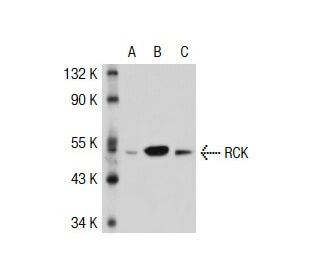


Anticorpo RCK (YZ-14): sc-101019
- RCK Antibody YZ-14 è un monoclonale di topo mouse IgG1 κ fornito in 100 µg/ml
- generato contro il ricombinante RCK di origine human
- raccomandato per il rilevamento di RCK di origine mouse, rat e human in WB, IP, IF, IHC(P) e ELISA
- Al momento non abbiamo ancora completato l'identificazione dei reagenti secondari di rilevazione preferiti per RCK l'anticorpo (YZ-14). Questo lavoro è in corso.

LINK RAPIDI
VEDI ANCHE...
RCK, nota anche come DDX6 e P54, è un membro della famiglia di proteine elicasi dell'RNA DEAD-box, tutte accomunate da motivi proteici. Presente nella maggior parte dei tessuti, RCK è una sbrogliatrice che presenta un'attività di sbrogliatura dell'RNA ATP-dipendente e la capacità di decadere l'RNA in direzione 5'-3'. Nelle cellule non maligne, RCK è associata a tutti i processi del normale metabolismo dell'RNA, compresi lo splicing, l'esportazione e l'iniziazione della traduzione. Mutazioni nel gene che codifica RCK possono causare la sovraespressione della proteina, trasformando la sua funzione in quella di un oncogene che regola positivamente l'espressione di geni coinvolti nella crescita e nella proliferazione cellulare. Si ritiene che, attraverso la sua attività di srotolatrice, la funzione principale di RCK sia quella di downregolare l'espressione dell'mRNA e di mantenere livelli trascrizionali normali all'interno della cellula.
Alexa Fluor® è un marchio registrato di Molecular Probes Inc., OR., USA
LI-COR® e Odyssey® sono marchi registrati di LI-COR Biosciences
Anticorpo RCK (YZ-14) Riferimenti:
- Sovraespressione di rck/p54, una proteina DEAD box, nei tumori del colon-retto umano. | Nakagawa, Y., et al. 1999. Br J Cancer. 80: 914-7. PMID: 10360675
- Espressione di rck/p54, una RNA elicasi DEAD-box, nella gametogenesi e nella prima embriogenesi dei topi. | Matsumoto, K., et al. 2005. Dev Dyn. 233: 1149-56. PMID: 15906376
- Strutture del dominio RCK della MthK ed effetto del Ca2+ sulla stabilità dell'anello di gating. | Dong, J., et al. 2005. J Biol Chem. 280: 41716-24. PMID: 16227203
- Il dominio RCK del trasportatore di K+ KtrAB: conformazioni multiple di un anello ottamerico. | Albright, RA., et al. 2006. Cell. 126: 1147-59. PMID: 16990138
- Il fattore H del complemento umano si lega alla proteina di membrana esterna Rck di Salmonella. | Ho, DK., et al. 2010. J Immunol. 185: 1763-9. PMID: 20622116
- Ruolo del legame Rck-Pat1b nell'assemblaggio dei corpi di trasformazione. | Ozgur, S. and Stoecklin, G. 2013. RNA Biol. 10: 528-39. PMID: 23535175
- Disposizione libera di RCK in Kch, un canale di potassio putativo di Escherichia coli, come suggerito dalla cristallografia elettronica. | Kuang, Q., et al. 2015. Structure. 23: 199-205. PMID: 25497729
- RCK: inferenza accurata ed efficiente di modelli di legame proteina-RNA basati sulla sequenza e sulla struttura da dati RNAcompete. | Orenstein, Y., et al. 2016. Bioinformatics. 32: i351-i359. PMID: 27307637
- Come i domini RCK regolano il gating dei canali K+. | Schrecker, M., et al. 2019. Biol Chem. 400: 1303-1322. PMID: 31361596
- L'attivazione di un dominio RCK dipendente dai nucleotidi richiede il legame di un cofattore cationico a un sito conservato. | Teixeira-Duarte, CM., et al. 2019. Elife. 8: PMID: 31868587
Informazioni ordini
| Nome del prodotto | Codice del prodotto | UNITÀ | Prezzo | Quantità | Preferiti | |
RCK Anticorpo (YZ-14) | sc-101019 | 100 µg/ml | $339.00 |