
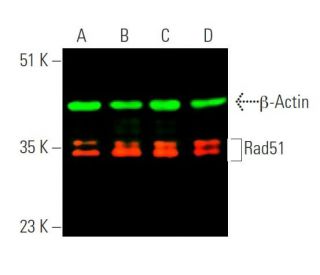
Rad51 Antibody (3C10): sc-53428
- Rad51 Antibody (3C10) is a mouse monoclonal IgG1 λ, cited in 21 publications, provided at 200 µg/ml
- raised against full length recombinant human RAD51 protein
- Anti-Rad51 Antibody (3C10) is recommended for detection of Rad51 of mouse, rat and human origin by WB, IP, IF, IHC(P) and ELISA
- Anti-Rad51 Antibody (3C10) is available conjugated to agarose for IP; HRP for WB, IHC(P) and ELISA; and to either phycoerythrin or FITC for IF, IHC(P) and FCM
- also available conjugated to Alexa Fluor® 488, Alexa Fluor® 546, Alexa Fluor® 594 or Alexa Fluor® 647 for WB (RGB), IF, IHC(P) and FCM, and for use with RGB fluorescent imaging systems, such as iBright™ FL1000, FluorChem™, Typhoon, Azure and other comparable systems
- also available conjugated to Alexa Fluor® 680 or Alexa Fluor® 790 for WB (NIR), IF and FCM; for use with Near-Infrared (NIR) detection systems, such as LI-COR®Odyssey®, iBright™ FL1000, FluorChem™, Typhoon, Azure and other comparable systems
- m-IgGλ BP-HRP (mouse IgGλ binding protein-HRP) is the preferred secondary detection reagent for Rad51 Antibody (3C10) for WB and IHC(P) applications. This reagent is now offered in a bundle with Rad51 Antibody (3C10) (see ordering information below). For additional m-IgGλ BP conjugates see our complete list of Mouse IgG Binding Proteins.

Rad51 Antibody (3C10) is a mouse monoclonal IgG1 lambda light chain antibody designed to detect Rad51 proteins from mouse, rat, and human sources with exceptional reliability across a variety of applications, including western blotting (WB), immunoprecipitation (IP), immunofluorescence (IF), immunohistochemistry with paraffin-embedded sections (IHCP), and enzyme-linked immunosorbent assay (ELISA). Anti-Rad51 antibody (3C10) is raised against the full-length recombinant human RAD51 protein, ensuring precise binding to the target protein. Rad51, also called Reca and Rad51a, is a pivotal protein involved in the homologous recombination repair (HRR) of DNA double-strand breaks, a critical mechanism for maintaining genomic stability and preventing mutations that could lead to cancerous transformations. By facilitating the search for homology and the pairing of DNA strands, Rad51 interacts closely with other key proteins such as BRCA1 and BRCA2, influencing their subcellular localization and enhancing the cellular response to DNA damage. This interaction is essential for the proper repair of DNA and the prevention of genomic instability, which is a hallmark of many cancers. The ability of Rad51 to form nucleoprotein filaments on DNA and promote strand invasion is fundamental to accurate DNA repair, making Rad51 an important biomarker and target for studying cancer biology and therapeutic interventions. Rad51 monoclonal antibody (3C10) is available in non-conjugated form and multiple conjugated variants, including agarose, horseradish peroxidase (HRP), phycoerythrin (PE), fluorescein isothiocyanate (FITC), and various Alexa Fluor® dyes, providing versatile options for diverse experimental setups. Anti-Rad51 antibody (3C10) enables researchers to gain deeper insights into DNA repair mechanisms, genomic integrity maintenance, and cancer development and treatment, underscoring Rad51′s essential role in advanced biomedical research.
Alexa Fluor® is a trademark of Molecular Probes Inc., OR., USA
LI-COR® and Odyssey® are registered trademarks of LI-COR Biosciences
Rad51 Antibody (3C10) References:
- Deficient nonhomologous end-joining activity in cell-free extracts from Brca1-null fibroblasts. | Zhong, Q., et al. 2002. Cancer Res. 62: 3966-70. PMID: 12124328
- Colocalization of multiple DNA double-strand breaks at a single Rad52 repair centre. | Lisby, M., et al. 2003. Nat Cell Biol. 5: 572-7. PMID: 12766777
- In vivo roles of Rad52, Rad54, and Rad55 proteins in Rad51-mediated recombination. | Sugawara, N., et al. 2003. Mol Cell. 12: 209-19. PMID: 12887906
- In vivo assembly and disassembly of Rad51 and Rad52 complexes during double-strand break repair. | Miyazaki, T., et al. 2004. EMBO J. 23: 939-49. PMID: 14765116
- The human Rap1 protein complex and modulation of telomere length. | O'Connor, MS., et al. 2004. J Biol Chem. 279: 28585-91. PMID: 15100233
- DNA annealing mediated by Rad52 and Rad59 proteins. | Wu, Y., et al. 2006. J Biol Chem. 281: 15441-9. PMID: 16565518
- Spatial organization of the mammalian genome surveillance machinery in response to DNA strand breaks. | Bekker-Jensen, S., et al. 2006. J Cell Biol. 173: 195-206. PMID: 16618811
- Effects of mutations of RAD50, RAD51, RAD52, and related genes on illegitimate recombination in Saccharomyces cerevisiae. | Tsukamoto, Y., et al. 1996. Genetics. 142: 383-91. PMID: 8852838
Ordering Information
| Product Name | Catalog # | UNIT | Price | Qty | FAVORITES | |
Rad51 Antibody (3C10) | sc-53428 | 200 µg/ml | $322.00 | |||
Rad51 Antibody (3C10): m-IgGλ BP-HRP Bundle | sc-520978 | 200 µg Ab, 40 µg BP | $361.00 | |||
Rad51 Antibody (3C10) AC | sc-53428 AC | 500 µg/ml, 25% agarose | $424.00 | |||
Rad51 Antibody (3C10) HRP | sc-53428 HRP | 200 µg/ml | $322.00 | |||
Rad51 Antibody (3C10) FITC | sc-53428 FITC | 200 µg/ml | $336.00 | |||
Rad51 Antibody (3C10) PE | sc-53428 PE | 200 µg/ml | $349.00 | |||
Rad51 Antibody (3C10) Alexa Fluor® 488 | sc-53428 AF488 | 200 µg/ml | $364.00 | |||
Rad51 Antibody (3C10) Alexa Fluor® 546 | sc-53428 AF546 | 200 µg/ml | $364.00 | |||
Rad51 Antibody (3C10) Alexa Fluor® 594 | sc-53428 AF594 | 200 µg/ml | $364.00 | |||
Rad51 Antibody (3C10) Alexa Fluor® 647 | sc-53428 AF647 | 200 µg/ml | $364.00 | |||
Rad51 Antibody (3C10) Alexa Fluor® 680 | sc-53428 AF680 | 200 µg/ml | $364.00 | |||
Rad51 Antibody (3C10) Alexa Fluor® 790 | sc-53428 AF790 | 200 µg/ml | $364.00 |