
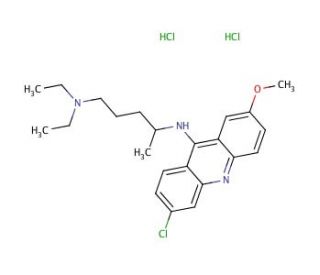

Quinacrine, Dihydrochloride (CAS 69-05-6)
See product citations (4)
QUICK LINKS
ABCA7 inhibitors are a class of chemical compounds that specifically target and inhibit the activity of the ATP-binding cassette sub-family A member 7 (ABCA7) protein. ABCA7 is a transmembrane protein that belongs to the ATP-binding cassette (ABC) transporter family, which is involved in the transport of various molecules across cellular membranes. ABCA7 plays a significant role in lipid homeostasis, particularly in the regulation of cholesterol and phospholipid transport. It is also involved in the efflux of cellular lipids to apolipoproteins, which are essential for lipid metabolism and the formation of high-density lipoprotein (HDL) particles. By inhibiting ABCA7, researchers can modulate lipid transport and investigate the pathways that regulate lipid metabolism at the cellular level, providing valuable insights into the physiological and biochemical processes governed by this protein. The use of ABCA7 inhibitors in research has facilitated the study of lipid-related signaling pathways and their impact on cellular function. Inhibition of ABCA7 allows scientists to explore the role of this transporter in the context of lipid accumulation, lipid raft formation, and membrane composition. This is particularly relevant in understanding how alterations in lipid transport can influence cellular processes such as membrane fluidity, signal transduction, and the trafficking of membrane proteins. Additionally, ABCA7 inhibitors are utilized to investigate the relationship between lipid metabolism and cellular stress responses, including autophagy and apoptosis, where lipid dynamics play a crucial role. By studying the effects of ABCA7 inhibition, researchers can uncover new regulatory mechanisms involved in lipid metabolism and their broader implications in cell biology, making ABCA7 inhibitors a valuable tool in the exploration of lipid homeostasis and its associated cellular functions.
Quinacrine, Dihydrochloride (CAS 69-05-6) References
- Quinacrine dihydrochloride, the non-surgical female sterilant induces dicentrics, rings, and marker chromosomes in human peripheral blood lymphocytes treated in vitro: a preliminary report. | Krishnaja, AP. and Chauhan, PS. 2000. Mutat Res. 466: 43-50. PMID: 10751724
- Re-evaluation of the mutagenic potential of quinacrine dihydrochloride dihydrate. | Clarke, JJ., et al. 2001. Mutat Res. 494: 41-53. PMID: 11423344
- The effect of chloroquine, quinacrine, and metronidazole on both soybean plants and soil microbiota. | Jjemba, PK. 2002. Chemosphere. 46: 1019-25. PMID: 11999765
- A one-year neonatal mouse carcinogenesis study of quinacrine dihydrochloride. | Cancel, AM., et al. 2006. Int J Toxicol. 25: 109-18. PMID: 16597549
- Micronucleus test on quinacrine dihydrochloride in mice: a comparison of dosage regimens. | Hitotsumachi, S., et al. 1990. Mutat Res. 234: 141-5. PMID: 1694962
- Variability in cytogenetic adaptive response of cultured human lymphocytes to mitomycin C, bleomycin, quinacrine dihydrochloride, Co60 gamma-rays and hyperthermia. | Krishnaja, AP. and Sharma, NK. 2008. Mutagenesis. 23: 77-86. PMID: 18184633
- Evaluation of phenolphthalein, diazepam and quinacrine dihydrochloride in the in vitro mammalian cell micronucleus test in Chinese hamster ovary (CHO) and TK6 cells. | Schuler, M., et al. 2010. Mutat Res. 702: 219-29. PMID: 20399283
- Determination of quinacrine dihydrochloride dihydrate stability and characterization of its degradants. | Rotival, R., et al. 2011. J Pharm Sci. 100: 3223-3232. PMID: 21425260
- Gender determination from pulpal tissue. | Khorate, MM., et al. 2014. J Forensic Dent Sci. 6: 107-12. PMID: 25125918
- Identification of SARS-CoV-2 inhibitors using lung and colonic organoids. | Han, Y., et al. 2021. Nature. 589: 270-275. PMID: 33116299
- Analysis of the G1 arrest position of senescent WI38 cells by quinacrine dihydrochloride nuclear fluorescence. Evidence for a late G1 arrest. | Gorman, SD. and Cristofalo, VJ. 1986. Exp Cell Res. 167: 87-94. PMID: 3758211
- Identification of G group anomalies in Down's syndrome by quinacrine dihydrochloride fluorescence staining. | Mikkelsen, M. 1971. Humangenetik. 12: 67-73. PMID: 4104181
- Quinacrine staining of marginal cells in the stria vascularis of the guinea-pig cochlea: a possible source of extracellular ATP? | White, PN., et al. 1995. Hear Res. 90: 97-105. PMID: 8975010
Ordering Information
| Product Name | Catalog # | UNIT | Price | Qty | FAVORITES | |
Quinacrine, Dihydrochloride, 100 mg | sc-204222 | 100 mg | $46.00 | |||
Quinacrine, Dihydrochloride, 1 g | sc-204222B | 1 g | $57.00 | |||
Quinacrine, Dihydrochloride, 5 g | sc-204222A | 5 g | $87.00 | |||
Quinacrine, Dihydrochloride, 200 g | sc-204222C | 200 g | $3257.00 | |||
Quinacrine, Dihydrochloride, 300 g | sc-204222D | 300 g | $4821.00 |