
Qa-1 CRISPR Activation Plasmid (m): sc-420781-ACT
- Target species: mouse
- 20 µg of transfection-ready, purified plasmid DNA; Suitable for up to 20 transfections
- Qa-1 CRISPR Activation Plasmid (m) is a synergistic activation mediator (SAM) transcription activation system designed to specifically upregulate gene expression
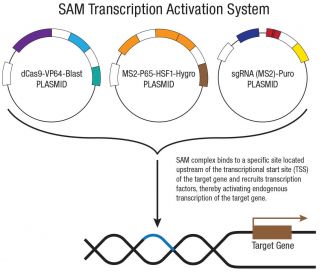
- Qa-1 CRISPR Activation Plasmid (m) consists of three plasmids at a 1:1:1 mass ratio: a plasmid encoding the deactivated Cas9 (dCas9) nuclease (D10A and N863A) fused to the transactivation domain VP64, and a blasticidin resistance gene; a plasmid encoding the MS2-p65-HSF1 fusion protein, and a hygromycin resistance gene; a plasmid encoding a target-specific 20 nt guide RNA fused to two MS2 RNA aptamers, and a puromycin resistance gene
- The resulting SAM complex binds to a site-specific region approximately 200-250 nt upstream of the transcriptional start site and provides robust recruitment of transcription factors for highly efficient gene activation
- gRNAs encoded by Qa-1 CRISPR Activation Plasmid (m) and Qa-1 CRISPR Activation Plasmid (m2) target distinct regulatory regions upstream of the H2-T23 transcriptional start site. One or both designs may be available
- Following transfection, gene knockout efficiency can be assayed by WB, IF or IHC using antibody: Qa-1 Antibody (6A8.6F10): sc-23889

Ordering Information
| Product Name | Catalog # | UNIT | Price | Qty | FAVORITES | |
Qa-1 CRISPR Activation Plasmid (m) | sc-420781-ACT | 20 µg | $397.00 | |||
Qa-1 CRISPR Activation Plasmid (m2) | sc-420781-ACT-2 | 20 µg | $397.00 |
Mouse H2-T23 encodes the nonclassical MHC class I molecule Qa-1, a surface glycoprotein that regulates immune surveillance by shaping NK cell and CD8+ T cell responses. Qa-1 presents a restricted peptide repertoire, including leader sequence–derived peptides, and signals through receptors such as CD94/NKG2 on NK cells to modulate cytotoxicity and tolerance. Through these interactions, Qa-1 influences antigen presentation dynamics, immune homeostasis, and responses to inflammation. Altered Qa-1 expression or recognition has been linked to dysregulated immunity and is commonly investigated in models of autoimmunity, infection, and tumor immune evasion.
Qa-1 CRISPR Activation Plasmid (m) provides a targeted, non-destructive approach to upregulating endogenous H2-T23 expression without altering the underlying DNA sequence.
Qa-1 CRISPR Activation Plasmid (m) is a three-plasmid synergistic activation mediator (SAM) system engineered for highly efficient, site-specific transcriptional upregulation of the H2-T23 locus in human cell lines. The system is built around a catalytically inactive Cas9 (dCas9) carrying two inactivating mutations (D10A and N863A) that eliminate nuclease activity while preserving DNA binding. This dCas9 is fused to VP64, a potent transcriptional activator, and is co-expressed with a blasticidin resistance gene for selection. The second plasmid encodes the MS2-p65-HSF1 fusion protein, a secondary activator complex that works in concert with dCas9-VP64, alongside a hygromycin resistance gene. The third plasmid encodes a target-specific 20 nt sgRNA fused to two MS2 RNA aptamers that recruit the MS2-p65-HSF1 complex to the activation site, accompanied by a puromycin resistance gene. The three plasmids are delivered at a 1:1:1 mass ratio for balanced expression of all system components.
Once assembled at the target locus, the SAM complex binds within approximately 200 bp upstream of the H2-T23 transcriptional start site, where VP64, p65, and HSF1 act in concert to recruit transcriptional machinery and drive upregulation of endogenous Qa-1 expression. Unlike nuclease-active Cas9, dCas9 does not introduce double-strand breaks or modify the genomic sequence, preserving the native H2-T23 locus and enabling the study of Qa-1-dependent transcriptional responses at the endogenous locus, making it a valuable tool for functional studies, target gene identification, and the modeling of Qa-1 pathway restoration in tumor cells with silenced or reduced H2-T23 expression.
For Research Use Only. Not Intended for Diagnostic or Therapeutic Use.