
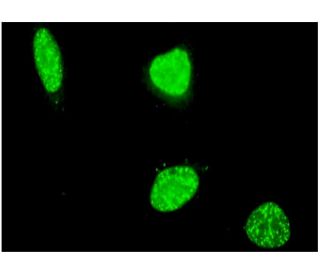


PTIP Antibody (4C11): sc-293322
- PTIP Antibody (4C11) is a mouse monoclonal IgG2a κ PTIP antibody, cited in 1 publications, provided at 100 µg/ml
- raised against amino acids 868-975 of PTIP of human origin
- recommended for detection of PTIP of human origin by WB, IP, IF, IHC(P) and ELISA
- At present, we have not yet completed the identification of the preferred secondary detection reagent(s) for PTIP Antibody (4C11). This work is in progress.

QUICK LINKS
SEE ALSO...
PTIP Antibody (4C11) is a mouse monoclonal IgG2a kappa light chain antibody that detects PTIP protein of human origin by western blotting (WB), immunoprecipitation (IP), immunofluorescence (IF), immunohistochemistry, and enzyme-linked immunosorbent assay (ELISA). Anti-PTIP antibody (4C11) is available as a non-conjugated format. PTIP, also known as PAXIP1 (PAX interacting (with transcription-activation domain) protein 1), TNRC2, CAGF28, CAGF29, PACIP1, or PAXIP1L, is a 1,035 amino acid protein that plays a vital role in the DNA damage response pathway. PTIP (4C11) monoclonal antibody recognizes targets primarily located at the nuclear membrane and the matrix side of the peripheral membrane, where PTIP contains five BRCT domains essential for recognizing phosphorylated substrates. PTIP′s ability to bind specifically to phosphoserine or phosphothreonine residues highlights its importance in cellular signaling and repair mechanisms, as PTIP facilitates the recruitment of other proteins involved in DNA repair processes. PTIP′s interaction with various proteins suggests involvement in early development and cellular proliferation, making PTIP a critical player in maintaining genomic stability and proper cellular function.
Alexa Fluor® is a trademark of Molecular Probes Inc., OR., USA
LI-COR® and Odyssey® are registered trademarks of LI-COR Biosciences
PTIP Antibody (4C11) References:
- PTIP, a novel BRCT domain-containing protein interacts with Pax2 and is associated with active chromatin. | Lechner, MS., et al. 2000. Nucleic Acids Res. 28: 2741-51. PMID: 10908331
- BRCT domain-containing protein PTIP is essential for progression through mitosis. | Cho, EA., et al. 2003. Mol Cell Biol. 23: 1666-73. PMID: 12588986
- BRCT repeats as phosphopeptide-binding modules involved in protein targeting. | Manke, IA., et al. 2003. Science. 302: 636-9. PMID: 14576432
- Linkage and association studies identify a novel locus for Alzheimer disease at 7q36 in a Dutch population-based sample. | Rademakers, R., et al. 2005. Am J Hum Genet. 77: 643-52. PMID: 16175510
- PTIP associates with MLL3- and MLL4-containing histone H3 lysine 4 methyltransferase complex. | Cho, YW., et al. 2007. J Biol Chem. 282: 20395-406. PMID: 17500065
- Phospho-epitope binding by the BRCT domains of hPTIP controls multiple aspects of the cellular response to DNA damage. | Munoz, IM., et al. 2007. Nucleic Acids Res. 35: 5312-22. PMID: 17690115
- PTIP/Swift is required for efficient PCNA ubiquitination in response to DNA damage. | Göhler, T., et al. 2008. DNA Repair (Amst). 7: 775-87. PMID: 18353733
- Accumulation of Pax2 transactivation domain interaction protein (PTIP) at sites of DNA breaks via RNF8-dependent pathway is required for cell survival after DNA damage. | Gong, Z., et al. 2009. J Biol Chem. 284: 7284-93. PMID: 19124460
Ordering Information
| Product Name | Catalog # | UNIT | Price | Qty | FAVORITES | |
PTIP Antibody (4C11) | sc-293322 | 100 µg/ml | $322.00 |