
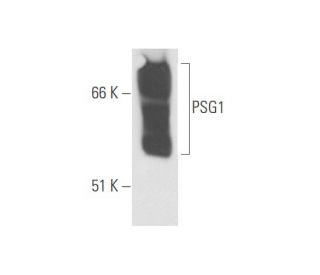

PSG1 Antibody (BAP3): sc-59348
- PSG1 Antibody (BAP3) is a mouse monoclonal IgG1 κ PSG1 antibody, cited in 3 publications, provided at 200 µg/ml
- raised against purified CD66f of human origin
- PSG1 Antibody (BAP3) is recommended for detection of PSG1 of human origin by WB, IP, IF and FCM; non cross-reactive with C-CAM subgroup members of the CEA family
- Anti-PSG1 Antibody (BAP3) is available conjugated to agarose for IP; HRP for WB, IHC(P) and ELISA; and to either phycoerythrin or FITC for IF, IHC(P) and FCM
- also available conjugated to Alexa Fluor® 488, Alexa Fluor® 546, Alexa Fluor® 594 or Alexa Fluor® 647 for WB (RGB), IF, IHC(P) and FCM, and for use with RGB fluorescent imaging systems, such as iBright™ FL1000, FluorChem™, Typhoon, Azure and other comparable systems
- also available conjugated to Alexa Fluor® 680 or Alexa Fluor® 790 for WB (NIR), IF and FCM; for use with Near-Infrared (NIR) detection systems, such as LI-COR®Odyssey®, iBright™ FL1000, FluorChem™, Typhoon, Azure and other comparable systems
- m-IgG Fc BP-HRP and m-IgG1 BP-HRP are the preferred secondary detection reagents for PSG1 Antibody (BAP3) for WB applications. These reagents are now offered in bundles with PSG1 Antibody (BAP3) (see ordering information below).

QUICK LINKS
PSG1 Antibody (BAP3) is a mouse monoclonal IgG1 kappa light chain antibody that detects PSG1 protein of human origin by western blotting (WB), immunoprecipitation (IP), immunofluorescence (IF), and flow cytometry (FCM). PSG1 (BAP3) antibody is available in both non-conjugated and various conjugated forms, including agarose, horseradish peroxidase (HRP), phycoerythrin (PE), fluorescein isothiocyanate (FITC), and multiple Alexa Fluor® conjugates, providing versatility for different experimental needs. Pregnancy-specific glycoprotein 1 (PSG1), also known as CD66f, is a crucial member of the PSG family, which consists of closely related secreted glycoproteins predominantly expressed in fetal placental syncytiotrophoblast cells. PSG proteins are characterized by a distinctive N-terminal domain that shares homology with the immunoglobulin variable region, which is significant for their role in immune modulation. PSG1 is detectable in maternal serum as early as two to three weeks into pregnancy, with levels increasing throughout gestation, ultimately becoming the most abundant fetal protein in maternal blood at term. PSG1 plays a vital role in stimulating the secretion of TH2-type cytokines from monocytes, which is essential for promoting a favorable immune environment during pregnancy, thereby protecting the semi-allotypic fetus from maternal immune rejection. Additionally, PSGs are implicated in trophoblast tumors, highlighting their importance in both normal and pathological conditions. With eleven human PSG proteins (PSG1-PSG11) identified, anti-PSG1 antibody (BAP3) serves as a valuable tool for researchers studying the complex interactions of these proteins in pregnancy and related disorders.
Alexa Fluor® is a trademark of Molecular Probes Inc., OR., USA
LI-COR® and Odyssey® are registered trademarks of LI-COR Biosciences
PSG1 Antibody (BAP3) References:
- Pregnancy-specific glycoproteins function as immunomodulators by inducing secretion of IL-10, IL-6 and TGF-beta1 by human monocytes. | Snyder, SK., et al. 2001. Am J Reprod Immunol. 45: 205-16. PMID: 11327547
- Binding of pregnancy-specific glycoprotein 17 to CD9 on macrophages induces secretion of IL-10, IL-6, PGE2, and TGF-beta1. | Ha, CT., et al. 2005. J Leukoc Biol. 77: 948-57. PMID: 15772125
- Cloning and expression of genes encoding human pregnancy-specific glycoproteins. | Lei, KJ., et al. 1992. J Biol Chem. 267: 16371-8. PMID: 1644821
- Human pregnancy-specific beta 1-glycoproteins are coded within chromosome 19. | Barnett, TR., et al. 1989. Am J Hum Genet. 44: 890-3. PMID: 2786334
- Pregnancy-specific beta 1-glycoprotein: cDNA cloning, tissue expression, and species specificity of one member of the PS beta G family. | Niemann, SC., et al. 1989. Hum Genet. 82: 239-43. PMID: 2786492
- Maternal levels of pregnancy-specific beta 1-glycoprotein (SP-1) are elevated in pregnancies affected by Down's syndrome. | Bartels, I. and Lindemann, A. 1988. Hum Genet. 80: 46-8. PMID: 2971018
- Pregnancy-specific glycoprotein gene expression and the induction by 5-bromo-2'-deoxyuridine. | Pan, CJ., et al. 1994. Biochemistry. 33: 7260-6. PMID: 8003489
- The pregnancy-specific glycoprotein (PSG) gene cluster on human chromosome 19: fine structure of the 11 PSG genes and identification of 6 new genes forming a third subgroup within the carcinoembryonic antigen (CEA) family. | Teglund, S., et al. 1994. Genomics. 23: 669-84. PMID: 7851896
Ordering Information
| Product Name | Catalog # | UNIT | Price | Qty | FAVORITES | |
PSG1 Antibody (BAP3) | sc-59348 | 200 µg/ml | $322.00 | |||
PSG1 Antibody (BAP3): m-IgG Fc BP-HRP Bundle | sc-526930 | 200 µg Ab; 10 µg BP | $361.00 | |||
PSG1 Antibody (BAP3): m-IgG1 BP-HRP Bundle | sc-532303 | 200 µg Ab; 20 µg BP | $361.00 | |||
PSG1 Antibody (BAP3) AC | sc-59348 AC | 500 µg/ml, 25% agarose | $424.00 | |||
PSG1 Antibody (BAP3) HRP | sc-59348 HRP | 200 µg/ml | $322.00 | |||
PSG1 Antibody (BAP3) FITC | sc-59348 FITC | 200 µg/ml | $336.00 | |||
PSG1 Antibody (BAP3) PE | sc-59348 PE | 200 µg/ml | $349.00 | |||
PSG1 Antibody (BAP3) Alexa Fluor® 488 | sc-59348 AF488 | 200 µg/ml | $364.00 | |||
PSG1 Antibody (BAP3) Alexa Fluor® 546 | sc-59348 AF546 | 200 µg/ml | $364.00 | |||
PSG1 Antibody (BAP3) Alexa Fluor® 594 | sc-59348 AF594 | 200 µg/ml | $364.00 | |||
PSG1 Antibody (BAP3) Alexa Fluor® 647 | sc-59348 AF647 | 200 µg/ml | $364.00 | |||
PSG1 Antibody (BAP3) Alexa Fluor® 680 | sc-59348 AF680 | 200 µg/ml | $364.00 | |||
PSG1 Antibody (BAP3) Alexa Fluor® 790 | sc-59348 AF790 | 200 µg/ml | $364.00 |