
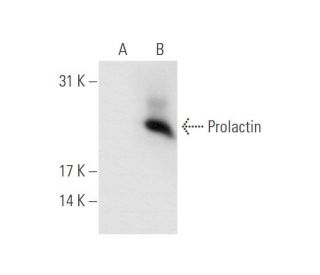


Prolactin (h): 293T Lysate: sc-170124
- human Prolactin transfected 293T lysate
- 100 µg protein in 200 µl SDS-PAGE buffer; suitable as Western Blotting control for Prolactin antibodies
- Suitable control antibody: Prolactin Antibody (E-9): sc-48383 is recommended as control antibody for monitoring of Prolactin expression knockdown by Western blotting or immunofluorescence
- should be stored at -20° C and repeated freezing and thawing should be minimized
- sample vial should be boiled once prior to use
- non-transfected control 293T lysate (sc-117752)

QUICK LINKS
Prolactin (h): 293T Lysate is a vital research reagent derived from the human embryonic kidney 293T cell line, which has been transfected to express human prolactin. Prolactin is a polypeptide hormone involved in numerous physiological processes, including lactation, reproduction, and immune regulation. The 293T cell line, known for its high transfection efficiency and protein production capabilities, serves as an excellent platform for producing prolactin. In research, Prolactin (h): 293T Lysate is used to study prolactin signaling pathways, particularly the JAK2-STAT5 pathway, which is activated upon prolactin binding to its receptor. This binding triggers receptor dimerization and subsequent activation of JAK2, leading to phosphorylation of STAT5, which then translocates to the nucleus to regulate gene expression. The lysate is employed in assays to investigate prolactin's role in cell proliferation, differentiation, and apoptosis. Additionally, it is used in immunoprecipitation and Western blot experiments to identify and quantify prolactin and its associated signaling molecules. This lysate is also essential for studying the crosstalk between prolactin and other hormonal signaling pathways, providing insights into complex cellular mechanisms. The detailed analysis of prolactin's effects using this lysate advances our understanding of its diverse biological roles.
Ordering Information
| Product Name | Catalog # | UNIT | Price | Qty | FAVORITES | |
Prolactin (h): 293T Lysate | sc-170124 | 100 µg/200 µl | $236.00 |