
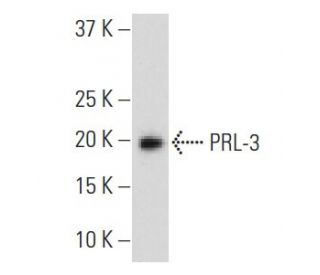

PRL-3 Anticuerpo (111AT714): sc-130245
- PRL-3 Anticuerpo 111AT714 es un monoclonal de ratón IgG1, ver las 1 publicaciones, proporcionado como 100 µg/ml
- producido contra una proteina recombinante PRL-3 de origen human
- recomendado para detectarPRL-3 de mouse, rat y human origen, mediante WB, IP y ELISA
- Actualmente, aún no hemos completado la identificación de los reactivos de detección secundaria preferidos para PRL-3 Anticuerpo (111AT714). Este trabajo está en progreso.

El anticuerpo PRL-3 (111AT714) es un anticuerpo monoclonal de ratón IgG1 que detecta PRL-3 de origen humano, de ratón y de rata mediante WB, IP y ELISA. El anticuerpo PRL-3 (111AT714) está disponible en forma de anticuerpo anti-PRL-3 no conjugado. Las proteínas tirosina fosfatasas (PTPs) desempeñan un papel en la regulación de diversos procesos celulares. Forman una pequeña clase de fosfatasas de proteínas preniladas llamadas proteínas PRL, caracterizadas por una secuencia de consenso C-terminal para prenilación. PRL-1, también designada como proteína tirosina fosfatasa tipo IVA 1 (PTP4A1), es una PTP nuclear única que se induce en el hígado en regeneración y en células estimuladas por mitógenos. Se expresa principalmente en el bazo, la médula ósea, el timo, los ganglios linfáticos, los linfocitos T y las amígdalas, y se sobreexpresa en líneas celulares tumorales. PRL-2 (proteína tirosina fosfatasa tipo IVA 2, o PTP4A2) se expresa de forma ubicua con niveles más altos en el corazón, el músculo esquelético y el timo, pero también se sobreexpresa en tejido tumoral de próstata. PRL-2 estimula la progresión de la fase G1 a la fase S durante la mitosis y promueve tumores. PRL-3, también conocida como proteína tirosina fosfatasa tipo IVA, miembro 3 (PTP4A3), se expresa en el corazón y el músculo esquelético, así como en células epiteliales del intestino delgado y se asocia con la membrana plasmática celular. La sobreexpresión de PRL-3 inhibe la movilización de calcio celular inducida por angiotensina-II y promueve el crecimiento celular. PRL-3 es importante para la metástasis del cáncer colorrectal y puede servir como un nuevo objetivo terapéutico para esta condición.
Alexa Fluor® es una marca registrada de Molecular Probes Inc., OR., USA
REIVEW LI-COR® y Odyssey® son marcas registradas de LI-COR Biosciences.
PRL-3 Anticuerpo (111AT714) Referencias:
- La fosfatasa PRL-3 y la metástasis del cáncer. | Al-Aidaroos, AQ. and Zeng, Q. 2010. J Cell Biochem. 111: 1087-98. PMID: 21053359
- PRL-3, un marcador emergente de carcinogénesis, está fuertemente asociado con un mal pronóstico. | Guzińska-Ustymowicz, K. and Pryczynicz, A. 2011. Anticancer Agents Med Chem. 11: 99-108. PMID: 21291404
- PRL-3 activa mTORC1 en la progresión del cáncer. | Ye, Z., et al. 2015. Sci Rep. 5: 17046. PMID: 26597054
- Mecanismos reguladores de la fosfatasa del hígado regenerador (PRL)-3. | Rubio, T. and Köhn, M. 2016. Biochem Soc Trans. 44: 1305-1312. PMID: 27911713
- PRL-3 promueve la desprotección de los telómeros y la inestabilidad cromosómica. | Lian, S., et al. 2017. Nucleic Acids Res. 45: 6546-6571. PMID: 28482095
- La PRL-3 promueve la progresión del cáncer de mama mediante la regulación a la baja de la expresión de p53 mediada por p14ARF. | Xie, H. and Wang, H. 2018. Oncol Lett. 15: 2795-2800. PMID: 29435006
- La fosfatasa PRL-3 interviene en etapas clave de la metástasis del cáncer. | Duciel, L., et al. 2019. J Mol Biol. 431: 3056-3067. PMID: 31207239
- PRL-3 facilita la progresión del carcinoma hepatocelular al co-amplificarse con FAK y activarla. | Zhou, Q., et al. 2020. Theranostics. 10: 10345-10359. PMID: 32929353
- PRL-3 induce un circuito de señalización positiva entre la glucólisis y la activación de STAT1/2. | Vandsemb, EN., et al. 2021. FEBS J. 288: 6700-6715. PMID: 34092011
- La PRL-3 desfosforila la p38 MAPK para promover la supervivencia celular en situaciones de estrés. | Shi, Y., et al. 2021. Free Radic Biol Med. 177: 72-87. PMID: 34662712
Información sobre pedidos
| Nombre del producto | Número de catálogo | UNIDAD | Precio | CANTIDAD | Favoritos | |
PRL-3 Anticuerpo (111AT714) | sc-130245 | 100 µg/ml | $322.00 |