
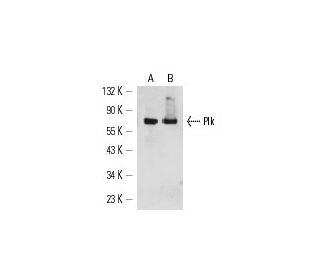
Plk Antibody (36-298): sc-56948
- Plk Antibody (36-298) is a mouse monoclonal IgG1, cited in 1 publications, provided at 200 µg/ml
- raised against full length Plk purified from Sf9 cells
- recommended for detection of Plk of mouse, rat and human origin by WB, IP, IF and ELISA
- See Plk (F-8): sc-17783 for Plk antibody conjugates, including AC, HRP, FITC, PE, Alexa Fluor® 488, 594, 647, 680 and 790.
- At present, we have not yet completed the identification of the preferred secondary detection reagent(s) for Plk Antibody (36-298). This work is in progress.

QUICK LINKS
SEE ALSO...
Plk Antibody (36-298) is a mouse monoclonal IgG1 antibody that detects Plk in mouse, rat, and human samples through applications such as western blotting (WB), immunoprecipitation (IP), immunofluorescence (IF), and enzyme-linked immunosorbent assay (ELISA). Anti-Plk antibody (36-298) recognizes the polo-like kinase protein, which plays a crucial role in cell cycle regulation, particularly during mitosis. This serine/threonine kinase is essential for the proper functioning of the mitotic spindle, a structure that segregates chromosomes during cell division. Plk is predominantly located in the cytoplasm and accumulates during the S and G2 phases of the cell cycle, with levels peaking at the onset of mitosis before rapidly decreasing post-mitosis. Plk regulation is vital, as activity is closely linked to cell proliferation and the maintenance of genomic stability. Elevated expression of Plk has been observed in various tumors, suggesting potential as a biomarker for cancer progression and a target for therapeutic intervention. Plk monoclonal antibody (36-298) enables researchers to gain insights into the dynamics of cell division and implications of Plk in both normal and pathological states.
Alexa Fluor® is a trademark of Molecular Probes Inc., OR., USA
LI-COR® and Odyssey® are registered trademarks of LI-COR Biosciences
Plk Antibody (36-298) References:
- Prognostic significance of polo-like kinase (PLK) expression in squamous cell carcinomas of the head and neck. | Knecht, R., et al. 1999. Cancer Res. 59: 2794-7. PMID: 10383133
- Polo-like kinase (PLK) expression in endometrial carcinoma. | Takai, N., et al. 2001. Cancer Lett. 169: 41-9. PMID: 11410324
- The TSC1-mTOR-PLK axis regulates the homeostatic switch from Schwann cell proliferation to myelination in a stage-specific manner. | Jiang, M., et al. 2018. Glia. 66: 1947-1959. PMID: 29722913
- Distinct surfaces on Cdc5/PLK Polo-box domain orchestrate combinatorial substrate recognition during cell division. | Almawi, AW., et al. 2020. Sci Rep. 10: 3379. PMID: 32099015
- SKA3 Promotes Cell Growth in Breast Cancer by Inhibiting PLK-1 Protein Degradation. | Ruan, LW., et al. 2020. Technol Cancer Res Treat. 19: 1533033820947488. PMID: 32799774
- The kinetoplastid-specific phosphatase KPP1 attenuates PLK activity to facilitate flagellum inheritance in Trypanosoma brucei. | An, T., et al. 2021. Sci Signal. 14: PMID: 33563698
- Co-delivery of anti-PLK-1 siRNA and camptothecin by nanometric polydiacetylenic micelles results in a synergistic cell killing. | Ripoll, M., et al. 2018. RSC Adv. 8: 20758-20763. PMID: 35542356
- Dual modifications of chitosan with PLK for amputation of cyanide ions: Equilibrium studies and optimization using RSM. | Gomase, V., et al. 2022. Int J Biol Macromol. 223: 636-651. PMID: 36370863
- Prognostic significance of polo-like kinase (PLK) expression in non-small cell lung cancer. | Wolf, G., et al. 1997. Oncogene. 14: 543-9. PMID: 9053852
- Cell cycle regulation of the human polo-like kinase (PLK) promoter. | Uchiumi, T., et al. 1997. J Biol Chem. 272: 9166-74. PMID: 9083047
Ordering Information
| Product Name | Catalog # | UNIT | Price | Qty | FAVORITES | |
Plk Antibody (36-298) | sc-56948 | 200 µg/ml | $322.00 |