
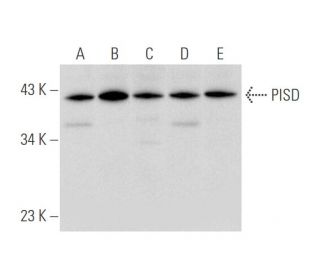

PISD Antibody (D-9): sc-514884
- PISD Antibody (D-9) is a mouse monoclonal IgM κ provided at 200 µg/ml
- specific for an epitope mapping between amino acids 291-312 within an internal region of PISD of human origin
- recommended for detection of PISD of mouse, rat and human origin by WB, IP, IF and ELISA
- At present, we have not yet completed the identification of the preferred secondary detection reagent(s) for PISD Antibody (D-9). This work is in progress.

QUICK LINKS
SEE ALSO...
PISD Antibody (D-9) is a mouse monoclonal IgM antibody that detects phosphatidylserine decarboxylase (PISD) in mouse, rat, and human samples through applications such as western blotting (WB), immunoprecipitation (IP), immunofluorescence (IF), and enzyme-linked immunosorbent assay (ELISA). PISD plays a crucial role in lipid metabolism by catalyzing the conversion of phosphatidylserine to phosphatidylethanolamine, a process essential for maintaining cellular membrane integrity and function. PISD (D-9) antibody targets an enzyme predominantly located in the inner mitochondrial membrane, where PISD contributes to the synthesis of phosphatidylethanolamine, a key component of mitochondrial membranes that influences membrane fluidity and protein function. PISD in mitochondria is vital for energy production and apoptosis regulation, highlighting its importance in cellular health and disease. PISD is characterized by a conserved LGST motif, which is cleaved to yield two isoforms, PISD alpha and PISD beta, that may have distinct functional roles. The gene encoding PISD is located on human chromosome 22q12.2, and PISD expression is notably high in liver and testis tissues, indicating its significance in metabolic processes within these organs. Anti-PISD antibody (D-9) is an invaluable tool for researchers studying lipid metabolism and mitochondrial function, providing insights into the physiological and pathological roles of phosphatidylserine decarboxylase.
Alexa Fluor® is a trademark of Molecular Probes Inc., OR., USA
LI-COR® and Odyssey® are registered trademarks of LI-COR Biosciences
PISD Antibody (D-9) References:
- Towards developing a protein infrared spectra databank (PISD) for proteomics research. | Hering, JA., et al. 2004. Proteomics. 4: 2310-9. PMID: 15274125
- Proliferative and estrogenic sensitivity of the mammary gland are modulated by isoflavones during distinct periods of adolescence. | Molzberger, AF., et al. 2013. Arch Toxicol. 87: 1129-40. PMID: 23288143
- Evolution of postirradiated sudden deafness in nasopharyngeal carcinoma survivors during the past two decades. | Cho, TY., et al. 2016. Laryngoscope. 126: 2016-21. PMID: 26864918
- Posteroinferior septal defect due to vomeral malformation. | Lee, YW., et al. 2019. Eur Arch Otorhinolaryngol. 276: 2229-2235. PMID: 31025110
- Metabolic changes induced by TGF-β1 via reduced expression of phosphatidylserine decarboxylase during myofibroblast transition. | Uchida, N., et al. 2022. J Clin Biochem Nutr. 70: 108-116. PMID: 35400823
- Ts66Yah, a mouse model of Down syndrome with improved construct and face validity. | Duchon, A., et al. 2022. Dis Model Mech. 15: PMID: 36374158
- Generalized mathematical framework for contrast-enhanced ultrasound imaging with pulse inversion spectral deconvolution. | Khairalseed, M. and Hoyt, K. 2023. Ultrasonics. 129: 106913. PMID: 36528905
- Hepatic CDP-diacylglycerol synthase 2 deficiency causes mitochondrial dysfunction and promotes rapid progression of NASH and fibrosis. | Xu, J., et al. 2022. Sci Bull (Beijing). 67: 299-314. PMID: 36546079
- Expression characteristics of lipid metabolism-related genes and correlative immune infiltration landscape in acute myocardial infarction. | Wu, J., et al. 2024. Sci Rep. 14: 14095. PMID: 38890389
- Mitochondrial bioenergetics stimulates autophagy for pathological MAPT/Tau clearance in tauopathy neurons. | Jia, N., et al. 2025. Autophagy. 21: 54-79. PMID: 39171695
Ordering Information
| Product Name | Catalog # | UNIT | Price | Qty | FAVORITES | |
PISD Antibody (D-9) | sc-514884 | 200 µg/ml | $322.00 | |||
PISD (D-9) Neutralizing Peptide | sc-514884 P | 100 µg/0.5 ml | $69.00 |