
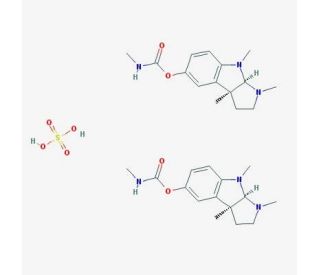

Physostigmine hemisulfate (CAS 64-47-1)
See product citations (2)
QUICK LINKS
Physostigmine hemisulfate is a compound often used in research to study cholinergic neurotransmission due to its role as a reversible inhibitor of the enzyme acetylcholinesterase. By inhibiting this enzyme, Physostigmine hemisulfate increases the levels of acetylcholine in the synaptic cleft, making it useful for investigating the dynamics of neurotransmitter release, receptor activation, and the consequent physiological responses. In neurobiology, it helps to elucidate the mechanisms underlying memory and learning, as these processes are heavily dependent on cholinergic pathways in the brain. This compound also serves as a reference standard in the calibration of analytical instruments for the detection of acetylcholinesterase activity in biological samples, contributing to a broader understanding of enzyme kinetics and inhibitor interactions.
Physostigmine hemisulfate (CAS 64-47-1) References
- Galanin inhibits acetylcholine release from rat cerebral cortex via a pertussis toxin-sensitive G(i)protein. | Wang, HY., et al. 1999. Neuropeptides. 33: 197-205. PMID: 10657492
- The combined effects of pyridostigmine and chronic stress on brain cortical and blood acetylcholinesterase, corticosterone, prolactin and alternation performance in rats. | Kant, GJ., et al. 2001. Pharmacol Biochem Behav. 70: 209-18. PMID: 11701190
- Quantitative determination of rivastigmine and its major metabolite in human plasma by liquid chromatography with atmospheric pressure chemical ionization tandem mass spectrometry. | Pommier, F. and Frigola, R. 2003. J Chromatogr B Analyt Technol Biomed Life Sci. 784: 301-13. PMID: 12505778
- Effects of subcutaneous and intracerebroventricular injection of physostigmine on the acute corneal nociception in rats. | Tamaddonfard, E. and Hamzeh-Gooshchi, N. 2010. Pharmacol Rep. 62: 858-63. PMID: 21098868
- Cholinergic modulation of narcoleptic attacks in double orexin receptor knockout mice. | Kalogiannis, M., et al. 2011. PLoS One. 6: e18697. PMID: 21533254
- Anticholinesterasic, nematostatic and anthelmintic activities of pyridinic and pyrazinic compounds. | Valli, M., et al. 2011. Curr Med Chem. 18: 3423-30. PMID: 21728957
- Acetylcholinesterase inhibition and locomotor function after motor-sensory cortex impact injury. | Holschneider, DP., et al. 2011. J Neurotrauma. 28: 1909-19. PMID: 21787180
- Extraction of physostigmine from biologic fluids and analysis by liquid chromatography with electrochemical detection. | Lawrence, GD. and Yatim, N. 1990. J Pharmacol Methods. 24: 137-43. PMID: 2232817
- Micronized emulsion for controlled release of physostigmine after oral administration. Part I. Formulation design. | Friedman, D., et al. 1989. Drug Des Deliv. 4: 135-42. PMID: 2765106
- Platelet-activating factor: diminished acetylcholine release from rat brain slices is mediated by a Gi protein. | Wang, HY., et al. 1994. J Neurochem. 63: 1720-5. PMID: 7931326
- Irreversible blockade of high-affinity choline uptake in rat brain by N-ethoxycarbonyl-2-ethoxy-1,2-dihydroquinoline (EEDQ). | Vickroy, TW. and Malphurs, WL. 1994. Biochem Pharmacol. 48: 1281-7. PMID: 7945422
- Monoamines, amino acids and acetylcholine in the preoptic area and anterior hypothalamus of rats: measurements of tissue extracts and in vivo microdialysates. | Yasumatsu, M., et al. 1998. Comp Biochem Physiol A Mol Integr Physiol. 121: 13-23. PMID: 9883566
- Effects of calyculin A and okadaic acid on acetylcholine release and subcellular distribution in rat hippocampal formation. | Issa, AM., et al. 1999. J Neurochem. 72: 166-73. PMID: 9886067
Ordering Information
| Product Name | Catalog # | UNIT | Price | Qty | FAVORITES | |
Physostigmine hemisulfate, 10 mg | sc-203661 | 10 mg | $184.00 | |||
Physostigmine hemisulfate, 100 mg | sc-203661A | 100 mg | $1428.00 |