
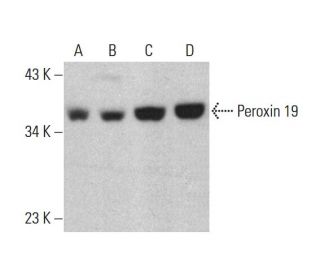

Peroxin 19 Antibody (2E4): sc-517578. NTERA-2 cl. D1 (A), U-698-M (B), T-47D (C), PC-3 (D) 全細胞溶解液における Peroxin 19 発現のウェスタンブロット解析.
Peroxin 19抗体(2E4): sc-517578
- Peroxin 19抗体 (2E4)はマウスモノクローナルIgG2a (kappa light chain)です。100 µg/mlで提供
- アミノ酸に対して調製された human 由来の全長組み換え Peroxin 19
- human由来のPeroxin 19 WB, IP と ELISAでの検出にはお勧めします
- 現在、Peroxin 19 Antibody (2E4)に適した二次検出試薬の同定はまだ完了していません。この研究は進めています。

クイックリンク
サポート品
説明
Gene情報
データシートとプロトコル
研究情報
関連項目
ペルオキシソーム19抗体(2E4)は、ウェスタンブロッティング(WB)、免疫沈降(IP)、および酵素免疫測定法(ELISA)により、ヒト由来のペルオキシソーム19を検出するマウスモノクローナルIgG2aκ軽鎖抗体です。ペルオキシソーム19抗体(2E4)は非結合型でご利用いただけます。ペルオキシソーム19は、ペルオキシソーム局在型ファルネシル化タンパク質またはPxFとしても知られ、ペルオキシソームの形成において重要な役割を果たしており、細胞代謝および脂肪酸分解に不可欠です。ペルオキシソーム19は主にペルオキシソームの細胞質表面に位置しており、特に肝細胞ではペルオキシソーム膜の初期形成に関与しています。ペルオキシソーム19の適切な局在は、ペルオキシソームの機能に必要なマトリックスタンパク質の取り込みを促進します。ペルオキシソーム19のカルボキシ末端領域にはCAAX相同性ボックスが含まれており、生物学的活性に不可欠です。ペルオキシソーム19をコードする遺伝子は、ヒト染色体1q22に位置するハウスキーピング遺伝子であり、ペルオキシソーム生合成異常症の補体群Jと関連していることから、ヒトの健康と疾患における重要性を示しています。
試験・研究用以外には使用しないでください。 臨床及び体外診断には使用できません。
Alexa Fluor® はMolecular Probes Inc., OR., USAの商標です。
LI-COR® and Odyssey® はLI-COR Biosciencesの登録商標です。
Peroxin 19 参考文献:
- ヒトPEX19:機能相補によるcDNAクローニング, Zellweger症候群患者における変異解析, ペルオキシソーム膜集合における潜在的役割。 | Matsuzono, Y., et al. 1999. Proc Natl Acad Sci U S A. 96: 2116-21. PMID: 10051604
- アミノ末端部分にある標的化エレメントが、ヒト70kDaペルオキシソーム積分膜タンパク質(PMP70)をペルオキシソームに誘導する。 | Biermanns, M. and Gärtner, J. 2001. Biochem Biophys Res Commun. 285: 649-55. PMID: 11453642
- ヒトペルオキシンPex11pの第3アイソフォームのcDNAクローニングと特性評価。 | Tanaka, A., et al. 2003. Biochem Biophys Res Commun. 300: 819-23. PMID: 12559946
- ペルオキシソーム生合成障害のショウジョウバエモデル:ペルオキシンは精子形成と超長鎖脂肪酸代謝に必要である。 | Chen, H., et al. 2010. Hum Mol Genet. 19: 494-505. PMID: 19933170
- Zellweger症候群とそれに伴う脳奇形:アメリカ先住民の乳児における新規Peroxin1(PEX1)変異の報告。 | Mohebbi, MR., et al. 2012. J Child Neurol. 27: 1589-92. PMID: 22378672
- ヒト・マロニル-CoA脱炭酸酵素の活性を調節するサブユニット間の構造的非対称性とジスルフィド橋。 | Aparicio, D., et al. 2013. J Biol Chem. 288: 11907-19. PMID: 23482565
- エンテロウイルス71は、ACOX1のダウンレギュレーションと活性酸素の生成を促進することにより、神経細胞のアポトーシスとオートファジーを誘導する。 | You, L., et al. 2020. Virulence. 11: 537-553. PMID: 32434419
- 偽外皮剥離のヒト初代海綿状網膜モデル。 | Chakraborty, M., et al. 2021. Cells. 10: PMID: 34943956
- ペルオキシソームのプレニル化タンパク質PxF。 | James, GL., et al. 1994. J Biol Chem. 269: 14182-90. PMID: 8188701
- ヒトペルオキシソームファルネシル化タンパク質HsPXFをコードする遺伝子のゲノム構成と分子生物学的特徴。 | Kammerer, S., et al. 1997. Genomics. 45: 200-10. PMID: 9339377
- Pex19p, ペルオキシソーム生合成に必須なファルネシル化タンパク質。 | Götte, K., et al. 1998. Mol Cell Biol. 18: 616-28. PMID: 9418908
- 新たに同定されたチャイニーズハムスター卵巣細胞変異体は, ペルオキシソーム膜小胞(ペルオキシソームゴースト)の生合成に欠損があり, 哺乳類における新規相補群を示す。 | Kinoshita, N., et al. 1998. J Biol Chem. 273: 24122-30. PMID: 9727033
注文情報
| 製品名 | カタログ # | 単位 | 価格 | 数量 | お気に入り | |
Peroxin 19 抗体 (2E4) | sc-517578 | 100 µg/ml | $322.00 |