
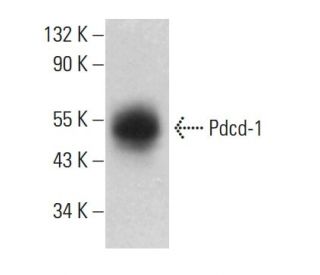

Pdcd-1 Antibody (RMP1-30): sc-56200
- Pdcd-1 Antibody (RMP1-30) is a rat monoclonal IgG2b Pdcd-1 antibody provided at 200 µg/ml
- raised against Pdcd-1 of mouse origin
- Pdcd-1 Antibody (RMP1-30) is recommended for detection of Pdcd-1 of mouse origin by WB, IP and FCM
- Anti-Pdcd-1 Antibody (RMP1-30) is available conjugated to agarose for IP; HRP for WB, IHC(P) and ELISA; and to either phycoerythrin or FITC for IF, IHC(P) and FCM
- also available conjugated to Alexa Fluor® 488, Alexa Fluor® 546, Alexa Fluor® 594 or Alexa Fluor® 647 for WB (RGB), IF, IHC(P) and FCM, and for use with RGB fluorescent imaging systems, such as iBright™ FL1000, FluorChem™, Typhoon, Azure and other comparable systems
- also available conjugated to Alexa Fluor® 680 or Alexa Fluor® 790 for WB (NIR), IF and FCM; for use with Near-Infrared (NIR) detection systems, such as LI-COR®Odyssey®, iBright™ FL1000, FluorChem™, Typhoon, Azure and other comparable systems
- At present, we have not yet completed the identification of the preferred secondary detection reagent(s) for Pdcd-1 Antibody (RMP1-30). This work is in progress.

QUICK LINKS
Pdcd-1 Antibody (RMP1-30) is a rat monoclonal IgG2b antibody that detects the Pdcd-1 protein of mouse origin by western blotting (WB), immunoprecipitation (IP), and flow cytometry (FCM). Anti-Pdcd-1 antibody (RMP1-30) is available in both non-conjugated and various conjugated forms, including agarose, horseradish peroxidase (HRP), phycoerythrin (PE), fluorescein isothiocyanate (FITC), and multiple Alexa Fluor® conjugates. The Pdcd-1 protein, also known as Programmed Cell Death-1 or CD279, is a type I transmembrane receptor that plays a crucial role in regulating immune responses. Pdcd-1 is primarily located on the surface of activated T cells and B cells, where Pdcd-1 functions to inhibit excessive immune activation, thereby maintaining immune homeostasis. Expression on these immune cells is vital, as Pdcd-1 helps prevent autoimmunity and promotes tolerance to self-antigens. Notably, Pdcd-1 interacts with ligands such as PD-L1 and PD-L2, which are expressed on antigen-presenting cells and tumor cells, respectively. This interaction is significant in cancer immunotherapy, as blocking the Pdcd-1 pathway can enhance anti-tumor immunity. Expression of Pdcd-1 is induced upon T cell activation, and Pdcd-1 signaling involves the recruitment of tyrosine phosphatases, which modulate various immune responses. Using Pdcd-1 (RMP1-30) monoclonal antibody, researchers can gain insights into immune regulation mechanisms and potential therapeutic targets for enhancing immune responses in various diseases.
Alexa Fluor® is a trademark of Molecular Probes Inc., OR., USA
LI-COR® and Odyssey® are registered trademarks of LI-COR Biosciences
Pdcd-1 Antibody (RMP1-30) References:
- Development of lupus-like autoimmune diseases by disruption of the PD-1 gene encoding an ITIM motif-carrying immunoreceptor. | Nishimura, H., et al. 1999. Immunity. 11: 141-51. PMID: 10485649
- New regulatory co-receptors: inducible co-stimulator and PD-1. | Okazaki, T., et al. 2002. Curr Opin Immunol. 14: 779-82. PMID: 12413529
- Induced expression of PD-1, a novel member of the immunoglobulin gene superfamily, upon programmed cell death. | Ishida, Y., et al. 1992. EMBO J. 11: 3887-95. PMID: 1396582
- PD-1 inhibits T-cell receptor induced phosphorylation of the ZAP70/CD3zeta signalosome and downstream signaling to PKCtheta. | Sheppard, KA., et al. 2004. FEBS Lett. 574: 37-41. PMID: 15358536
- The association between polymorphisms in the PDCD1 gene and the risk of cancer: A PRISMA-compliant meta-analysis. | Zhang, J., et al. 2016. Medicine (Baltimore). 95: e4423. PMID: 27749524
- Epigenetic and Genetic Regulation of PDCD1 Gene in Cancer Immunology. | Mishra, A. and Verma, M. 2018. Methods Mol Biol. 1856: 247-254. PMID: 30178256
- Inhibitory immune checkpoints PDCD-1 and LAG-3 hypermethylation may reduce the risk of colorectal cancer. | Zhang, Y., et al. 2021. Mol Med. 27: 114. PMID: 34544358
- Lack of Association Between PDCD-1 Polymorphisms and Colorectal Cancer Risk: A Case-Control Study. | Lin, J., et al. 2022. Immunol Invest. 51: 1867-1882. PMID: 35499255
- Evaluation of the possible association of PDCD-1 and LAG3 gene polymorphisms with hepatocellular carcinoma risk. | Wei, J., et al. 2023. BMC Med Genomics. 16: 92. PMID: 37131179
- Expression of the PD-1 antigen on the surface of stimulated mouse T and B lymphocytes. | Agata, Y., et al. 1996. Int Immunol. 8: 765-72. PMID: 8671665
- Role of the inositol phosphatase SHIP in negative regulation of the immune system by the receptor Fc(gamma)RIIB. | Ono, M., et al. 1996. Nature. 383: 263-6. PMID: 8805703
- Immunoreceptor tyrosine-based inhibition motifs. | Vivier, E. and Daëron, M. 1997. Immunol Today. 18: 286-91. PMID: 9190115
Ordering Information
| Product Name | Catalog # | UNIT | Price | Qty | FAVORITES | |
Pdcd-1 Antibody (RMP1-30) | sc-56200 | 200 µg/ml | $322.00 | |||
Pdcd-1 Antibody (RMP1-30) AC | sc-56200 AC | 500 µg/ml, 25% agarose | $424.00 | |||
Pdcd-1 Antibody (RMP1-30) HRP | sc-56200 HRP | 200 µg/ml | $322.00 | |||
Pdcd-1 Antibody (RMP1-30) FITC | sc-56200 FITC | 200 µg/ml | $336.00 | |||
Pdcd-1 Antibody (RMP1-30) PE | sc-56200 PE | 200 µg/ml | $349.00 | |||
Pdcd-1 Antibody (RMP1-30) Alexa Fluor® 488 | sc-56200 AF488 | 200 µg/ml | $364.00 | |||
Pdcd-1 Antibody (RMP1-30) Alexa Fluor® 546 | sc-56200 AF546 | 200 µg/ml | $364.00 | |||
Pdcd-1 Antibody (RMP1-30) Alexa Fluor® 594 | sc-56200 AF594 | 200 µg/ml | $364.00 | |||
Pdcd-1 Antibody (RMP1-30) Alexa Fluor® 647 | sc-56200 AF647 | 200 µg/ml | $364.00 | |||
Pdcd-1 Antibody (RMP1-30) Alexa Fluor® 680 | sc-56200 AF680 | 200 µg/ml | $364.00 | |||
Pdcd-1 Antibody (RMP1-30) Alexa Fluor® 790 | sc-56200 AF790 | 200 µg/ml | $364.00 |