
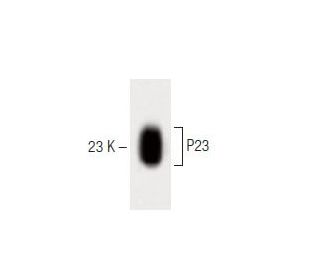


P23 Anticorpo (16): sc-136021
- P23 Anticorpo 16é um anticorpo monoclonal produzido em camundongo IgG1 fornecido em 50 µg/0.5 ml
- Produzido contra aminoácidos 1-94 de P23 de mouse origem
- recomendado para a detecção de P23 de mouse e rat origem em
- Atualmente, ainda não concluímos a identificação do(s) reagente(s) de deteção secundário(s) preferido(s) para P23 Anticorpo (16). Este trabalho está em curso.

LINKS RÁPIDOS
VEJA TAMBÉM
A P23, também conhecida por PTGES3 (prostaglandina E sintase 3) ou TEBP (telomerase-binding protein p23), é uma proteína ubiquamente expressa que funciona como uma cochaperona e desempenha um papel importante na transdução de sinais. Uma das várias proteínas do complexo de chaperonas moleculares baseado na HSP 90, a P23 promove a rutura de complexos reguladores da transcrição, perturbando a ativação transcricional mediada por receptores. A P23 actua de uma forma dependente das hormonas para chaperonear o recetor de estrogénio alfa (ERα), um complexo de esteróides, para a sua forma madura e para regular a expressão de genes relacionados com o ERα. Localizada no citoplasma, a P23 interage com o recetor de glucocorticóides (GR) e, através da desmontagem da maquinaria de transcrição do GR, pensa-se que inibe a transcrição dependente do GR. O envolvimento da P23 em várias vias mediadas pelos receptores de esteróides sugere um envolvimento próximo na transdução de sinais e na regulação dos processos celulares. A regulação positiva da P23 está implicada na invasão e nas metástases de vários cancros.
Alexa Fluor® é uma marca comercial da Molecular Probes Inc., OR., EUA
LI-COR® e Odyssey® são marcas registadas da LI-COR Biosciences
Referencias do P23 Anticorpo (16):
- A proteína transmembrana p23 contribui para a organização do aparelho de Golgi. | Rojo, M., et al. 2000. J Cell Sci. 113 (Pt 6): 1043-57. PMID: 10683152
- A influência do ATP e da p23 na conformação da hsp90. | Sullivan, WP., et al. 2002. J Biol Chem. 277: 45942-8. PMID: 12324468
- A cochaperona p23 da Hsp90 é essencial para a sobrevivência perinatal. | Grad, I., et al. 2006. Mol Cell Biol. 26: 8976-83. PMID: 17000766
- A p23/Tmp21 tem como alvo diferencial a Rac-GAP beta2-chimaerin e a proteína quinase C através dos seus domínios C1. | Wang, H. and Kazanietz, MG. 2010. Mol Biol Cell. 21: 1398-408. PMID: 20164256
- A co-chaperona p23 protege o recetor de hidrocarbonetos de arilo da degradação em linhas celulares de ratinho e humanas. | Nguyen, PM., et al. 2012. Biochem Pharmacol. 84: 838-50. PMID: 22759865
- A chaperona molecular p23 e a acetilase GCN5 modulam conjuntamente a dinâmica proteína-ADN e o estado da cromatina aberta. | Zelin, E., et al. 2012. Mol Cell. 48: 459-70. PMID: 23022381
- Caracterização de uma Interação Independente de Hsp90 entre a Co-Chaperona p23 e o Fator de Transcrição p53. | Wu, H., et al. 2018. Biochemistry. 57: 935-944. PMID: 29334217
- A co-chaperona Hsp90 p23 contribui para o stress mitocondrial dopaminérgico através da estabilização de PHD2: implicações para a doença de Parkinson. | Rane, A., et al. 2018. Neurotoxicology. 65: 166-173. PMID: 29471019
- Leucemia Mieloide Aguda com t(6;9)(p23;q34.1); DEK-NUP214: A Patogénese e o Potencial. | Gardner, JA., et al. 2020. J Assoc Genet Technol. 46: 98-102. PMID: 32526729
- A p23, uma importante proteína da membrana da vesícula COPI, percorre constitutivamente a via secretora inicial. | Nickel, W., et al. 1997. Proc Natl Acad Sci U S A. 94: 11393-8. PMID: 9326620
Informacoes sobre ordens
| Nome do Produto | Numero de Catalogo | UNID | Preco | Qde | FAVORITOS | |
P23 Anticorpo (16) | sc-136021 | 50 µg/0.5 ml | $322.00 |