
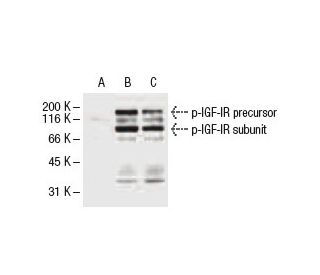

p-IGF-1 Receptor/IGF1R Antibody (2B9): sc-81499
- p-IGF-1 Receptor/IGF1R Antibody (2B9) is a mouse monoclonal IgG1, cited in 7 publications, provided at 50 µg/0.5 ml
- raised against phosphopeptide corresponding to amino acid residues surrounding Tyrosine 1316 of processed IGF-IR of human origin
- recommended for detection of Tyr 1316 phosphorylated IGF-IR of human origin by WB and IP
- At present, we have not yet completed the identification of the preferred secondary detection reagent(s) for p-IGF-1 Receptor/IGF1R Antibody (2B9). This work is in progress.
p-IGF-IR Antibody (2B9) is a mouse monoclonal IgG1 antibody that detects insulin-like growth factor-I receptor (IGF-IR) in human samples through applications such as western blotting (WB) and immunoprecipitation (IP). anti-IGF-IR antibody (2B9) plays a crucial role in studying IGF-IR function, a receptor tyrosine kinase integral to cellular processes including growth, survival, and differentiation. IGF-IR is primarily located on the cell membrane, where IGF-IR interacts with insulin-like growth factor-I (IGF-I) to initiate signaling cascades that promote cell proliferation and inhibit apoptosis. IGF-IR′s ability to modulate these critical pathways makes IGF-IR significant in cancer biology, as aberrant IGF-IR signaling can lead to tumor growth and therapy resistance. The human IGF-IR gene, located on chromosome 15q26.3, encodes a precursor protein that is cleaved into α and β subunits, which are essential for functional activity. Understanding IGF-IR structure and function, along with IGF-IR interactions with downstream signaling molecules, is vital for developing targeted cancer therapies and elucidating growth factor signaling mechanisms in normal and pathological conditions.
Alexa Fluor® is a trademark of Molecular Probes Inc., OR., USA
LI-COR® and Odyssey® are registered trademarks of LI-COR Biosciences
p-IGF-1 Receptor/IGF1R Antibody (2B9) References:
- The role of Shc and insulin-like growth factor 1 receptor in mediating the translocation of estrogen receptor alpha to the plasma membrane. | Song, RX., et al. 2004. Proc Natl Acad Sci U S A. 101: 2076-81. PMID: 14764897
- Inhibition of the insulin-like growth factor receptor-1 tyrosine kinase activity as a therapeutic strategy for multiple myeloma, other hematologic malignancies, and solid tumors. | Mitsiades, CS., et al. 2004. Cancer Cell. 5: 221-30. PMID: 15050914
- Inhibition of in vivo breast cancer growth by antisense oligodeoxynucleotides to type I insulin-like growth factor receptor mRNA involves inactivation of ErbBs, PI-3K/Akt and p42/p44 MAPK signaling pathways but not modulation of progesterone receptor activity. | Salatino, M., et al. 2004. Oncogene. 23: 5161-74. PMID: 15122317
- IL-1beta impairs insulin-like growth factor i-induced differentiation and downstream activation signals of the insulin-like growth factor i receptor in myoblasts. | Broussard, SR., et al. 2004. J Immunol. 172: 7713-20. PMID: 15187154
- Insulin receptor substrate-1/SHP-2 interaction, a phenotype-dependent switching machinery of insulin-like growth factor-I signaling in vascular smooth muscle cells. | Hayashi, K., et al. 2004. J Biol Chem. 279: 40807-18. PMID: 15272025
- Expression of insulin-like growth factor 1 receptor in primary breast cancer: immunohistochemical analysis. | Shimizu, C., et al. 2004. Hum Pathol. 35: 1537-42. PMID: 15619214
- The insulin-like growth factor-I receptor stimulating activity (IRSA) in health and disease. | Janssen, JAMJL., et al. 2019. Growth Horm IGF Res. 48-49: 16-28. PMID: 31493625
- Mechanism of insulin and IGF-I receptor activation and signal transduction specificity. Receptor dimer cross-linking, bell-shaped curves, and sustained versus transient signaling. | De Meyts, P., et al. 1995. Ann N Y Acad Sci. 766: 388-401. PMID: 7486684
- Molecular defects of insulin/IGF-1 receptor transmembrane signaling. | Frattali, AL. and Pessin, JE. 1993. Ann N Y Acad Sci. 687: 77-89. PMID: 8323192
- Insulin and IGF-I signaling through the insulin receptor substrate 1. | Keller, SR., et al. 1993. Mol Reprod Dev. 35: 346-51; discussion 351-2. PMID: 8398112
Ordering Information
| Product Name | Catalog # | UNIT | Price | Qty | FAVORITES | |
p-IGF-1 Receptor/IGF1R Antibody (2B9) | sc-81499 | 50 µg/0.5 ml | $316.00 |