
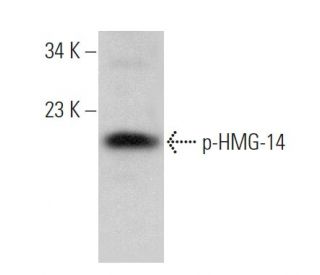

p-HMG-14 Antibody (91.Ser 21): sc-135763
- p-HMG-14 Antibody (91.Ser 21) is a mouse monoclonal IgG1 κ provided at 200 µg/ml
- raised against a short amino acid sequence containing phosphorylated Ser 21 of HMG-14 of human origin
- recommended for detection of Ser 21 phosphorylated HMG-14 of human origin, Ser 20 phosphorylated HMG-14 of mouse origin, and the corresponding rat homolog by WB, IP and ELISA
- available conjugated to agarose for IP; and to HRP for WB, IHC(P) and ELISA
- TransCruz reagent for ChIP application (sc-135763 X, 200 µg/0.1 ml)
- m-IgG Fc BP-HRP and m-IgGκ BP-HRP are the preferred secondary detection reagents for p-HMG-14 Antibody (91.Ser 21) for WB applications. These reagents are now offered in bundles with p-HMG-14 Antibody (91.Ser 21) (see ordering information below).

p-HMG-14 Antibody (91.Ser 21) is a mouse monoclonal IgG1 kappa light chain antibody that detects the Ser 21 phosphorylated HMG-14 protein of human origin, Ser 20 phosphorylated HMG-14 of mouse origin, and the corresponding rat homolog by western blotting (WB), immunoprecipitation (IP), and enzyme-linked immunosorbent assay (ELISA). anti-HMG-14 antibody (91.Ser 21) is available in both conjugated and non-conjugated forms, providing flexibility for various experimental needs. The high-mobility group (HMG) proteins, including HMG-14, play a crucial role in chromatin architecture and gene regulation. Specifically, HMG-14 interacts with linker histones and other chromatin-associated proteins, which is vital for maintaining the structural integrity of chromatin and facilitating transcriptional activation. This interaction is particularly important during embryonic development, where HMG-14 contributes to the dynamic changes in chromatin structure necessary for proper gene expression and cellular differentiation. Furthermore, HMG-14 phosphorylation at Serine 6 has been linked to the regulation of specific gene expression patterns in actively dividing cells, highlighting its significance in cellular processes such as growth and development. HMG-14 monoclonal antibody (91.Ser 21) enables researchers to gain valuable insights into the functional dynamics of chromatin and the regulatory mechanisms underlying gene expression in various biological contexts.
Alexa Fluor® is a trademark of Molecular Probes Inc., OR., USA
LI-COR® and Odyssey® are registered trademarks of LI-COR Biosciences
p-HMG-14 Antibody (91.Ser 21) References:
- High-mobility group proteins 14 and 17 maintain the timing of early embryonic development in the mouse. | Mohamed, OA., et al. 2001. Dev Biol. 229: 237-49. PMID: 11133167
- Mitotic phosphorylation prevents the binding of HMGN proteins to chromatin. | Prymakowska-Bosak, M., et al. 2001. Mol Cell Biol. 21: 5169-78. PMID: 11438671
- The HMG-14/-17 chromosomal protein family: architectural elements that enhance transcription from chromatin templates. | Bustin, M., et al. 1995. Semin Cell Biol. 6: 247-55. PMID: 8562917
- Clusters of nucleosomes containing chromosomal protein HMG-17 in chromatin. | Postnikov, YV., et al. 1997. J Mol Biol. 274: 454-65. PMID: 9417927
- Dynamic relocation of chromosomal protein HMG-17 in the nucleus is dependent on transcriptional activity. | Hock, R., et al. 1998. EMBO J. 17: 6992-7001. PMID: 9843505
- Chromosomal proteins HMG-14 and HMG-17 are released from mitotic chromosomes and imported into the nucleus by active transport. | Hock, R., et al. 1998. J Cell Biol. 143: 1427-36. PMID: 9852141
Ordering Information
| Product Name | Catalog # | UNIT | Price | Qty | FAVORITES | |
p-HMG-14 Antibody (91.Ser 21) | sc-135763 | 200 µg/ml | $322.00 | |||
p-HMG-14 Antibody (91.Ser 21): m-IgG Fc BP-HRP Bundle | sc-552979 | 200 µg Ab; 10 µg BP | $361.00 | |||
p-HMG-14 Antibody (91.Ser 21): m-IgGκ BP-HRP Bundle | sc-552978 | 200 µg Ab; 40 µg BP | $361.00 | |||
p-HMG-14 Antibody (91.Ser 21) X | sc-135763 X | 200 µg/0.1 ml | $322.00 | |||
p-HMG-14 Antibody (91.Ser 21) AC | sc-135763 AC | 500 µg/ml, 25% agarose | $424.00 | |||
p-HMG-14 Antibody (91.Ser 21) HRP | sc-135763 HRP | 200 µg/ml | $322.00 |