
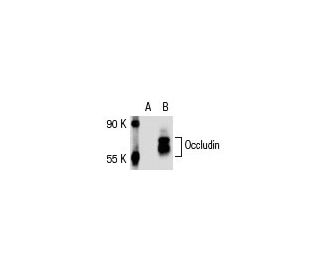
Occludin (h): 293T Lysate: sc-114467
- human Occludin transfected 293T lysate
- 100 µg protein in 200 µl SDS-PAGE buffer; suitable as Western Blotting control for Occludin antibodies
- Suitable control antibody: Occludin Antibody (E-5): sc-133256 is recommended as control antibody for monitoring of Occludin expression knockdown by Western blotting or immunofluorescence
- should be stored at -20° C and repeated freezing and thawing should be minimized
- sample vial should be boiled once prior to use
- non-transfected control 293T lysate (sc-117752)

QUICK LINKS
Occludin (h): 293T Lysate, derived from the HEK 293T cell line, is a critical resource for studying occludin, a transmembrane protein integral to tight junctions in epithelial and endothelial cells. The HEK 293T cells, a modified version of the original HEK 293 cells, express the SV40 large T antigen, enhancing their ability to produce high levels of recombinant proteins, making this lysate ideal for examining the structural and functional aspects of occludin. Researchers use Occludin (h): 293T Lysate to explore how occludin contributes to the formation and maintenance of tight junctions, which are essential for regulating paracellular permeability and maintaining cell polarity. Occludin interacts with other tight junction proteins such as claudins and zonula occludens (ZO) proteins, and these interactions are pivotal for the assembly and function of tight junctions. Techniques such as immunoprecipitation, Western blotting, and immunofluorescence microscopy are employed to study occludin's interactions, phosphorylation states, and its role in tight junction dynamics. This lysate facilitates research into the molecular mechanisms by which occludin regulates tight junction integrity and cellular barrier function. By focusing on these fundamental processes, scientists gain insights into cellular junction formation and maintenance. Research involving Occludin (h): 293T Lysate is strictly confined to basic scientific inquiry, providing a deeper understanding of cellular junction biology.
Ordering Information
| Product Name | Catalog # | UNIT | Price | Qty | FAVORITES | |
Occludin (h): 293T Lysate | sc-114467 | 100 µg/200 µl | $236.00 |