
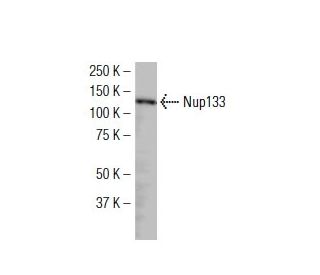


Nup133 Antibody (378.1): sc-101290
- Nup133 Antibody (378.1) is a mouse monoclonal IgG2a κ, cited in 2 publications, provided at 100 µg/ml
- raised against recombinant Nup133 of human origin
- recommended for detection of Nup133 of human origin by WB, IP, IF, IHC(P) and ELISA
- At present, we have not yet completed the identification of the preferred secondary detection reagent(s) for Nup133 Antibody (378.1). This work is in progress.

Nup133 Antibody (378.1) is a mouse monoclonal IgG2a antibody that detects Nuclear pore complex protein Nup133 in human samples through various applications including western blotting (WB), immunoprecipitation (IP), immunofluorescence (IF), immunohistochemistry, and enzyme-linked immunosorbent assay (ELISA). Nup133 plays a crucial role in the structure and function of nuclear pore complexes (NPCs), which are essential for the regulated transport of macromolecules between the nucleus and cytoplasm. Nuclear pore complex protein Nup133 is strategically located on both the cytoplasmic and nuclear sides of the nuclear pore, and Nup133 is particularly important during mitosis as Nup133 localizes to kinetochores, facilitating proper chromosome segregation. Nuclear pore complex protein Nup133 is a key component of the Nup160 nuclear pore subcomplex, which also includes Nup160, Nup96, and Nup107, and is vital for RNA export, ensuring that mRNA and other RNA molecules are efficiently transported out of the nucleus to the cytoplasm for translation. The proper functioning of Nuclear pore complex protein Nup133 and associated complexes is critical for maintaining cellular homeostasis and regulating gene expression, making Nup133 an important target for research in cellular biology and disease mechanisms.
Alexa Fluor® is a trademark of Molecular Probes Inc., OR., USA
LI-COR® and Odyssey® are registered trademarks of LI-COR Biosciences
Nup133 Antibody (378.1) References:
- Structural and functional studies of Nup107/Nup133 interaction and its implications for the architecture of the nuclear pore complex. | Boehmer, T., et al. 2008. Mol Cell. 30: 721-31. PMID: 18570875
- Gene amplification during myogenic differentiation. | Fischer, U., et al. 2016. Oncotarget. 7: 6864-77. PMID: 26760505
- Disentangling the molecular determinants for Cenp-F localization to nuclear pores and kinetochores. | Berto, A., et al. 2018. EMBO Rep. 19: PMID: 29632243
- Mutations in multiple components of the nuclear pore complex cause nephrotic syndrome. | Braun, DA., et al. 2018. J Clin Invest. 128: 4313-4328. PMID: 30179222
- Homozygous splicing mutation in NUP133 causes Galloway-Mowat syndrome. | Fujita, A., et al. 2018. Ann Neurol. 84: 814-828. PMID: 30427554
- Roles of Nup133, Nup153 and membrane fenestrations in assembly of the nuclear pore complex at the end of mitosis. | Bilir, Ş., et al. 2019. Genes Cells. 24: 338-353. PMID: 30821042
- NUP133 Controls Nuclear Pore Assembly, Transcriptome Composition, and Cytoskeleton Regulation in Podocytes. | Rogg, M., et al. 2022. Cells. 11: PMID: 35455939
- A nuclear pore complex-associated regulation of SUMOylation in meiosis. | Yang, HJ., et al. 2023. Genes Cells. 28: 188-201. PMID: 36562208
- Steroid-resistant nephrotic syndrome caused by nuclear pore gene NUP133 variation. | Wang, Q., et al. 2023. Clin Genet. 104: 272-274. PMID: 37041680
- Nucleoporin-associated steroid-resistant nephrotic syndrome. | Yao, L., et al. 2025. Pediatr Nephrol. 40: 629-649. PMID: 39331077
Ordering Information
| Product Name | Catalog # | UNIT | Price | Qty | FAVORITES | |
Nup133 Antibody (378.1) | sc-101290 | 100 µg/ml | $339.00 |