
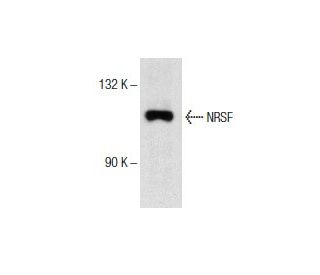
NRSF Anticuerpo (F-3): sc-374611
- NRSF Anticuerpo F-3 es un monoclonal de ratón IgG1 κ NRSF Anticuerpo, ver las 11 publicaciones, proporcionado como 200 µg/ml
- producido contra los amino ácidos 1-290 de NRSF de origen human
- NRSF Anticuerpo (F-3) es recomendado para detectar NRSF de human origen, mediante WB, IP, IF y ELISA
- NRSF Anticuerpo (F-3) es disponible conjugado a agarosa para IP; HRP para WB, IHC(P) y ELISA; y tanto a phycoerythrin como a FITC para IF, IHC(P) y FCM
- también disponible conjugado a Alexa Fluor® 488, Alexa Fluor® 546, Alexa Fluor® 594 o Alexa Fluor® 647 para WB (RGB), IF, IHC (P) y FCM
- también disponible conjugado a Alexa Fluor® 680 o Alexa Fluor® 790 para WB (NIR), IF y FCM
- TransCruz reactivo para Gel Supershift y ChIP (sc-374611 X, 200 µg/0.1 ml)
- 1 BP-HRP">m-IgG1 BP-HRP y m-IgGκ BP-HRP son los reactivos de detección secundarios preferidos para NRSF Anticuerpo (F-3) para aplicaciones WB. Estos reactivos se ofrecen ahora en paquetes con NRSF Anticuerpo (F-3)(véase la información de pedido más abajo).

ENLACES RÁPIDOS
VER TAMBIÉN ....
El anticuerpo NRSF (F-3) es un anticuerpo monoclonal de ratón IgG1 κ NRSF (también designado como anticuerpo miembro de la familia del factor de transcripción de dedo de zinc tipo Kruppel, anticuerpo de unión al elemento cis del silenciador restrictivo neuronal (NRSE/RE1), anticuerpo represor transcripcional del desarrollo embrionario y la neurogénesis, anticuerpo relacionado con la enfermedad de Alzheimer y anticuerpo regulador transcripcional del cerebro humano envejecido) que detecta la proteína NRSF de origen humano por WB, IP, IF y ELISA. El anticuerpo NRSF (F-3) está disponible tanto en forma de anticuerpo anti-NRSF no conjugado, como en múltiples formas conjugadas de anticuerpo anti-NRSF, incluyendo agarosa, HRP, PE, FITC y múltiples conjugados de Alexa Fluor®. NRSF (factor silenciador restrictivo neuronal, también designado como XBR y REST para factor de silenciamiento RE1) es una proteína silenciadora que se une al elemento de secuencia de ADN NRSE (elemento silenciador restrictivo neuronal). La unión de NRSF al NRSE reprime la transcripción génica neuronal en células no neuronales. Aunque NRSF se expresa principalmente en tejidos no neurales, también se expresa en neuronas en desarrollo y en niveles bajos en el cerebro. NRSF contiene nueve dominios de dedos de zinc, pero también existe como una forma truncada en el extremo C producida por empalme alternativo. Esta variante, REST4, contiene cinco de los dominios de dedos de zinc y se une débilmente al ADN, pero se transporta al núcleo. NRSF se asocia con mSin3 y HDAC en miocitos ventriculares, lo que sugiere un papel para NRSF fuera del sistema nervioso. La regulación a la baja de NRSF, que normalmente ocurre durante la diferenciación neuronal, es necesaria para el desarrollo adecuado de ciertas clases de neuronas. NRSF es necesario para reprimir la expresión génica neuronal in vivo, tanto en tejido extra-neural como en tejido neural indiferenciado.
Alexa Fluor® es una marca registrada de Molecular Probes Inc., OR., USA
REIVEW LI-COR® y Odyssey® son marcas registradas de LI-COR Biosciences.
NRSF Anticuerpo (F-3) Referencias:
- Represión transcripcional por REST: reclutamiento de Sin3A e histona deacetilasa a genes neuronales. | Huang, Y., et al. 1999. Nat Neurosci. 2: 867-72. PMID: 10491605
- Estudios sobre la interacción de REST4 con el elemento represor colinérgico-1/elemento silenciador restrictivo de neuronas. | Lee, JH., et al. 2000. Brain Res Mol Brain Res. 80: 88-98. PMID: 11039732
- La expresión constitutiva del factor silenciador restrictivo de neuronas (NRSF)/REST en neuronas en diferenciación interrumpe la expresión génica neuronal y causa errores en la trayectoria de los axones in vivo. | Paquette, AJ., et al. 2000. Proc Natl Acad Sci U S A. 97: 12318-23. PMID: 11050251
- Papel de los dominios zinc finger del factor de transcripción neuron-restrictive silencer factor/repressor element-1 silencing transcription factor en la unión al ADN y la localización nuclear. | Shimojo, M., et al. 2001. J Biol Chem. 276: 13121-6. PMID: 11145971
- El sistema elemento silenciador restrictivo de neuronas-factor silenciador restrictivo de neuronas regula la expresión génica del péptido natriurético auricular basal e inducible por endotelina 1 en miocitos ventriculares. | Kuwahara, K., et al. 2001. Mol Cell Biol. 21: 2085-97. PMID: 11238943
- El factor de transcripción silenciador del elemento represor/factor silenciador restrictivo de neuronas (REST/NRSF) puede actuar como potenciador y como represor de la transcripción del gen de la hormona liberadora de corticotropina. | Seth, KA. and Majzoub, JA. 2001. J Biol Chem. 276: 13917-23. PMID: 11278361
- El REST/NRSF cerebral no es sólo un represor silencioso sino también un protector activo. | Zhao, Y., et al. 2017. Mol Neurobiol. 54: 541-550. PMID: 26742529
- El NRSF y sus efectores epigenéticos: Nuevos tratamientos para las enfermedades neurológicas. | Thompson, R. and Chan, C. 2018. Brain Sci. 8: PMID: 30572571
- REST/NRSF impulsa la plasticidad homeostática de las sinapsis inhibitorias de forma dependiente de la diana. | Prestigio, C., et al. 2021. Elife. 10: PMID: 34855580
- El análisis de la red de factores de transcripción identifica a REST/NRSF como un regulador intrínseco de la regeneración del SNC en ratones. | Cheng, Y., et al. 2022. Nat Commun. 13: 4418. PMID: 35906210
- El factor silenciador restrictivo de neuronas (NRSF): un represor coordinado de múltiples genes específicos de neuronas. | Schoenherr, CJ. and Anderson, DJ. 1995. Science. 267: 1360-3. PMID: 7871435
- NRSF/REST es necesario in vivo para la represión de múltiples genes diana neuronales durante la embriogénesis. | Chen, ZF., et al. 1998. Nat Genet. 20: 136-42. PMID: 9771705
Información sobre pedidos
| Nombre del producto | Número de catálogo | UNIDAD | Precio | CANTIDAD | Favoritos | |
NRSF Anticuerpo (F-3) | sc-374611 | 200 µg/ml | $322.00 | |||
Paquete de NRSF (F-3): m-IgGκ BP-HRP | sc-522789 | 200 µg Ab, 40 µg BP | $361.00 | |||
Paquete de NRSF (F-3): m-IgG1 BP-HRP | sc-533526 | 200 µg Ab; 20 µg BP | $361.00 | |||
NRSF Anticuerpo (F-3) X | sc-374611 X | 200 µg/0.1 ml | $322.00 | |||
NRSF Anticuerpo (F-3) AC | sc-374611 AC | 500 µg/ml, 25% agarose | $424.00 | |||
NRSF Anticuerpo (F-3) HRP | sc-374611 HRP | 200 µg/ml | $322.00 | |||
NRSF Anticuerpo (F-3) FITC | sc-374611 FITC | 200 µg/ml | $336.00 | |||
NRSF Anticuerpo (F-3) PE | sc-374611 PE | 200 µg/ml | $349.00 | |||
NRSF Anticuerpo (F-3) Alexa Fluor® 488 | sc-374611 AF488 | 200 µg/ml | $364.00 | |||
NRSF Anticuerpo (F-3) Alexa Fluor® 546 | sc-374611 AF546 | 200 µg/ml | $364.00 | |||
NRSF Anticuerpo (F-3) Alexa Fluor® 594 | sc-374611 AF594 | 200 µg/ml | $364.00 | |||
NRSF Anticuerpo (F-3) Alexa Fluor® 647 | sc-374611 AF647 | 200 µg/ml | $364.00 | |||
NRSF Anticuerpo (F-3) Alexa Fluor® 680 | sc-374611 AF680 | 200 µg/ml | $364.00 | |||
NRSF Anticuerpo (F-3) Alexa Fluor® 790 | sc-374611 AF790 | 200 µg/ml | $364.00 |