
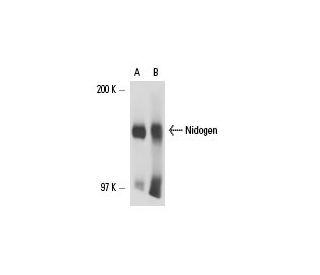


Nidogen Antibody (2Q584): sc-71699
- Nidogen Antibody (2Q584) is a rat monoclonal IgG2a provided at 200 µg/ml
- raised against recombinant Nidogen of mouse origin
- recommended for detection of native and denatured Nidogen of mouse, rat and human origin by WB and IP
- At present, we have not yet completed the identification of the preferred secondary detection reagent(s) for Nidogen Antibody (2Q584). This work is in progress.

QUICK LINKS
Nidogen Antibody (2Q584) is a rat monoclonal IgG2a antibody that detects Nidogen in mouse, rat, and human samples through applications such as western blotting (WB) and immunoprecipitation (IP). Nidogen, a crucial component of basement membranes, plays a significant role in structural integrity and function of extracellular matrices during embryogenesis. Anti-Nidogen antibody (2Q584) serves as a vital link between various matrix molecules, including Laminin 1 and Collagen Type IV, facilitating basement membrane assembly essential for tissue organization and cellular signaling. Nidogen′s importance extends beyond structural support; Nidogen regulates cellular adhesion and communication, particularly in mesenchymal peritubular and myoepithelial cells, influencing cell behavior in an autocrine manner. Additionally, Nidogen is characterized by high level N- and O-glycosylation, critical for interactions with other extracellular matrix components, such as Collagens Type I and IV and Perlecan. This glycosylation enhances stability and functionality of Nidogen and underscores evolutionary conservation within the Nidogen family, which includes Nidogen-2. Nidogen expression during embryonic and fetal development is restricted to fully developed basement membranes of the ectoderm, highlighting a specialized role in tissue development and maintenance. With multifaceted functions and critical interactions, Nidogen is indispensable for proper formation and function of basement membranes, making Nidogen (2Q584) antibody an essential tool for researchers studying extracellular matrix dynamics and cellular interactions.
Alexa Fluor® is a trademark of Molecular Probes Inc., OR., USA
LI-COR® and Odyssey® are registered trademarks of LI-COR Biosciences
Nidogen Antibody (2Q584) References:
- Differential regulation of the human nidogen gene promoter region by a novel cell-type-specific silencer element. | Zedlacher, M., et al. 1999. Biochem J. 338 (Pt 2): 343-50. PMID: 10024509
- Recombinant domain IV of perlecan binds to nidogens, laminin-nidogen complex, fibronectin, fibulin-2 and heparin. | Hopf, M., et al. 1999. Eur J Biochem. 259: 917-25. PMID: 10092882
- Ultrastructural triple localization of laminin-1, nidogen-1, and collagen type IV helps elucidate basement membrane structure in vivo. | Miosge, N., et al. 1999. Anat Rec. 254: 382-8. PMID: 10096670
- Neurologic defects and selective disruption of basement membranes in mice lacking entactin-1/nidogen-1. | Dong, L., et al. 2002. Lab Invest. 82: 1617-30. PMID: 12480912
- Identification of Gln726 in nidogen as the amine acceptor in transglutaminase-catalyzed cross-linking of laminin-nidogen complexes. | Aeschlimann, D., et al. 1992. J Biol Chem. 267: 11316-21. PMID: 1350783
- Laminin gamma3 chain binds to nidogen and is located in murine basement membranes. | Gersdorff, N., et al. 2005. J Biol Chem. 280: 22146-53. PMID: 15824114
- Cross-linking of laminin-nidogen complexes by tissue transglutaminase. A novel mechanism for basement membrane stabilization. | Aeschlimann, D. and Paulsson, M. 1991. J Biol Chem. 266: 15308-17. PMID: 1678389
- Basement membranes in skin are differently affected by lack of nidogen 1 and 2. | Mokkapati, S., et al. 2008. J Invest Dermatol. 128: 2259-67. PMID: 18356808
- Structural characterization of two variants of fibulin-1 that differ in nidogen affinity. | Sasaki, T., et al. 1995. J Mol Biol. 245: 241-50. PMID: 7844816
- Differential regulation of fibulin, tenascin-C, and nidogen expression during wound healing of normal and glucocorticoid-treated mice. | Fässler, R., et al. 1996. Exp Cell Res. 222: 111-6. PMID: 8549652
Ordering Information
| Product Name | Catalog # | UNIT | Price | Qty | FAVORITES | |
Nidogen Antibody (2Q584) | sc-71699 | 200 µg/ml | $322.00 |