
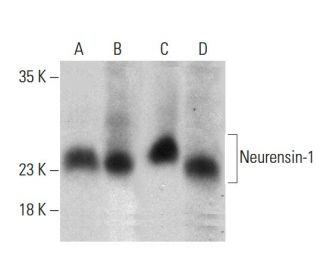
Neurensin-1 Antibody (22): sc-136360
- Neurensin-1 Antibody (22) is a mouse monoclonal IgG1 κ Neurensin-1 antibody provided at 200 µg/ml
- raised against amino acids 93-196 of Neurensin-1 of mouse origin
- recommended for detection of Neurensin-1 of mouse, rat and human origin by WB, IP and IF
- available conjugated to agarose for IP; and to HRP for WB, IHC(P) and ELISA
- m-IgG1 BP-HRP is the preferred secondary detection reagent for Neurensin-1 Antibody (22) for WB applications. This reagent is now offered in a bundle with Neurensin-1 Antibody (22) (see ordering information below).

QUICK LINKS
Neurensin-1 Antibody (22) is a mouse monoclonal IgG1 kappa light chain antibody that detects Neurensin-1 protein in mouse, rat, and human samples through western blotting (WB), immunoprecipitation (IP), and immunofluorescence (IF). Anti-Neurensin-1 antibody (22) is available in non-conjugated forms and conjugated to agarose and horseradish peroxidase (HRP). Neurensin-1 (NRSN1), also known as Vesicular membrane protein of 24 kDa (VMP) or Neuro-p24, is a 195 amino acid multi-pass membrane protein that helps transport neural organelles and transduce nerve signals, essential for neuronal function and communication. NRSN1 shows exclusive expression in brain tissue, where anti-NRSN1 antibody (22) reveals its role in facilitating neurite extension, a process crucial for neuronal development and regeneration. Located on human chromosome 6, a region containing approximately 1,200 genes, NRSN1 shares genomic space with genes linked to early onset intestinal cancer and various genetic disorders. Research using Neurensin-1 monoclonal antibody (22) continues to advance understanding of neural transport and signaling, while exploring potential connections to neurodegenerative diseases and neurological disorders.
Alexa Fluor® is a trademark of Molecular Probes Inc., OR., USA
LI-COR® and Odyssey® are registered trademarks of LI-COR Biosciences
Neurensin-1 Antibody (22) References:
- The DNA sequence and analysis of human chromosome 6. | Mungall, AJ., et al. 2003. Nature. 425: 805-11. PMID: 14574404
- A stop codon mutation in COL11A2 induces exon skipping and leads to non-ocular Stickler syndrome. | Vuoristo, MM., et al. 2004. Am J Med Genet A. 130A: 160-4. PMID: 15372529
- Combined analysis from eleven linkage studies of bipolar disorder provides strong evidence of susceptibility loci on chromosomes 6q and 8q. | McQueen, MB., et al. 2005. Am J Hum Genet. 77: 582-95. PMID: 16175504
- Molecular characterization of a transport vesicle protein Neurensin-2, a homologue of Neurensin-1, expressed in neural cells. | Nakanishi, K., et al. 2006. Brain Res. 1081: 1-8. PMID: 16527258
- Neurensin-1 expression in the mouse retina during postnatal development and in the cultured retinal neurons. | Nagata, K., et al. 2006. Brain Res. 1081: 65-71. PMID: 16696124
- Modulation of parkin gene expression in noradrenergic neuronal cells. | Park, E., et al. 2007. Int J Dev Neurosci. 25: 491-7. PMID: 17976945
- Recurrent deletions at 6q in early age of onset non-HNPCC- and non-FAP-associated intestinal carcinomas. Evidence for a novel cancer susceptibility locus at 6q14-q22. | Bläker, H., et al. 2008. Genes Chromosomes Cancer. 47: 159-64. PMID: 18008368
Ordering Information
| Product Name | Catalog # | UNIT | Price | Qty | FAVORITES | |
Neurensin-1 Antibody (22) | sc-136360 | 200 µg/ml | $322.00 | |||
Neurensin-1 Antibody (22): m-IgG1 BP-HRP Bundle | sc-531666 | 200 µg Ab; 20 µg BP | $361.00 | |||
Neurensin-1 Antibody (22) AC | sc-136360 AC | 500 µg/ml, 25% agarose | $424.00 | |||
Neurensin-1 Antibody (22) HRP | sc-136360 HRP | 200 µg/ml | $322.00 |