
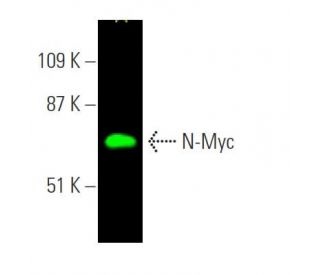
N-Myc Antikörper (B8.4.B): sc-53993
- N-Myc Antikörper B8.4.B ist ein Maus monoklonales IgG2a κ N-Myc Antikörper, verwendet in 209 wissenschaftlichen Veröffentlichungen, in einer Menge von 200 µg/ml
- gegen N-terminal rekombinantes N-Myc von human Ursprung
- N-Myc Antikörper (B8.4.B) ist empfohlen für die Detektion von N-Myc aus der Spezies mouse, rat und human per WB und IP
- Anti-N-Myc Antikörper (B8.4.B) ist erhältlich als Konjugat mit Agarose für IP; HRP für WB, IHC(P) und ELISA; und entweder mit Phycoerythrin oder FITC für IF, IHC(P) und FCM
- auch erhältlich als Konjugat mit Alexa Fluor® 488, Alexa Fluor® 546, Alexa Fluor® 594 oder Alexa Fluor® 647 für IF, IHC(P) und FCM
- auch erhältlich als Konjugat mit Alexa Fluor® 680 oder Alexa Fluor® 790 für WB (NIR), IF und FCM
- m-IgG Fc BP-HRP, 2a BP-HRP">m-IgG2a BP-HRP und m-IgGκ BP-HRP sind die bevorzugten sekundären Nachweisreagenzien für N-Myc Antikörper (B8.4.B) für WB-Anwendungen. Diese Reagenzien werden jetzt in Bündeln mit N-Myc Antikörper (B8.4.B) angeboten(siehe Bestellinformationen unten).

Der N-Myc-Antikörper (B8.4.B) ist ein monoklonaler IgG2a-Kappa-Leichtketten-Antikörper der Maus, der das N-Myc-Protein von Mäusen, Ratten und Menschen durch Western Blot (WB) und Immunopräzipitation (IP) nachweist. Der Anti-N-Myc-Antikörper (B8.4.B) ist sowohl in nicht konjugierter als auch in verschiedenen konjugierten Formen erhältlich, darunter Agarose, Meerrettichperoxidase (HRP), Phycoerythrin (PE), Fluoresceinisothiocyanat (FITC) und mehrere Alexa Fluor®-Konjugate, wodurch er für verschiedene experimentelle Anforderungen vielseitig einsetzbar ist. Das N-Myc-Protein, ein Mitglied der Myc-Familie von Transkriptionsfaktoren, spielt eine entscheidende Rolle bei der Zellproliferation, -differenzierung und -apoptose, was N-Myc zu einem bedeutenden Akteur in der Onkogenese macht. Eine Fehlregulation von N-Myc, insbesondere durch Genamplifikation, wird häufig mit aggressiven Formen des Neuroblastoms in Verbindung gebracht, bei denen die N-Myc-Expressionsniveaus mit dem Krankheitsverlauf und der Prognose der Patienten korrelieren. Das N-Myc-Protein befindet sich hauptsächlich im Zellkern, wo N-Myc als Transkriptionsregulator fungiert und an spezifische DNA-Sequenzen bindet, um die Expression von Zielgenen zu modulieren, die an der Steuerung des Zellzyklus und am Wachstum beteiligt sind. Das Verständnis der Lokalisierung und Funktion von N-Myc ist für die Entwicklung gezielter Therapien zur Hemmung der N-Myc-Aktivität in Krebszellen von entscheidender Bedeutung und bietet somit potenzielle Behandlungsmöglichkeiten bei N-Myc-bedingten bösartigen Tumoren.
Alexa Fluor® ist ein Markenzeichen von Molecular Probes Inc., OR., USA
LI-COR® und Odyssey® sind Markenzeichen von LI-COR Biosciences
N-Myc Antikörper (B8.4.B) Literaturhinweise:
- MAZ, ein Zinkfingerprotein, bindet an c-MYC- und C2-Gensequenzen, die die Transkriptionsinitiierung und -terminierung regulieren. | Bossone, SA., et al. 1992. Proc Natl Acad Sci U S A. 89: 7452-6. PMID: 1502157
- Die Rolle der Kinasen der Src-Familie und N-Myc bei der Proliferation von Spermatogonien. | Braydich-Stolle, L., et al. 2007. Dev Biol. 304: 34-45. PMID: 17222400
- N-MYC reguliert die Expression der fokalen Adhäsionskinase im menschlichen Neuroblastom. | Beierle, EA., et al. 2007. J Biol Chem. 282: 12503-16. PMID: 17327229
- Die Assoziation von Myn, dem murinen Homolog von max, mit c-Myc stimuliert die methylierungssensitive DNA-Bindung und die ras-Kotransformation. | Prendergast, GC., et al. 1991. Cell. 65: 395-407. PMID: 1840505
- Max: ein Helix-Loop-Helix-Zipper-Protein, das einen sequenzspezifischen DNA-Bindungskomplex mit Myc bildet. | Blackwood, EM. and Eisenman, RN. 1991. Science. 251: 1211-7. PMID: 2006410
- Das Myc-Onkogen: seine Rolle bei Transformation und Differenzierung. | Cole, MD. 1986. Annu Rev Genet. 20: 361-84. PMID: 3028245
- N-Myc-induzierte metabolische Umstrukturierung schafft neue therapeutische Schwachstellen bei Neuroblastomen. | Tjaden, B., et al. 2020. Sci Rep. 10: 7157. PMID: 32346009
- N-Myc induziert die Tumorprogression von Prostatakrebs durch Regulierung von FSCN1. | He, G., et al. 2020. Oncol Rep. 44: 2265-2274. PMID: 33000273
- PHA-680626 ist ein wirksamer Inhibitor der Interaktion zwischen Aurora-A und N-Myc. | Boi, D., et al. 2021. Int J Mol Sci. 22: PMID: 34884931
- N-Myc und STAT Interactor ist ein Endometriose-Suppressor. | Park, Y., et al. 2024. Int J Mol Sci. 25: PMID: 39125716
- Die Amplifikation von N-myc in unbehandelten menschlichen Neuroblastomen korreliert mit einem fortgeschrittenen Krankheitsstadium. | Brodeur, GM., et al. 1984. Science. 224: 1121-4. PMID: 6719137
- Amplifizierte DNA mit begrenzter Homologie zum zellulären Onkogen myc wird von menschlichen Neuroblastom-Zelllinien und einem Neuroblastom-Tumor verwendet. | Schwab, M., et al. Nature. 305: 245-8. PMID: 6888561
Bestellinformation
| Produkt | Katalog # | EINHEIT | Preis | ANZAHL | Favoriten | |
N-Myc Antikörper (B8.4.B) | sc-53993 | 200 µg/ml | $322.00 | |||
N-Myc (B8.4.B): m-IgG Fc BP-HRP Bundle | sc-528591 | 200 µg Ab; 10 µg BP | $361.00 | |||
N-Myc (B8.4.B): m-IgGκ BP-HRP Bundle | sc-521004 | 200 µg Ab, 40 µg BP | $361.00 | |||
N-Myc (B8.4.B): m-IgG2a BP-HRP Bundle | sc-547126 | 200 µg Ab; 10 µg BP | $361.00 | |||
N-Myc Antikörper (B8.4.B) AC | sc-53993 AC | 500 µg/ml, 25% agarose | $424.00 | |||
N-Myc Antikörper (B8.4.B) HRP | sc-53993 HRP | 200 µg/ml | $322.00 | |||
N-Myc Antikörper (B8.4.B) FITC | sc-53993 FITC | 200 µg/ml | $336.00 | |||
N-Myc Antikörper (B8.4.B) PE | sc-53993 PE | 200 µg/ml | $349.00 | |||
N-Myc Antikörper (B8.4.B) Alexa Fluor® 488 | sc-53993 AF488 | 200 µg/ml | $364.00 | |||
N-Myc Antikörper (B8.4.B) Alexa Fluor® 546 | sc-53993 AF546 | 200 µg/ml | $364.00 | |||
N-Myc Antikörper (B8.4.B) Alexa Fluor® 594 | sc-53993 AF594 | 200 µg/ml | $364.00 | |||
N-Myc Antikörper (B8.4.B) Alexa Fluor® 647 | sc-53993 AF647 | 200 µg/ml | $364.00 | |||
N-Myc Antikörper (B8.4.B) Alexa Fluor® 680 | sc-53993 AF680 | 200 µg/ml | $364.00 | |||
N-Myc Antikörper (B8.4.B) Alexa Fluor® 790 | sc-53993 AF790 | 200 µg/ml | $364.00 |