
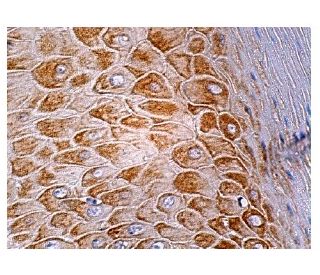


MiRP1 Anticorpo (H-4): sc-374667
- MiRP1 Anticorpo H-4é um anticorpo monoclonal produzido em camundongo IgG2a (kappa light chain) MiRP1 anticorpo fornecido em 200 µg/ml
- produzido contra aminoácidos 1-70 mapeamento no N-terminus de MiRP1 of human origem
- MiRP1 Anticorpo (H-4) é recomendado para a detecção de MiRP1 of human origin by WB, IP, IF, IHC(P) and ELISA
- Anticorpo anti-MiRP1 O anticorpo anti-MiRP1 (H-4) está disponível conjugado com agarose para IP; HRP para WB, IHC(P) e ELISA; e com fioeritrina ou FITC para IF, IHC(P) e FCM
- também disponível conjugado com Alexa Fluor® 488, Alexa Fluor® 546, Alexa Fluor® 594 ou Alexa Fluor® 647 para WB (RGB), IF, IHC(P) e FCM, e para utilização com sistemas de imagiologia fluorescente RGB, tais como iBright™ FL1000, FluorChem™, Typhoon, Azure e outros sistemas comparáveis
- também disponível conjugado com Alexa Fluor® 680 ou Alexa Fluor® 790 para WB (NIR), IF e FCM; para utilização com sistemas de deteção de infravermelhos próximos (NIR), tais como LI-COR®Odyssey®, iBright™ FL1000, FluorChem™, Typhoon, Azure e outros sistemas comparáveis
- m-IgG Fc BP-HRP e 2a BP-HRP">m-IgG2a BP-HRP são os reagentes de deteção secundários preferidos para MiRP1 Antibody (H-4) para aplicações WB e IHC(P). Estes reagentes são agora oferecidos em conjuntos com MiRP1 Antibody (H-4)(ver informações de encomenda abaixo).

LINKS RÁPIDOS
VEJA TAMBÉM
O anticorpo MiRP1 (H-4) é um anticorpo monoclonal de cadeia leve IgG2a kappa de camundongo que detecta o MiRP1 de origem humana por western blotting (WB), imunoprecipitação (IP), imunofluorescência (IF), imunohistoquímica com secções incluídas em parafina (IHCP) e ensaio de imunoabsorção enzimática (ELISA). O anticorpo MiRP1 (H-4) está disponível em formas não conjugadas e em várias formas conjugadas, incluindo agarose, peroxidase de rábano (HRP), ficoeritrina (PE), isotiocianato de fluoresceína (FITC) e vários conjugados Alexa Fluor®. O MiRP1, também conhecido como KCNE2, desempenha um papel crucial na regulação da excitabilidade cardíaca e neuronal através da modulação dos canais de potássio dependentes da voltagem. O MiRP1 interage com o canal HERG, essencial para a repolarização cardíaca, e a sua função adequada é vital para manter o ritmo cardíaco normal. Alterações no MiRP1 podem levar à síndrome congénita do QT longo, uma condição que eleva o risco de arritmias potencialmente fatais. O MiRP1 também modula os canais KCNQ2 no cérebro, influenciando a sinalização e a excitabilidade neuronais. O gene humano MiRP1 está localizado no cromossoma 21q22.12 e a sua expressão é crítica para a saúde cardíaca e neuronal, o que faz do MiRP1 um alvo importante para a investigação de arritmias cardíacas e doenças neurológicas.
Alexa Fluor® é uma marca comercial da Molecular Probes Inc., OR., EUA
LI-COR® e Odyssey® são marcas registadas da LI-COR Biosciences
Referencias do MiRP1 Anticorpo (H-4):
- A MiRP1 forma canais de potássio IKr com HERG e está associada a arritmia cardíaca. | Abbott, GW., et al. 1999. Cell. 97: 175-87. PMID: 10219239
- Um canal de potássio constitutivamente aberto formado por KCNQ1 e KCNE3. | Schroeder, BC., et al. 2000. Nature. 403: 196-9. PMID: 10646604
- Um polimorfismo comum associado à arritmia cardíaca induzida por antibióticos. | Sesti, F., et al. 2000. Proc Natl Acad Sci U S A. 97: 10613-8. PMID: 10984545
- Os canais de potássio KCNQ2-KCNQ3 do tipo M são modulados pela subunidade KCNE2. | Tinel, N., et al. 2000. FEBS Lett. 480: 137-41. PMID: 11034315
- A subunidade KCNE2 confere características de corrente de fundo ao canal de potássio cardíaco KCNQ1. | Tinel, N., et al. 2000. EMBO J. 19: 6326-30. PMID: 11101505
- O canal de K+ cardíaco KCNQ1 é essencial para a secreção de ácido gástrico. | Grahammer, F., et al. 2001. Gastroenterology. 120: 1363-71. PMID: 11313306
- Clonagem de uma proteína de membrana que induz uma corrente lenta de potássio com controlo de voltagem. | Takumi, T., et al. 1988. Science. 242: 1042-5. PMID: 3194754
- Clonagem posicional de um novo gene de canal de potássio: Mutações no gene KVLQT1 causam arritmias cardíacas. | Wang, Q., et al. 1996. Nat Genet. 12: 17-23. PMID: 8528244
Informacoes sobre ordens
| Nome do Produto | Numero de Catalogo | UNID | Preco | Qde | FAVORITOS | |
MiRP1 Anticorpo (H-4) | sc-374667 | 200 µg/ml | $322.00 | |||
Pacote do MiRP1 (H-4): m-IgG Fc BP-HRP | sc-525986 | 200 µg Ab; 10 µg BP | $361.00 | |||
Pacote do MiRP1 (H-4): m-IgG2a BP-HRP | sc-552254 | 200 µg Ab; 10 µg BP | $361.00 | |||
MiRP1 Anticorpo (H-4) AC | sc-374667 AC | 500 µg/ml, 25% agarose | $424.00 | |||
MiRP1 Anticorpo (H-4) HRP | sc-374667 HRP | 200 µg/ml | $322.00 | |||
MiRP1 Anticorpo (H-4) FITC | sc-374667 FITC | 200 µg/ml | $336.00 | |||
MiRP1 Anticorpo (H-4) PE | sc-374667 PE | 200 µg/ml | $349.00 | |||
MiRP1 Anticorpo (H-4) Alexa Fluor® 488 | sc-374667 AF488 | 200 µg/ml | $364.00 | |||
MiRP1 Anticorpo (H-4) Alexa Fluor® 546 | sc-374667 AF546 | 200 µg/ml | $364.00 | |||
MiRP1 Anticorpo (H-4) Alexa Fluor® 594 | sc-374667 AF594 | 200 µg/ml | $364.00 | |||
MiRP1 Anticorpo (H-4) Alexa Fluor® 647 | sc-374667 AF647 | 200 µg/ml | $364.00 | |||
MiRP1 Anticorpo (H-4) Alexa Fluor® 680 | sc-374667 AF680 | 200 µg/ml | $364.00 | |||
MiRP1 Anticorpo (H-4) Alexa Fluor® 790 | sc-374667 AF790 | 200 µg/ml | $364.00 |