
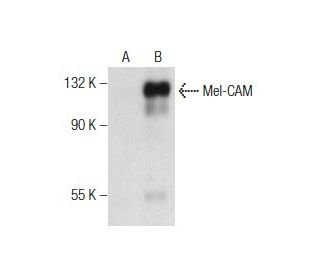
Mel-CAM Antibody (B-10): sc-376762
- Mel-CAM Antibody (B-10) is a mouse monoclonal IgG1 κ, cited in 1 publications, provided at 200 µg/ml
- specific for an epitope mapping between amino acids 611-639 at the C-terminus of Mel-CAM of human origin
- recommended for detection of Mel-CAM of mouse, rat and human origin by WB, IP, IF and ELISA; also reactive with additional species, including and canine and bovine; may cross-react with COL16A1 of mouse and rat origin
- See Mel-CAM (P1H12): sc-18837 for Mel-CAM antibody conjugates, including AC, HRP, FITC, PE, Alexa Fluor® 488, 594, 647, 680 and 790.
- m-IgG Fc BP-HRP and m-IgG1 BP-HRP are the preferred secondary detection reagents for Mel-CAM Antibody (B-10) for WB applications. These reagents are now offered in bundles with Mel-CAM Antibody (B-10) (see ordering information below).

QUICK LINKS
SEE ALSO...
Mel-CAM Antibody (B-10) is a mouse monoclonal IgG1 antibody that detects Mel-CAM in mouse, rat, and human samples through applications such as western blotting (WB), immunoprecipitation (IP), immunofluorescence (IF), and enzyme-linked immunosorbent assay (ELISA). Mel-CAM, also known as MCAM, MUC18, or CD146, is a transmembrane glycoprotein encoded by the human Mel-CAM gene, which plays a crucial role in cell adhesion and is a member of the immunoglobulin superfamily. This protein consists of 603 amino acids, featuring a signal peptide, five immunoglobulin-like domains, a transmembrane region, and a short cytoplasmic tail, which are essential for its function. Mel-CAM is predominantly expressed in advanced primary and metastatic melanomas, as well as in neuroectodermal lineage cell lines, but is absent in normal melanocytes. Notably, Mel-CAM is present in approximately 80% of advanced primary human melanomas and is closely associated with the progression of metastatic disease. The activation of Mel-CAM triggers an outside-in signaling pathway involving protein tyrosine kinases such as Fyn, focal adhesion kinase (FAK), and paxillin, which are vital for regulating the dynamics of actin cytoskeleton rearrangement. This process is not only important for tumor progression but also plays a significant role in maintaining thymic architecture and function, highlighting the relevance of Mel-CAM in both cancer biology and immune system integrity.
Alexa Fluor® is a trademark of Molecular Probes Inc., OR., USA
LI-COR® and Odyssey® are registered trademarks of LI-COR Biosciences
Mel-CAM Antibody (B-10) References:
- Mel-CAM (CD146) expression in parotid mucoepidermoid carcinoma. | Pires, FR., et al. 2003. Oral Oncol. 39: 277-81. PMID: 12618200
- Stratification of patients by melanoma cell adhesion molecule (MCAM) expression on the basis of risk: implications for sentinel lymph node biopsy. | Pearl, RA., et al. 2008. J Plast Reconstr Aesthet Surg. 61: 265-71. PMID: 17569608
- Secretion of interleukin-17 by CD8+ T cells expressing CD146 (MCAM). | Dagur, PK., et al. 2014. Clin Immunol. 152: 36-47. PMID: 24681356
- Laminins 411 and 421 differentially promote tumor cell migration via α6β1 integrin and MCAM (CD146). | Ishikawa, T., et al. 2014. Matrix Biol. 38: 69-83. PMID: 24951930
- The multifaceted role of CD146/MCAM in the promotion of melanoma progression. | Lei, X., et al. 2015. Cancer Cell Int. 15: 3. PMID: 25685061
- Incorrect Analysis of MCAM Gene Promoter Methylation in Prostate Cancer. | Kocemba, KA., et al. 2016. Prostate. 76: 1464-5. PMID: 27418327
- MCAM/CD146 promotes tamoxifen resistance in breast cancer cells through induction of epithelial-mesenchymal transition, decreased ERα expression and AKT activation. | Liang, YK., et al. 2017. Cancer Lett. 386: 65-76. PMID: 27838413
- KDM3A/Ets1/MCAM axis promotes growth and metastatic properties in Rhabdomyosarcoma. | Sobral, LM., et al. 2020. Genes Cancer. 11: 53-65. PMID: 32577157
- Expression of MCAM/MUC18 by human melanoma cells leads to increased tumor growth and metastasis. | Xie, S., et al. 1997. Cancer Res. 57: 2295-303. PMID: 9187135
- Loss of AP-2 results in up-regulation of MCAM/MUC18 and an increase in tumor growth and metastasis of human melanoma cells. | Jean, D., et al. 1998. J Biol Chem. 273: 16501-8. PMID: 9632718
Ordering Information
| Product Name | Catalog # | UNIT | Price | Qty | FAVORITES | |
Mel-CAM Antibody (B-10) | sc-376762 | 200 µg/ml | $322.00 | |||
Mel-CAM Antibody (B-10): m-IgG Fc BP-HRP Bundle | sc-540639 | 200 µg Ab; 10 µg BP | $361.00 | |||
Mel-CAM Antibody (B-10): m-IgG1 BP-HRP Bundle | sc-542261 | 200 µg Ab; 20 µg BP | $361.00 | |||
Mel-CAM (B-10) Neutralizing Peptide | sc-376762 P | 100 µg/0.5 ml | $69.00 |