
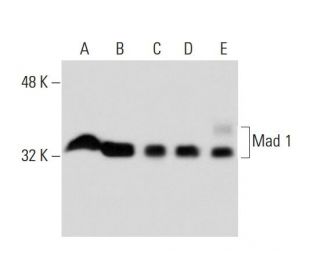
Mad 1 抗体 (F-1): sc-8012. A-431 (A), C32 (B), HeLa (C), MCF7 (D) 核抽出液および HT-1080 全細胞溶解液 (E) における Mad 1 発現のウエスタンブロット解析.
Mad 1抗体(F-1): sc-8012
- Mad 1抗体 (F-1)はマウスモノクローナルIgG1 λ Mad 1 抗体 です。200 µg/mlで提供
- human由来の全長Mad 1を表するアミノ酸1-221に対応
- Mad 1抗体 (F-1) mouse, rat と human 由来のMad 1 WB, IP, IF と ELISAでの検出にはお勧めします
- 抗 Mad 1 抗体 (F-1) は、IP 用には アガロース、WB、IHC(P)、ELISA 用には HRP、IF、IHC(P)、FCM 用には フィコエリスリン または FITC にそれぞれ結合したものが利用可能
- WB (RGB)、IF、IHC(P)、FCM、iBright™ FL1000、FluorChem™、Typhoon、Azureと他の同等システムでRGB蛍光イメージングシステム用のAlexa Fluor® 488、Alexa Fluor® 546、Alexa Fluor® 594 または Alexa Fluor® 647、に共役での利用可能です。
- WB (NIR)、IF、FCMとLI-COR®/Odyssey®、iBright™ FL1000、FluorChem™、Typhoon、Azureと他の同等システムで近赤外(NIR)検出法用のAlexa Fluor® 680 または Alexa Fluor® 790、に共役での利用可能です。
- ゲルスーパーシフトとChIPアプリケーション用のTransCruz試薬 (sc-8012 X、 200 µg/0.1 ml)
- m-IgG Fc BP-HRPおよび m-IgG1 BP-HRPは、Mad 1 Antibody (F-1) for WB applications. の二次検出試薬として推奨されています。これらの試薬は現在、Mad 1 Antibody (F-1) とバンドルして提供されています(下記の注文情報を参照)。

Mad 1 抗体 (F-1) は、マウス、ラット、ヒト由来の Mad 1 タンパク質をウェスタンブロッティング (WB)、免疫沈降 (IP)、免疫蛍光 (IF)、および酵素免疫測定法 (ELISA) で検出するマウスモノクローナル IgG1 抗体です。Mad 1 (F-1) 抗体は非結合型と、アガロース、西洋ワサビペルオキシダーゼ (HRP)、フィコエリトリン (PE)、フルオレセインイソチオシアネート (FITC)、および複数の Alexa Fluor® 結合体を含む各種結合体型の両方でご利用いただけます。Mad 1タンパク質は、特に細胞分化と増殖において、転写抑制因子として遺伝子発現の調節に重要な役割を果たしています。 Mad 1タンパク質は、Myc-Maxヘテロ二量体の活性を阻害するMaxとヘテロ二量体を形成することで機能し、それによって細胞増殖と分裂を促進する遺伝子を抑制します。 Mad 1タンパク質の調節メカニズムは、細胞の恒常性を維持し、腫瘍形成につながる制御不能な細胞増殖を防ぐために不可欠です。高度に制御されているMycタンパク質とは対照的に、Mad 1タンパク質は安定性が高いため、さまざまな細胞シグナルに応答して遺伝子発現を効果的に調節することができます。Mad 1タンパク質の動態と他のタンパク質との相互作用を理解することは、細胞の挙動を支配する複雑なネットワークを解明し、これらの経路を標的とした潜在的な治療戦略を開発するために不可欠です。
試験・研究用以外には使用しないでください。 臨床及び体外診断には使用できません。
Alexa Fluor® はMolecular Probes Inc., OR., USAの商標です。
LI-COR® and Odyssey® はLI-COR Biosciencesの登録商標です。
Mad 1抗体(F-1) 参考文献:
- Mycファミリーのオンコプロテインは共通の経路で機能し, 培養中の正常細胞を形質転換する。 | Mukherjee, B., et al. 1992. Genes Dev. 6: 1480-92. PMID: 1644290
- maxのマウスホモログであるMynとc-Mycとの会合は, メチル化感受性DNA結合とrasの共形成を刺激する。 | Prendergast, GC., et al. 1991. Cell. 65: 395-407. PMID: 1840505
- 細胞内ロイシンジッパー相互作用はc-Mycのヘテロオリゴマー化を示唆している。 | Dang, CV., et al. 1991. Mol Cell Biol. 11: 954-62. PMID: 1990293
- Max: Mycと配列特異的DNA結合複合体を形成するヘリックス-ループ-ヘリックスジッパータンパク質。 | Blackwood, EM. and Eisenman, RN. 1991. Science. 251: 1211-7. PMID: 2006410
- 二量体化による転写調節:近親相姦的関係の二つの側面。 | Jones, N. 1990. Cell. 61: 9-11. PMID: 2180585
- Bub1-Mad1相互作用は、紡錘体チェックポイントを開始するために、接着していない動原体にMad1-Mad2複合体を標的とする。 | Poloni, A., et al. 2013. Leuk Res. 37: 1538-44. PMID: 24095110
- H19の過剰発現は、大腸がん細胞においてmiR-675-5pを介してVDRを標的とし、1,25(OH)2D3に対する耐性を誘導する。 | Moyle, MW., et al. 2014. J Cell Biol. 204: 647-57. PMID: 24567362
- フィブリン-1は歯の連続した歯板の形成を制御する。 | Chen, S., et al. 2017. Neoplasia. 19: 226-236. PMID: 28189050
- テロメア長、c-myc、およびmad-1発現は、骨髄異形成症候群の予後マーカーとなり得る。 | Verburg, FE., et al. 2018. Clin Oral Investig. 22: 1995-2003. PMID: 29214378
- Mad:Myc転写活性に拮抗するMaxのヘテロ二量体パートナー。 | Ayer, DE., et al. 1993. Cell. 72: 211-22. PMID: 8425218
- Maxと特異的に相互作用してMyc-Max認識部位に結合するタンパク質, Mxi1。 | Zervos, AS., et al. 1993. Cell. 72: 223-32. PMID: 8425219
- c-Mycタンパク質の発がん活性には, Maxとの二量体化が必要である。 | Amati, B., et al. 1993. Cell. 72: 233-45. PMID: 8425220
注文情報
| 製品名 | カタログ # | 単位 | 価格 | 数量 | お気に入り | |
Mad 1 抗体 (F-1) | sc-8012 | 200 µg/ml | $322.00 | |||
Mad 1 (F-1): m-IgG Fc BP-HRP Bundle | sc-553128 | 200 µg Ab; 10 µg BP | $361.00 | |||
Mad 1 (F-1): m-IgG1 BP-HRP Bundle | sc-553129 | 200 µg Ab; 20 µg BP | $361.00 | |||
Mad 1 抗体 (F-1) X | sc-8012 X | 200 µg/0.1 ml | $322.00 | |||
Mad 1 抗体 (F-1) AC | sc-8012 AC | 500 µg/ml, 25% agarose | $424.00 | |||
Mad 1 抗体 (F-1) HRP | sc-8012 HRP | 200 µg/ml | $322.00 | |||
Mad 1 抗体 (F-1) FITC | sc-8012 FITC | 200 µg/ml | $336.00 | |||
Mad 1 抗体 (F-1) PE | sc-8012 PE | 200 µg/ml | $349.00 | |||
Mad 1 抗体 (F-1) Alexa Fluor® 488 | sc-8012 AF488 | 200 µg/ml | $364.00 | |||
Mad 1 抗体 (F-1) Alexa Fluor® 546 | sc-8012 AF546 | 200 µg/ml | $364.00 | |||
Mad 1 抗体 (F-1) Alexa Fluor® 594 | sc-8012 AF594 | 200 µg/ml | $364.00 | |||
Mad 1 抗体 (F-1) Alexa Fluor® 647 | sc-8012 AF647 | 200 µg/ml | $364.00 | |||
Mad 1 抗体 (F-1) Alexa Fluor® 680 | sc-8012 AF680 | 200 µg/ml | $364.00 | |||
Mad 1 抗体 (F-1) Alexa Fluor® 790 | sc-8012 AF790 | 200 µg/ml | $364.00 |