
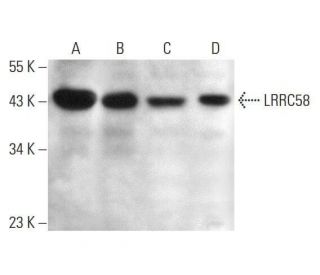


LRRC58 Antibody (C-4): sc-515597
- LRRC58 Antibody (C-4) is a mouse monoclonal IgM κ LRRC58 antibody provided at 200 µg/ml
- specific for an epitope mapping between amino acids 263-287 within an internal region of LRRC58 of human origin
- recommended for detection of LRRC58 of mouse, rat and human origin by WB, IP, IF and ELISA
- m-IgGκ BP-HRP is the preferred secondary detection reagent for LRRC58 Antibody (C-4) for WB applications. This reagent is now offered in a bundle with LRRC58 Antibody (C-4) (see ordering information below). For additional m-IgGκ BP conjugates see our complete list of Mouse IgG Binding Proteins.

LRRC58 Antibody (C-4) is a mouse monoclonal IgM antibody that detects LRRC58 of mouse, rat, and human origin by western blotting (WB), immunoprecipitation (IP), immunofluorescence (IF), and enzyme-linked immunosorbent assay (ELISA). Anti-LRRC58 antibody (C-4) is available as the non-conjugated form. LRRC58, also known as leucine-rich repeat-containing protein 58, is composed of 371 amino acids and features nine leucine-rich repeats, which are critical for protein-protein interactions and play a significant role in various cellular processes. LRRC58 is primarily located in the cytoplasm, where LRRC58 is involved in the regulation of signaling pathways essential for cellular communication and function. Proper localization of LRRC58 ensures effective interaction with binding partners and participation in the modulation of cellular responses. LRRC58 is encoded on human chromosome 3q13.33, a region known for involvement in multiple human cancers, including nasopharyngeal carcinoma, due to the presence of tumor suppressor gene clusters. The unique structural features of LRRC58, along with specific cellular localization, underscore LRRC58′s importance in maintaining cellular homeostasis and potential role in oncogenesis, making LRRC58 a valuable target for research in cancer biology and therapeutic development.
Alexa Fluor® is a trademark of Molecular Probes Inc., OR., USA
LI-COR® and Odyssey® are registered trademarks of LI-COR Biosciences
LRRC58 Antibody (C-4) References:
- The molecular genetics of Marfan syndrome and related microfibrillopathies. | Robinson, PN. and Godfrey, M. 2000. J Med Genet. 37: 9-25. PMID: 10633129
- Mapping of the CCXCR1, CX3CR1, CCBP2 and CCR9 genes to the CCR cluster within the 3p21.3 region of the human genome. | Maho, A., et al. 1999. Cytogenet Cell Genet. 87: 265-8. PMID: 10702689
- [New tumor suppressor genes in hot spots of human chromosome 3: new methods of identification]. | Braga, EA., et al. 2003. Mol Biol (Mosk). 37: 194-211. PMID: 12723467
- Plasticity of human chromosome 3 during primate evolution. | Tsend-Ayush, E., et al. 2004. Genomics. 83: 193-202. PMID: 14706448
- Comparative cytogenetics of human chromosome 3q21.3 reveals a hot spot for ectopic recombination in hominoid evolution. | Yue, Y., et al. 2005. Genomics. 85: 36-47. PMID: 15607420
- Methylation of the tumor suppressor gene RASSF1A in human tumors. | Pfeifer, GP. and Dammann, R. 2005. Biochemistry (Mosc). 70: 576-83. PMID: 15948711
- High-resolution analysis of 3p deletion in neuroblastoma and differential methylation of the SEMA3B tumor suppressor gene. | Nair, PN., et al. 2007. Cancer Genet Cytogenet. 174: 100-10. PMID: 17452250
- A second locus for Marfan syndrome maps to chromosome 3p24.2-p25. | Collod, G., et al. 1994. Nat Genet. 8: 264-8. PMID: 7632217
- Mutilating neuropathic ulcerations in a chromosome 3q13-q22 linked Charcot-Marie-Tooth disease type 2B family. | De Jonghe, P., et al. 1997. J Neurol Neurosurg Psychiatry. 62: 570-3. PMID: 9219740
Ordering Information
| Product Name | Catalog # | UNIT | Price | Qty | FAVORITES | |
LRRC58 Antibody (C-4) | sc-515597 | 200 µg/ml | $322.00 | |||
LRRC58 Antibody (C-4): m-IgGκ BP-HRP Bundle | sc-552748 | 200 µg Ab; 40 µg BP | $361.00 | |||
LRRC58 (C-4) Neutralizing Peptide | sc-515597 P | 100 µg/0.5 ml | $69.00 |