
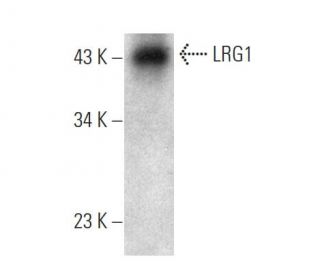

LRG1 Antibody (D2): sc-517443
- LRG1 Antibody (D2) is a mouse monoclonal IgG2a κ, cited in 1 publications, provided at 100 µg/ml
- raised against a recombinant protein corresponding to amino acids 37-340 of LRG1 of human origin
- recommended for detection of LRG1 of human origin by WB, IP, IF, IHC(P) and ELISA
- m-IgG Fc BP-HRP and m-IgG2a BP-HRP are the preferred secondary detection reagents for LRG1 Antibody (D2) for WB and IHC(P) applications. These reagents are now offered in bundles with LRG1 Antibody (D2) (see ordering information below).

QUICK LINKS
SEE ALSO...
LRG1 Antibody (D2) is a mouse monoclonal IgG2a kappa light chain antibody that detects LRG1 of human origin by western blotting (WB), immunoprecipitation (IP), immunofluorescence (IF), immunohistochemistry with paraffin-embedded sections (IHCP), and enzyme-linked immunosorbent assay (ELISA). LRG1, or leucine-rich alpha-2-glycoprotein, is a 347 amino acid secreted protein characterized by eight leucine-rich repeats and one LRRCT domain, which play a crucial role in mediating protein-protein interactions, signal transduction, and cell adhesion. LRG1 presence in plasma is particularly significant as LRG1 is expressed during granulocyte differentiation, highlighting LRG1′s importance in immune response and inflammation. The gene encoding LRG1 is located on human chromosome 19p13.3, a region known for its high gene density, containing approximately 1,400 genes, including several members of the immunoglobulin superfamily. This chromosomal location is vital as it houses genes essential for various immune functions, including those involved in cell signaling and adhesion, which are critical for maintaining immune homeostasis and responding to pathogens. Anti-LRG1 antibody (D2) is an invaluable tool for researchers studying LRG1′s role in health and disease, providing insights into its function and potential as a biomarker in various conditions.
Alexa Fluor® is a trademark of Molecular Probes Inc., OR., USA
LI-COR® and Odyssey® are registered trademarks of LI-COR Biosciences
LRG1 Antibody (D2) References:
- LRG1 modulates invasion and migration of glioma cell lines through TGF-β signaling pathway. | Zhong, D., et al. 2015. Acta Histochem. 117: 551-8. PMID: 26049667
- LRG1 downregulation in allergic airway disorders and its expression in peripheral blood and tissue cells. | Hao, L., et al. 2016. J Transl Med. 14: 202. PMID: 27378305
- LRG1 promotes proliferation and inhibits apoptosis in colorectal cancer cells via RUNX1 activation. | Zhou, Y., et al. 2017. PLoS One. 12: e0175122. PMID: 28376129
- The Clinical Prognostic Value of LRG1 in Esophageal Squamous Cell Carcinoma. | Wang, Y., et al. 2019. Curr Cancer Drug Targets. 19: 756-763. PMID: 30714525
- Collaborative Regulation of LRG1 by TGF-β1 and PPAR-β/δ Modulates Chronic Pressure Overload-Induced Cardiac Fibrosis. | Liu, C., et al. 2019. Circ Heart Fail. 12: e005962. PMID: 31830829
- LRG1 Suppresses Migration and Invasion of Esophageal Squamous Cell Carcinoma by Modulating Epithelial to Mesenchymal Transition. | Zhang, N., et al. 2020. J Cancer. 11: 1486-1494. PMID: 32047555
- LRG1 Expression Is Elevated in the Eyes of Patients with Neovascular Age-Related Macular Degeneration. | Mundo, L., et al. 2021. Int J Mol Sci. 22: PMID: 34445590
- LRG1 in pancreatic cancer cells promotes inflammatory factor synthesis and the angiogenesis of HUVECs by activating VEGFR signaling. | Cai, D., et al. 2022. J Gastrointest Oncol. 13: 400-412. PMID: 35284128
- Structural basis of human LRG1 recognition by Magacizumab, a humanized monoclonal antibody with therapeutic potential. | Gutiérrez-Fernández, J., et al. 2022. Acta Crystallogr D Struct Biol. 78: 725-734. PMID: 35647920
- The pan-cancer analysis of LRG1 and its potential role in kidney renal clear cell carcinoma. | Lei, Z., et al. 2025. RSC Med Chem.. PMID: 40008188
Ordering Information
| Product Name | Catalog # | UNIT | Price | Qty | FAVORITES | |
LRG1 Antibody (D2) | sc-517443 | 100 µg/ml | $322.00 | |||
LRG1 Antibody (D2): m-IgG Fc BP-HRP Bundle | sc-541108 | 100 µg Ab; 10 µg BP | $361.00 | |||
LRG1 Antibody (D2): m-IgG2a BP-HRP Bundle | sc-547018 | 100 µg Ab; 10 µg BP | $361.00 |