
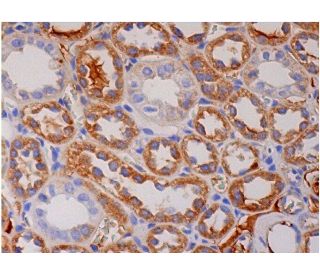


LCOR Antibody (C-6): sc-377019
- LCOR Antibody (C-6) is a mouse monoclonal IgG1 κ LCOR antibody, cited in 1 publications, provided at 200 µg/ml
- raised against amino acids 87-281 mapping within an internal region of LCOR of human origin
- LCOR Antibody (C-6) is recommended for detection of LCOR of mouse, rat and human origin by WB, IP, IF, IHC(P) and ELISA; also reactive with additional species, including bovine
- Anti-LCOR Antibody (C-6) is available conjugated to agarose for IP; HRP for WB, IHC(P) and ELISA; and to either phycoerythrin or FITC for IF, IHC(P) and FCM
- also available conjugated to Alexa Fluor® 488, Alexa Fluor® 546, Alexa Fluor® 594 or Alexa Fluor® 647 for WB (RGB), IF, IHC(P) and FCM, and for use with RGB fluorescent imaging systems, such as iBright™ FL1000, FluorChem™, Typhoon, Azure and other comparable systems
- also available conjugated to Alexa Fluor® 680 or Alexa Fluor® 790 for WB (NIR), IF and FCM; for use with Near-Infrared (NIR) detection systems, such as LI-COR®Odyssey®, iBright™ FL1000, FluorChem™, Typhoon, Azure and other comparable systems
- m-IgG Fc BP-HRP and m-IgG1 BP-HRP are the preferred secondary detection reagents for LCOR Antibody (C-6) for WB and IHC(P) applications. These reagents are now offered in bundles with LCOR Antibody (C-6) (see ordering information below).

QUICK LINKS
SEE ALSO...
LCOR Antibody (C-6) is a mouse monoclonal IgG1 kappa light chain antibody that detects LCOR protein of mouse, rat, and human origin by western blotting (WB), immunoprecipitation (IP), immunofluorescence (IF), immunohistochemistry, and enzyme-linked immunosorbent assay (ELISA). LCOR (C-6) antibody is available in both non-conjugated and various conjugated forms, including agarose, horseradish peroxidase (HRP), phycoerythrin (PE), fluorescein isothiocyanate (FITC), and multiple Alexa Fluor® conjugates. LCOR protein, also known as Ligand-dependent corepressor or MLR2, is a 433 amino acid transcriptional corepressor characterized by an LXXLL motif, a nuclear localization signal, and a helix-loop-helix domain. LCOR protein is crucial for regulating gene expression as LCOR is widely expressed in both fetal and adult tissues, where LCOR plays a significant role in mediating the effects of nuclear receptors. LCOR interacts with several estrogen receptors, including ERα and ERβ, in the presence of estradiol, thereby functioning as a molecular scaffold that recruits proteins involved in transcriptional repression to the DNA. LCOR′s structure facilitates these interactions, which are essential for maintaining hormonal balance and regulating transcriptional activity. LCOR′s activity is modulated by the histone deacetylase inhibitor trichostatin A, indicating a receptor-dependent mechanism of action that contributes to LCOR′s role in negative feedback loops to diminish hormone-induced transactivation.
Alexa Fluor® is a trademark of Molecular Probes Inc., OR., USA
LI-COR® and Odyssey® are registered trademarks of LI-COR Biosciences
LCOR Antibody (C-6) References:
- Ligand-dependent nuclear receptor corepressor LCoR functions by histone deacetylase-dependent and -independent mechanisms. | Fernandes, I., et al. 2003. Mol Cell. 11: 139-50. PMID: 12535528
- Agonist-bound nuclear receptors: not just targets of coactivators. | Fernandes, I. and White, JH. 2003. J Mol Endocrinol. 31: 1-7. PMID: 12914520
- The role of corepressors in transcriptional regulation by nuclear hormone receptors. | Privalsky, ML. 2004. Annu Rev Physiol. 66: 315-60. PMID: 14977406
- Corepressor recruitment by agonist-bound nuclear receptors. | White, JH., et al. 2004. Vitam Horm. 68: 123-43. PMID: 15193453
- Coactivators and corepressors as mediators of nuclear receptor function: an update. | Jenster, G. 1998. Mol Cell Endocrinol. 143: 1-7. PMID: 9806345
Ordering Information
| Product Name | Catalog # | UNIT | Price | Qty | FAVORITES | |
LCOR Antibody (C-6) | sc-377019 | 200 µg/ml | $322.00 | |||
LCOR Antibody (C-6): m-IgG Fc BP-HRP Bundle | sc-527573 | 200 µg Ab; 10 µg BP | $361.00 | |||
LCOR Antibody (C-6): m-IgG1 BP-HRP Bundle | sc-532946 | 200 µg Ab; 20 µg BP | $361.00 | |||
LCOR Antibody (C-6) AC | sc-377019 AC | 500 µg/ml, 25% agarose | $424.00 | |||
LCOR Antibody (C-6) HRP | sc-377019 HRP | 200 µg/ml | $322.00 | |||
LCOR Antibody (C-6) FITC | sc-377019 FITC | 200 µg/ml | $336.00 | |||
LCOR Antibody (C-6) PE | sc-377019 PE | 200 µg/ml | $349.00 | |||
LCOR Antibody (C-6) Alexa Fluor® 488 | sc-377019 AF488 | 200 µg/ml | $364.00 | |||
LCOR Antibody (C-6) Alexa Fluor® 546 | sc-377019 AF546 | 200 µg/ml | $364.00 | |||
LCOR Antibody (C-6) Alexa Fluor® 594 | sc-377019 AF594 | 200 µg/ml | $364.00 | |||
LCOR Antibody (C-6) Alexa Fluor® 647 | sc-377019 AF647 | 200 µg/ml | $364.00 | |||
LCOR Antibody (C-6) Alexa Fluor® 680 | sc-377019 AF680 | 200 µg/ml | $364.00 | |||
LCOR Antibody (C-6) Alexa Fluor® 790 | sc-377019 AF790 | 200 µg/ml | $364.00 |