
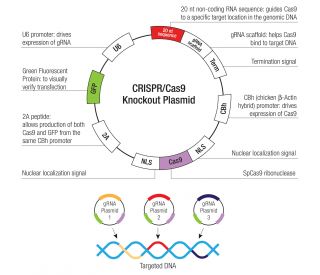
KLHDC7B CRISPR/Cas9 KO Plasmid (h): sc-414026
- Target species: human
- 20 µg of transfection-ready, purified plasmid DNA; Suitable for up to 20 transfections
- KLHDC7B CRISPR/Cas9 Knockout (KO) Plasmid (h) is a pool of plasmids, each encoding Cas9 nuclease and a target-specific 20 nt guide RNA (gRNA) designed for maximum knockout efficiency using sequences derived from the GeCKO v2 library
- gRNA sequences direct Cas9 to induce site-specific double-strand breaks (DSBs) in the KLHDC7B genomic locus, resulting in gene knockout through non-homologous end joining (NHEJ)
- KLHDC7B HDR Plasmid (h) (sc-414026-HDR) is recommended for co-transfection with KLHDC7B CRISPR/Cas9 KO Plasmid (h) to enable selection of successfully edited cells through HDR-mediated integration of a puromycin resistance cassette and RFP reporter gene
- KLHDC7B HDR Plasmid (h) is a pool of plasmids, each containing a homology-directed repair (HDR) template corresponding to the gRNA target sites in the KLHDC7B CRISPR/Cas9 KO Plasmid (h)
- Each HDR plasmid contains two ~800 bp homology arms flanking the puromycin resistance and RFP cassettes, designed to bind genomic DNA sequences surrounding the Cas9-induced double-strand break site and facilitate precise HDR-mediated integration
- The puromycin resistance and RFP genes are flanked by LoxP sites, enabling removal of selection markers via Cre recombinase (Cre Vector: sc-418923) after establishing stable knockout cell lines

Ordering Information
| Product Name | Catalog # | UNIT | Price | Qty | FAVORITES | |
KLHDC7B CRISPR/Cas9 KO Plasmid (h) | sc-414026 | 20 µg | $397.00 | |||
KLHDC7B HDR Plasmid (h) | sc-414026-HDR | 20 µg | $445.00 |
Overview
KLHDC7B (kelch domain containing 7B) encodes a predicted kelch repeat–containing protein that is thought to participate in protein–protein interactions and may contribute to ubiquitin-dependent proteostasis through adaptor-like functions in Cullin-RING E3 ligase pathways. Kelch family proteins are frequently linked to regulation of cytoskeletal organization, vesicular trafficking, and selective turnover of signaling components, positioning KLHDC7B as a candidate modulator of cellular homeostasis. Altered KLHDC7B expression has been reported in transcriptomic studies of several malignancies, supporting its use as a research target in cancer biology and cellular stress-response programs. Functional interrogation of KLHDC7B can help clarify how kelch-domain proteins tune pathway output and phenotype in human cell models.
KLHDC7B CRISPR/Cas9 KO Plasmid (h) is a pool of plasmids designed for targeted disruption of the KLHDC7B gene in human cell lines. Each plasmid in the pool co-expresses a unique sgRNA, targeting a distinct site within the KLHDC7B locus, alongside the Streptococcus pyogenes Cas9 nuclease, and encodes GFP to enable fluorescent identification and enrichment of successfully transfected cells. This multi-guide strategy increases the likelihood of inducing frameshifts or deletions that produce a functional knockout, offering a more robust alternative to single-guide approaches. DSBs induced at multiple sites are resolved through non-homologous end joining (NHEJ) or, when used with the included HDR donor template, homology-directed repair (HDR) at a defined target site within the locus.
When used in conjunction with the RFP-expressing HDR donor, GFP and RFP fluorescence can be used together to distinguish transfected from edited cell populations, streamlining flow cytometry-based sorting and clone selection workflows.
Homology-Directed Repair (HDR) Donor — Puromycin Cassette with RFP Reporter
For applications requiring confirmed, selectable knockout clones, KLHDC7B HDR Plasmid (h) includes an HDR donor construct containing a puromycin resistance cassette (PuroR) and a red fluorescent protein (RFP) reporter, flanked by homology arms specific to a defined KLHDC7B target site.
When co-transfected with KLHDC7B CRISPR/Cas9 KO Plasmid (h):
- The PuroR-RFP cassette integrates at the Cas9 cut site via HDR, disrupting the KLHDC7B open reading frame.
- RFP fluorescence provides an immediate visual indicator of successful integration, enabling fluorescence-based identification or sorting of edited cells prior to or alongside puromycin selection.
- Successfully edited cells are confirmed through puromycin resistance, substantially reducing clone screening burden.
- This selection strategy is ideal for generating stable, clonal KO cell lines for downstream functional studies, drug screening, or model development.
Cre-lox Cassette Removal System
The HDR donor construct features loxP sites flanking the PuroR-RFP selection cassette to allow clean marker removal following clone confirmation. Transient expression of Cre recombinase via the included Cre Vector: sc-418923 excises the cassette, leaving a minimal residual loxP site within the KLHDC7B locus and eliminating potential confounding effects on downstream assays.
This two-step approach:
- Minimizes disruption to local chromatin architecture and neighboring regulatory elements
- Restores a near-native genomic context at the edited locus
- Enables reuse of the puromycin selection strategy in the same cell line for additional edits
Key Features
- gRNA targeting KLHDC7B exon(s) critical for KLHDC7B function
- Co-expression of SpCas9 and sgRNA from a single plasmid for simplified delivery
- HDR donor with puromycin resistance for positive clone selection
- loxP-flanked PuroR cassette with Cre recombinase vector for seamless marker removal
- Supplied ready to use for delivery by transfection
For Research Use Only. Not Intended for Diagnostic or Therapeutic Use.