
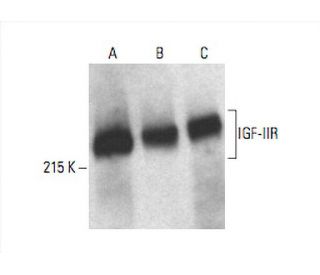


IGF2R/M6PR Antibody (29): sc-136321
- IGF2R/M6PR Antibody (29) is a mouse monoclonal IgG1 κ IGF2R/M6PR antibody, cited in 1 publications, provided at 200 µg/ml
- raised against amino acids 245-441 of IGF-IIR of rat origin
- IGF2R/M6PR Antibody (29) is recommended for detection of IGF-IIR of mouse and rat origin by WB, IP and IF
- IGF2R/M6PR Antibody (29) is available conjugated to agarose for IP; and to HRP for WB, IHC(P) and ELISA
- m-IgGκ BP-HRP is the preferred secondary detection reagent for IGF2R/M6PR Antibody (29) for WB applications. This reagent is now offered in a bundle with IGF2R/M6PR Antibody (29) (see ordering information below). For additional m-IgGκ BP conjugates see our complete list of Mouse IgG Binding Proteins.

IGF-IIR Antibody (29) is a mouse monoclonal IgG1 kappa light chain antibody that detects IGF-IIR protein of mouse and rat origin by western blotting (WB), immunoprecipitation (IP), and immunofluorescence (IF). IGF-IIR (29) antibody is available in both non-conjugated and various conjugated forms, including agarose and horseradish peroxidase (HRP). The insulin-like growth factor II receptor (IGF-IIR), also known as M6P/IGF2R, is a vital integral glycoprotein that plays a crucial role in cellular processes by binding glycoproteins through extracytoplasmic domains. This interaction is essential for mediating the activation of transforming growth factor beta 1 (TGFβ1), which acts as a growth inhibitor, as well as facilitating the degradation of insulin-like growth factor II (IGF-II) and the transport of lysosomal enzymes. IGF-IIR forms oligomeric complexes to enhance affinity for lysosomal enzymes, promoting efficient cellular function. Unlike IGF-IR, IGF-IIR does not amplify IGF-I or IGF-II signaling pathways, which are known for mitogenic and cell survival effects, positioning anti-IGF-IIR antibody (29) as a significant tumor suppressor. IGF-IIR gene is located on chromosome 6q26, a region frequently associated with mutations or deletions in various human cancers, underscoring IGF-IIR′s importance in cancer biology and potential therapeutic interventions.
Alexa Fluor® is a trademark of Molecular Probes Inc., OR., USA
LI-COR® and Odyssey® are registered trademarks of LI-COR Biosciences
IGF2R/M6PR Antibody (29) References:
- Insulin-like growth factors in human breast cancer. | Ellis, MJ., et al. 1998. Breast Cancer Res Treat. 52: 175-84. PMID: 10066081
- Type-2 IGF receptor: a multi-ligand binding protein. | Braulke, T. 1999. Horm Metab Res. 31: 242-6. PMID: 10226808
- M6P/IGF2R is mutated in squamous cell carcinoma of the lung. | Kong, FM., et al. 2000. Oncogene. 19: 1572-8. PMID: 10734317
- Mechanisms for high affinity mannose 6-phosphate ligand binding to the insulin-like growth factor II/mannose 6-phosphate receptor. | Byrd, JC. and MacDonald, RG. 2000. J Biol Chem. 275: 18638-46. PMID: 10764735
- Dimerization of the insulin-like growth factor II/mannose 6-phosphate receptor. | Byrd, JC., et al. 2000. J Biol Chem. 275: 18647-56. PMID: 10764761
- Invasive properties of murine squamous carcinoma cells: secretion of matrix-degrading cathepsins is attributable to a deficiency in the mannose 6-phosphate/insulin-like growth factor II receptor. | Lorenzo, K., et al. 2000. Cancer Res. 60: 4070-6. PMID: 10945612
- Mutation analysis of the gene encoding the human mannose 6-phosphate/insulin-like growth factor 2 receptor (M6P/IGF2R) in human cell lines resistant to growth inhibition by transforming growth factor beta(1) (TGF-beta(1)). | Gemma, A., et al. 2000. Lung Cancer. 30: 91-8. PMID: 11086202
- The N terminus of mannose 6-phosphate/insulin-like growth factor 2 receptor in regulation of fibrinolysis and cell migration. | Leksa, V., et al. 2002. J Biol Chem. 277: 40575-82. PMID: 12189157
- Doxorubicin attenuates CHIP-guarded HSF1 nuclear translocation and protein stability to trigger IGF-IIR-dependent cardiomyocyte death. | Huang, CY., et al. 2016. Cell Death Dis. 7: e2455. PMID: 27809308
- p53-mediated miR-18 repression activates HSF2 for IGF-IIR-dependent myocyte hypertrophy in hypertension-induced heart failure. | Huang, CY., et al. 2017. Cell Death Dis. 8: e2990. PMID: 28796250
- Inhibition of ERK-Drp1 signaling and mitochondria fragmentation alleviates IGF-IIR-induced mitochondria dysfunction during heart failure. | Huang, CY., et al. 2018. J Mol Cell Cardiol. 122: 58-68. PMID: 30098987
- Artemisia argyi mitigates doxorubicin-induced cardiotoxicity by inhibiting mitochondrial dysfunction through the IGF-IIR/Drp1/GATA4 signaling pathway. | Chen, JK., et al. 2024. Biotechnol Appl Biochem.. PMID: 39375847
Ordering Information
| Product Name | Catalog # | UNIT | Price | Qty | FAVORITES | |
IGF2R/M6PR Antibody (29) | sc-136321 | 200 µg/ml | $322.00 | |||
IGF2R/M6PR Antibody (29): m-IgGκ BP-HRP Bundle | sc-551091 | 200 µg Ab; 40 µg BP | $361.00 | |||
IGF2R/M6PR Antibody (29) AC | sc-136321 AC | 500 µg/ml, 25% agarose | $424.00 | |||
IGF2R/M6PR Antibody (29) HRP | sc-136321 HRP | 200 µg/ml | $322.00 |