
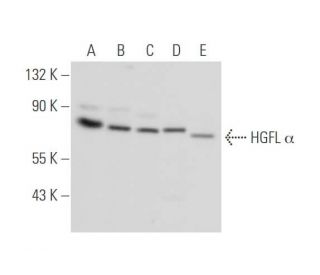

HGFL α Antibody (57J13): sc-80040
- HGFL α Antibody (57J13) is a mouse monoclonal IgG1 HGFL α antibody provided at 100 µg/ml
- raised against full length recombinant HGFL of human origin, with epitope mapping to HGFL α
- recommended for detection of HGFL α of human origin by WB, IP and ELISA
- At present, we have not yet completed the identification of the preferred secondary detection reagent(s) for HGFL α Antibody (57J13). This work is in progress.

HGFL α Antibody (57J13) is a mouse monoclonal IgG1 antibody that detects the HGFL alpha protein of human origin by western blotting (WB), immunoprecipitation (IP), and enzyme-linked immunosorbent assay (ELISA). Anti-HGFL alpha antibody (57J13) is available as a non-conjugated format. Hepatocyte growth factor-like protein (HGFL) plays a crucial role in the inflammatory response, acting as a mediator that is essential for the chemotactic response of peritoneal macrophages. This function is particularly important as HGFL helps orchestrate the immune response during tissue injury and infection, facilitating the recruitment of immune cells to sites of inflammation. Unlike hepatocyte growth factor (HGF), which primarily promotes growth and differentiation in epithelial and endothelial cells, HGFL′s role in modulating immune cell behavior highlights its significance in both innate immunity and tissue repair processes. The receptor for HGFL, Ron, is a receptor tyrosine kinase that shares a high degree of homology with the HGF receptor c-Met and is expressed in various epithelial tissues, granulocytes, and monocytes. While HGF does not activate Ron′s tyrosine kinase activity, HGFL induces Ron autophosphorylation in epithelial cells, leading to DNA synthesis, suggesting that Ron serves as the in vivo receptor for HGFL. This unique interaction underscores HGFL′s importance in immune regulation and potential implications in therapeutic strategies targeting inflammatory diseases.
Alexa Fluor® is a trademark of Molecular Probes Inc., OR., USA
LI-COR® and Odyssey® are registered trademarks of LI-COR Biosciences
HGFL α Antibody (57J13) References:
- Characterization of the DNF15S2 locus on human chromosome 3: identification of a gene coding for four kringle domains with homology to hepatocyte growth factor. | Han, S., et al. 1991. Biochemistry. 30: 9768-80. PMID: 1655021
- HGF/SF: a potent cytokine for mammary growth, morphogenesis and development. | Niranjan, B., et al. 1995. Development. 121: 2897-908. PMID: 7555716
- Molecular evolution and domain structure of plasminogen-related growth factors (HGF/SF and HGF1/MSP). | Donate, LE., et al. 1994. Protein Sci. 3: 2378-94. PMID: 7756992
- Biological activation of pro-HGF (hepatocyte growth factor) by urokinase is controlled by a stoichiometric reaction. | Naldini, L., et al. 1995. J Biol Chem. 270: 603-11. PMID: 7822285
- RON is a heterodimeric tyrosine kinase receptor activated by the HGF homologue MSP. | Gaudino, G., et al. 1994. EMBO J. 13: 3524-32. PMID: 8062829
- Proteolytic activation of hepatocyte growth factor in response to tissue injury. | Miyazawa, K., et al. 1994. J Biol Chem. 269: 8966-70. PMID: 8132634
- Are hepatocyte growth factor-like protein and macrophage stimulating protein the same protein? | Bezerra, JA., et al. 1993. Protein Sci. 2: 666-8. PMID: 8518737
- Coexpression of hepatocyte growth factor and receptor (Met) in human breast carcinoma. | Tuck, AB., et al. 1996. Am J Pathol. 148: 225-32. PMID: 8546209
- Functional characterization of domains contained in hepatocyte growth factor-like protein. | Waltz, SE., et al. 1997. J Biol Chem. 272: 30526-37. PMID: 9374547
Ordering Information
| Product Name | Catalog # | UNIT | Price | Qty | FAVORITES | |
HGFL α Antibody (57J13) | sc-80040 | 100 µg/ml | $322.00 |