
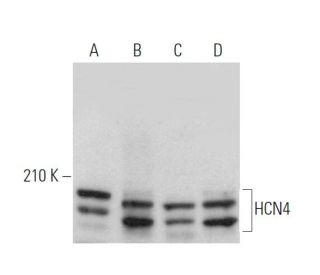
HCN4 Antibody (SHG 1E5): sc-58622
- HCN4 Antibody (SHG 1E5) is a rat monoclonal IgG1 HCN4 antibody, cited in 6 publications, provided at 200 µg/ml
- raised against amino acids 1048-1085 of HCN4 of human origin
- HCN4 Antibody (SHG 1E5) is recommended for detection of HCN4 of mouse, rat and human origin by WB, IP and IF
- Anti-HCN4 Antibody (SHG 1E5) is available conjugated to agarose for IP; HRP for WB, IHC(P) and ELISA; and to either phycoerythrin or FITC for IF, IHC(P) and FCM
- also available conjugated to Alexa Fluor® 488, Alexa Fluor® 546, Alexa Fluor® 594 or Alexa Fluor® 647 for WB (RGB), IF, IHC(P) and FCM, and for use with RGB fluorescent imaging systems, such as iBright™ FL1000, FluorChem™, Typhoon, Azure and other comparable systems
- also available conjugated to Alexa Fluor® 680 or Alexa Fluor® 790 for WB (NIR), IF and FCM; for use with Near-Infrared (NIR) detection systems, such as LI-COR®Odyssey®, iBright™ FL1000, FluorChem™, Typhoon, Azure and other comparable systems
- At present, we have not yet completed the identification of the preferred secondary detection reagent(s) for HCN4 Antibody (SHG 1E5). This work is in progress.

QUICK LINKS
HCN4 Antibody (SHG 1E5) is a rat monoclonal IgG1 antibody that detects HCN4 of mouse, rat, and human origin by western blotting (WB), immunoprecipitation (IP), and immunofluorescence (IF). Anti-HCN4 antibody (SHG 1E5) is available in both non-conjugated and various conjugated forms, including agarose, horseradish peroxidase (HRP), phycoerythrin (PE), fluorescein isothiocyanate (FITC), and multiple Alexa Fluor® conjugates. HCN4 is a member of the hyperpolarization-activated cyclic nucleotide-binding channel family, which plays a crucial role in generating rhythmic electrical activity in excitable tissues such as the heart and brain. Specifically, HCN4 channels are predominantly expressed in the sinoatrial node of the heart, where these channels contribute to the pacemaker potential that regulates heart rate. This function is vital for maintaining proper cardiac rhythm and overall cardiovascular health. HCN4 is characterized by a core transmembrane segment domain and a C-terminal cyclic nucleotide-binding domain, which allows HCN4 to respond to changes in intracellular cyclic nucleotide levels, thus modulating activity in response to physiological signals. The genes encoding HCN channels are located on different chromosomes, with HCN4 mapping to chromosome 15q24-q25, highlighting the genetic diversity and regulatory mechanisms governing these important ion channels.
Alexa Fluor® is a trademark of Molecular Probes Inc., OR., USA
LI-COR® and Odyssey® are registered trademarks of LI-COR Biosciences
HCN4 Antibody (SHG 1E5) References:
- Two pacemaker channels from human heart with profoundly different activation kinetics. | Ludwig, A., et al. 1999. EMBO J. 18: 2323-9. PMID: 10228147
- Molecular characterization of a slowly gating human hyperpolarization-activated channel predominantly expressed in thalamus, heart, and testis. | Seifert, R., et al. 1999. Proc Natl Acad Sci U S A. 96: 9391-6. PMID: 10430953
- The human gene coding for HCN2, a pacemaker channel of the heart. | Vaccari, T., et al. 1999. Biochim Biophys Acta. 1446: 419-25. PMID: 10524219
- Molecular mechanism of cAMP modulation of HCN pacemaker channels. | Wainger, BJ., et al. 2001. Nature. 411: 805-10. PMID: 11459060
- Molecular basis for the different activation kinetics of the pacemaker channels HCN2 and HCN4. | Stieber, J., et al. 2003. J Biol Chem. 278: 33672-80. PMID: 12813043
- The hyperpolarization-activated channel HCN4 is required for the generation of pacemaker action potentials in the embryonic heart. | Stieber, J., et al. 2003. Proc Natl Acad Sci U S A. 100: 15235-40. PMID: 14657344
- Functional characterization of a trafficking-defective HCN4 mutation, D553N, associated with cardiac arrhythmia. | Ueda, K., et al. 2004. J Biol Chem. 279: 27194-8. PMID: 15123648
- Pacemaker activity of the human sinoatrial node: effects of HCN4 mutations on the hyperpolarization-activated current. | Verkerk, AO. and Wilders, R. 2014. Europace. 16: 384-95. PMID: 24569893
- HCN4 Gene Variations in Sudden Unexplained Nocturnal Death Syndrome in the Southern Han Chinese Population. | Wu, Q., et al. 2019. J Forensic Sci. 64: 1112-1118. PMID: 30452770
- HCN4 knockdown in dorsal hippocampus promotes anxiety-like behavior in mice. | Günther, A., et al. 2019. Genes Brain Behav. 18: e12550. PMID: 30585408
- Ectopic HCN4 expression drives mTOR-dependent epilepsy in mice. | Hsieh, LS., et al. 2020. Sci Transl Med. 12: PMID: 33208499
- HCN4 current during human sinoatrial node-like action potentials. | Hoekstra, M., et al. 2021. Prog Biophys Mol Biol. 166: 105-118. PMID: 34153331
Ordering Information
| Product Name | Catalog # | UNIT | Price | Qty | FAVORITES | |
HCN4 Antibody (SHG 1E5) | sc-58622 | 200 µg/ml | $322.00 | |||
HCN4 Antibody (SHG 1E5) AC | sc-58622 AC | 500 µg/ml, 25% agarose | $424.00 | |||
HCN4 Antibody (SHG 1E5) HRP | sc-58622 HRP | 200 µg/ml | $322.00 | |||
HCN4 Antibody (SHG 1E5) FITC | sc-58622 FITC | 200 µg/ml | $336.00 | |||
HCN4 Antibody (SHG 1E5) PE | sc-58622 PE | 200 µg/ml | $349.00 | |||
HCN4 Antibody (SHG 1E5) Alexa Fluor® 488 | sc-58622 AF488 | 200 µg/ml | $364.00 | |||
HCN4 Antibody (SHG 1E5) Alexa Fluor® 546 | sc-58622 AF546 | 200 µg/ml | $364.00 | |||
HCN4 Antibody (SHG 1E5) Alexa Fluor® 594 | sc-58622 AF594 | 200 µg/ml | $364.00 | |||
HCN4 Antibody (SHG 1E5) Alexa Fluor® 647 | sc-58622 AF647 | 200 µg/ml | $364.00 | |||
HCN4 Antibody (SHG 1E5) Alexa Fluor® 680 | sc-58622 AF680 | 200 µg/ml | $364.00 | |||
HCN4 Antibody (SHG 1E5) Alexa Fluor® 790 | sc-58622 AF790 | 200 µg/ml | $364.00 |