
Date published: 2026-4-26

1-800-457-3801

SCBT Portrait Logo
Seach Input

H2-I/Adβ Antibody (34-5-3): sc-52538

4.0(1)
Write a reviewAsk a question

Datasheets
  • H2-I/Adβ Antibody (34-5-3) is a mouse monoclonal IgG2a H2-I/Adβ antibody provided at 100 µg/ml
  • raised against C57BL/6 x DBA/2)F1 splenocytes of mouse origin
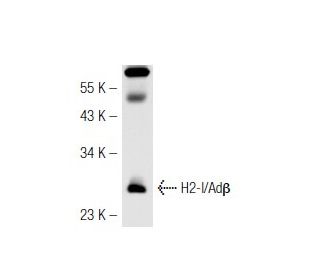
  • recommended for detection of H2-I/Adβ of mouse origin by WB, IP and FCM; may cross-react with H2-I/Ab
  • At present, we have not yet completed the identification of the preferred secondary detection reagent(s) for H2-I/Adβ Antibody (34-5-3). This work is in progress.
    Gene Editing Promo Banner

    QUICK LINKS

    SEE ALSO...

    H2-I/Adβ Antibody (34-5-3) is a mouse monoclonal IgG2a antibody that detects H2-I/Ad beta protein of mouse origin by western blotting (WB), immunoprecipitation (IP), and flow cytometry (FCM). Anti-H2-I/Ad beta antibody (34-5-3) is available as the non-conjugated form. H2-I/Ad beta protein plays a crucial role in the immune system as a component of the major histocompatibility complex (MHC) class II molecules, which are essential for the adaptive immune response. These molecules are responsible for presenting processed foreign peptides to CD4+ T helper cells, thereby initiating a cascade of immune responses that help the body fight infections. Proper functioning of MHC class II molecules is vital for the activation of T lymphocytes, which are key players in orchestrating the immune response. Any dysfunction or alteration in H2-I/Ad beta expression can lead to impaired immune responses and has been associated with various autoimmune diseases. H2-I/Ad beta monoclonal antibody (34-5-3) is an invaluable tool for researchers studying the mechanisms of immune activation and the role of MHC molecules in health and disease.

    For Research Use Only. Not Intended for Diagnostic or Therapeutic Use.

    Alexa Fluor® is a trademark of Molecular Probes Inc., OR., USA

    LI-COR® and Odyssey® are registered trademarks of LI-COR Biosciences

    H2-I/Adβ Antibody (34-5-3) References:

    1. Signal transduction by the major histocompatibility complex class I molecule.  |  Pedersen, AE., et al. 1999. APMIS. 107: 887-95. PMID: 10549585
    2. Presentation of antigens by MHC class II molecules: getting the most out of them.  |  Villadangos, JA. 2001. Mol Immunol. 38: 329-46. PMID: 11684289
    3. Peptide-binding motifs for the I-Ad MHC class II molecule: alternate pH-dependent binding behavior.  |  Chaves, FA., et al. 2006. Biochemistry. 45: 6426-33. PMID: 16700553
    4. Influence of major histocompatibility complex class I, class II and TLA genes on tumor rejection.  |  Ostrand-Rosenberg, S., et al. 1991. Semin Cancer Biol. 2: 311-9. PMID: 1773047
    5. The assignment of chain specificities for anti-Ia monoclonal antibodies using L cell transfectants.  |  Landias, D., et al. 1986. J Immunol. 137: 3002-5. PMID: 3463623
    6. Beta 2-microglobulin is not required for cell surface expression of the murine class I histocompatibility antigen H-2Db or of a truncated H-2Db.  |  Allen, H., et al. 1986. Proc Natl Acad Sci U S A. 83: 7447-51. PMID: 3532114
    7. Structure of the murine immune response I-A beta locus: sequence of the I-A beta gene and an adjacent beta-chain second domain exon.  |  Larhammar, D., et al. 1983. Cell. 34: 179-88. PMID: 6411350
    8. Monoclonal antibodies to mouse MHC antigens. III. Hybridoma antibodies reacting to antigens of the H-2b haplotype reveal genetic control of isotype expression.  |  Ozato, K. and Sachs, DH. 1981. J Immunol. 126: 317-21. PMID: 6935293
    9. Structure and function of H-2 T (Tla) region class I MHC molecules.  |  Teitell, M., et al. 1994. Crit Rev Immunol. 14: 1-27. PMID: 7741975
    10. Assembly, transport, and function of MHC class II molecules.  |  Cresswell, P. 1994. Annu Rev Immunol. 12: 259-93. PMID: 8011283
    11. Antigen presentation by major histocompatibility complex class I-B molecules.  |  Shawar, SM., et al. 1994. Annu Rev Immunol. 12: 839-80. PMID: 8011299
    12. Expression of MHC class II molecules in different cellular and functional compartments is controlled by differential usage of multiple promoters of the transactivator CIITA.  |  Muhlethaler-Mottet, A., et al. 1997. EMBO J. 16: 2851-60. PMID: 9184229

    Ordering Information

    Product NameCatalog #UNITPriceQtyFAVORITES

    H2-I/Adβ Antibody (34-5-3)

    sc-52538
    100 µg/ml
    $322.00

    What is the recommended storage condition for H2-I/Adβ (34-5-3): sc-52538?

    Asked by: DefinitelyNotMatt
    Thank you for your question. We recommend storing the antibody at 4° C.
    Answered by: Technical Support
    Date published: 2017-03-27
    • y_2026, m_4, d_23, h_7CST
    • bvseo_bulk, prod_bvqa, vn_bulk_3.0.43
    • cp_1, bvpage1
    • co_hasquestionsanswers, tq_1
    • loc_en_US, sid_52538, prod, sort_[SortEntry(order=LAST_APPROVED_ANSWER_SUBMISSION_TIME, direction=DESCENDING)]
    • clientName_scbt
    • bvseo_sdk, java_sdk, bvseo-4.0.0
    • CLOUD, getContent, 105ms
    • QUESTIONS, PRODUCT
    Rated 4 out of 5 by from Good signal strength at expected mw withGood signal strength at expected mw with mouse PBL whole cell lysate. Other bands detected -SCBT QC
    Date published: 2013-09-07
    • y_2026, m_4, d_23, h_7
    • bvseo_bulk, prod_bvrr, vn_bulk_3.0.43
    • cp_1, bvpage1
    • co_hasreviews, tv_0, tr_1
    • loc_en_US, sid_52538, prod, sort_[SortEntry(order=SUBMISSION_TIME, direction=DESCENDING)]
    • clientName_scbt
    • bvseo_sdk, java_sdk, bvseo-4.0.0
    • CLOUD, getReviews, 17ms
    • REVIEWS, PRODUCT
    H2-I/Adβ Antibody (34-5-3) is rated 4.0 out of 5 by 1.
    • y_2026, m_4, d_23, h_7
    • bvseo_bulk, prod_bvrr, vn_bulk_3.0.43
    • cp_1, bvpage1
    • co_hasreviews, tv_0, tr_1
    • loc_en_US, sid_52538, prod, sort_[SortEntry(order=SUBMISSION_TIME, direction=DESCENDING)]
    • clientName_scbt
    • bvseo_sdk, java_sdk, bvseo-4.0.0
    • CLOUD, getAggregateRating, 97ms
    • REVIEWS, PRODUCT
