
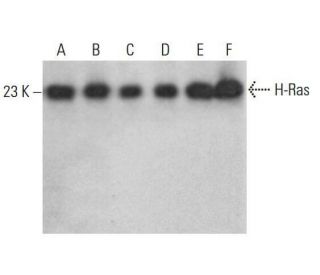
H-Ras抗体(259): sc-35
- H-Ras抗体 259はラットモノクローナルIgG1H-Ras 抗体 です。200 µg/mlで提供
- 反-H-Ras抗体 (259) mouse, rat と human 由来のantigenic determinants common to H-, K- and N-Ras p21 WB, IP, IF, FCM と ELISAでの検出にはお勧めします
- H-Ras 抗体(259)は、IP用にアガロース、WB、IHCP、ELISA用にHRP、IF、IHCP、FCM用にフィコエリスリンまたはFITCに結合したものが利用可能である
- WB (RGB)、IF、IHC(P)、FCM、iBright™ FL1000、FluorChem™、Typhoon、Azureと他の同等システムでRGB蛍光イメージングシステム用のAlexa Fluor® 488、Alexa Fluor® 546、Alexa Fluor® 594 または Alexa Fluor® 647、に共役での利用可能です。
- WB (NIR)、IF、FCMとLI-COR®/Odyssey®、iBright™ FL1000、FluorChem™、Typhoon、Azureと他の同等システムで近赤外(NIR)検出法用のAlexa Fluor® 680 または Alexa Fluor® 790、に共役での利用可能です。
- RafのH-Ras結合阻害用(アジドフリー)(sc-35 L、200 µg/0.1 ml
- 現在、H-Ras Antibody (259)に適した二次検出試薬の同定はまだ完了していません。この研究は進めています。

H-Ras Antibody (259) は IgG1 ラットモノクローナル H-Ras 抗体 (HRAS 抗体) で、マウス、ラット、ヒト由来の H-Ras タンパク質を WB、IP、IF、FCM、ELISA で検出します。H-Ras Antibody (259) は、ノンコンジュゲート抗 H-Ras 抗体の他、アガロース、HRP、PE、FITC、Alexa Fluor® コンジュゲートなど、複数のコンジュゲート抗 H-Ras 抗体があります。哺乳類のRas(v-Ha-Ras、Harvey rat sarcoma viral oncogene homolog、HRAS1、K-Ras、N-Ras、RASH1またはc-bas/hasとも呼ばれる)遺伝子ファミリーは、HarveyおよびKirsten Ras遺伝子(c-H-Ras1およびc-K-Ras2)、それぞれの不活性偽遺伝子(c-H-Ras2およびc-K-Ras1)、およびN-Ras遺伝子から構成されています。H-Ras、K-Ras、N-Rasの3つのRasがん遺伝子は、GTP/GDP結合とGTPase活性を持つタンパク質をコードしている。Rasタンパク質は、GDPに結合した不活性型とGTPに結合した活性型を交互に繰り返し、グアニンヌクレオチド交換因子(GEF)によって活性化され、GTPアーゼ活性化タンパク質(GAP)によって不活性化される。Rasの命名法は、C型哺乳類レトロウイルスであるネズミ肉腫ウイルスのHarvey株(HaMSV)の発癌性配列を含むクローン化DNA断片と相同なヒトDNA配列の特徴付けに由来する。正常な状態では、Rasファミリーのメンバーは、細胞膜下コンパートメントに基づくシグナル伝達系において、細胞の増殖や分化に影響を及ぼす。がん化したRasは、細胞増殖とアポトーシスの両方を制御するプロセスを調節できなくする可能性がある。GTP加水分解共役型シグナル伝達リレータンパク質のRasスーパーファミリーは、Ras、Rho、RabおよびARFファミリーに分類される。
Alexa Fluor® はMolecular Probes Inc., OR., USAの商標です。
LI-COR® and Odyssey® はLI-COR Biosciencesの登録商標です。
H-Ras抗体(259) 参考文献:
- GTP依存的なH-rasの脂質ラフトからの分離は、生物学的活性に必要である。 | Prior, IA., et al. 2001. Nat Cell Biol. 3: 368-75. PMID: 11283610
- H-Rasシグナル伝達とK-Rasシグナル伝達は、エンドサイトーシスに異なる程度依存している。 | Roy, S., et al. 2002. Mol Cell Biol. 22: 5128-40. PMID: 12077341
- RasGRFファミリーのグアニンヌクレオチド交換因子による小胞体でのH-Rasの活性化。 | Arozarena, I., et al. 2004. Mol Cell Biol. 24: 1516-30. PMID: 14749369
- 3つの分離可能なドメインが、H-rasと細胞膜のGTP依存的結合を制御している。 | Rotblat, B., et al. 2004. Mol Cell Biol. 24: 6799-810. PMID: 15254246
- 個々のパルミトイル残基は、H-rasの輸送、局在、シグナル伝達において異なる役割を果たしている | Roy, S., et al. 2005. Mol Cell Biol. 25: 6722-33. PMID: 16024806
- H-RasはCHO-K1細胞のリサイクルエンドソームと動的に相互作用する:H-Rasのこの中心体周辺エンドサイトーシス区画への輸送におけるRab5およびRab11の関与。 | Gomez, GA. and Daniotti, JL. 2005. J Biol Chem. 280: 34997-5010. PMID: 16079139
- 新規のスイッチ領域は、H-rasの膜配向とシグナル出力を制御する。 | Abankwa, D., et al. 2008. EMBO J. 27: 727-35. PMID: 18273062
- 非ステロイド性抗炎症薬は、細胞膜上のRasタンパク質の時空間的組織を変化させる。 | Zhou, Y., et al. 2012. J Biol Chem. 287: 16586-95. PMID: 22433858
- 細胞膜マイクロドメインにおけるH-rasの分布とシグナル伝達は, アシル化と脱アシル化のイベントによって制御されている。 | Agudo-Ibáñez, L., et al. 2015. Mol Cell Biol. 35: 1898-914. PMID: 25776558
- 個々のS-アシル化システインは、H-Rasの細胞内膜輸送とアシル化/脱アシル化サイクルに異なる形で寄与する。 | Pedro, MP., et al. 2017. Mol Biol Cell. 28: 962-974. PMID: 28179458
注文情報
| 製品名 | カタログ # | 単位 | 価格 | 数量 | お気に入り | |
H-Ras 抗体 (259) | sc-35 | 200 µg/ml | $322.00 | |||
H-Ras 抗体 (259) L | sc-35 L | 200 µg/0.1 ml | $322.00 | |||
H-Ras 抗体 (259) AC | sc-35 AC | 500 µg/ml, 25% agarose | $424.00 | |||
H-Ras 抗体 (259) HRP | sc-35 HRP | 200 µg/ml | $322.00 | |||
H-Ras 抗体 (259) FITC | sc-35 FITC | 200 µg/ml | $336.00 | |||
H-Ras 抗体 (259) PE | sc-35 PE | 200 µg/ml | $349.00 | |||
H-Ras 抗体 (259) Alexa Fluor® 488 | sc-35 AF488 | 200 µg/ml | $364.00 | |||
H-Ras 抗体 (259) Alexa Fluor® 546 | sc-35 AF546 | 200 µg/ml | $364.00 | |||
H-Ras 抗体 (259) Alexa Fluor® 594 | sc-35 AF594 | 200 µg/ml | $364.00 | |||
H-Ras 抗体 (259) Alexa Fluor® 647 | sc-35 AF647 | 200 µg/ml | $364.00 | |||
H-Ras 抗体 (259) Alexa Fluor® 680 | sc-35 AF680 | 200 µg/ml | $364.00 | |||
H-Ras 抗体 (259) Alexa Fluor® 790 | sc-35 AF790 | 200 µg/ml | $364.00 | |||
H-Ras (259) 中和ペプチド | sc-35 P | 100 µg/0.5 ml | $69.00 |