
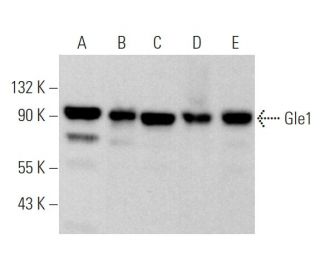
Gle1 Antibody (G-9): sc-514796
- Gle1 Antibody (G-9) is a mouse monoclonal IgG1 λ Gle1 antibody provided at 200 µg/ml
- raised against amino acids 399-698 mapping at the C-terminus of Gle1 of human origin
- Gle1 Antibody (G-9) is recommended for detection of Gle1 of mouse, rat and human origin by WB, IP, IF and ELISA
- Anti-Gle1 Antibody (G-9) is available conjugated to agarose for IP; HRP for WB, IHC(P) and ELISA; and to either phycoerythrin or FITC for IF, IHC(P) and FCM
- also available conjugated to Alexa Fluor® 488, Alexa Fluor® 546, Alexa Fluor® 594 or Alexa Fluor® 647 for WB (RGB), IF, IHC(P) and FCM, and for use with RGB fluorescent imaging systems, such as iBright™ FL1000, FluorChem™, Typhoon, Azure and other comparable systems
- also available conjugated to Alexa Fluor® 680 or Alexa Fluor® 790 for WB (NIR), IF and FCM; for use with Near-Infrared (NIR) detection systems, such as LI-COR®Odyssey®, iBright™ FL1000, FluorChem™, Typhoon, Azure and other comparable systems
- m-IgGλ BP-HRP (mouse IgGλ binding protein-HRP) is the preferred secondary detection reagent for Gle1 Antibody (G-9) for WB applications. This reagent is now offered in a bundle with Gle1 Antibody (G-9) (see ordering information below). For additional m-IgGλ BP conjugates see our complete list of Mouse IgG Binding Proteins.

QUICK LINKS
SEE ALSO...
Gle1 Antibody (G-9) is a mouse monoclonal IgG1 antibody that detects Gle1 protein of mouse, rat, and human origin by western blotting (WB), immunoprecipitation (IP), immunofluorescence (IF), and enzyme-linked immunosorbent assay (ELISA). Gle1 (G-9) antibody is available in both non-conjugated and various conjugated forms, including agarose, horseradish peroxidase (HRP), phycoerythrin (PE), fluorescein isothiocyanate (FITC), and multiple Alexa Fluor® conjugates. Gle1 protein, also known as GLE1L, is a crucial component in the transport of poly(A)-containing mRNAs from the nucleus to the cytoplasm, a process essential for gene expression regulation. This 698 amino acid protein is expressed in two alternatively spliced isoforms and is localized to both the nucleus and cytoplasm, where Gle1 associates with the nuclear pore complex (NPC). Proper functioning of Gle1 is vital, as defects in the gene encoding Gle1 can lead to severe developmental disorders, including lethal congenital contracture syndrome type 1 (LCCS1) and lethal arthrogryposis with anterior horn cell disease (LAAHD). These conditions are characterized by significant prenatal complications, such as hydrops and respiratory failure, underscoring the importance of Gle1 in normal cellular function and development.
Alexa Fluor® is a trademark of Molecular Probes Inc., OR., USA
LI-COR® and Odyssey® are registered trademarks of LI-COR Biosciences
Gle1 Antibody (G-9) References:
- An essential role for hGle1 nucleocytoplasmic shuttling in mRNA export. | Kendirgi, F., et al. 2003. J Cell Biol. 160: 1029-40. PMID: 12668658
- The mRNA export factor human Gle1 interacts with the nuclear pore complex protein Nup155. | Rayala, HJ., et al. 2004. Mol Cell Proteomics. 3: 145-55. PMID: 14645504
- Interaction between the shuttling mRNA export factor Gle1 and the nucleoporin hCG1: a conserved mechanism in the export of Hsp70 mRNA. | Kendirgi, F., et al. 2005. Mol Biol Cell. 16: 4304-15. PMID: 16000379
- Mutations in mRNA export mediator GLE1 result in a fetal motoneuron disease. | Nousiainen, HO., et al. 2008. Nat Genet. 40: 155-7. PMID: 18204449
- Gle1 does double duty. | Kutay, U. and Panse, VG. 2008. Cell. 134: 564-6. PMID: 18724928
- The mRNA export factor Gle1 and inositol hexakisphosphate regulate distinct stages of translation. | Bolger, TA., et al. 2008. Cell. 134: 624-33. PMID: 18724935
- Gle1 functions during mRNA export in an oligomeric complex that is altered in human disease. | Folkmann, AW., et al. 2013. Cell. 155: 582-93. PMID: 24243016
- Insights into mRNA export-linked molecular mechanisms of human disease through a Gle1 structure-function analysis. | Folkmann, AW., et al. 2014. Adv Biol Regul. 54: 74-91. PMID: 24275432
- Functions of Gle1 are governed by two distinct modes of self-association. | Mason, AC. and Wente, SR. 2020. J Biol Chem. 295: 16813-16825. PMID: 32981894
- The nucleoporin Gle1 activates DEAD-box protein 5 (Dbp5) by promoting ATP binding and accelerating rate limiting phosphate release. | Gray, S., et al. 2022. Nucleic Acids Res. 50: 3998-4011. PMID: 35286399
- Phosphorylation impacts GLE1 nuclear localization and association with DDX1. | Sharma, M., et al. 2023. Adv Biol Regul. 90: 100990. PMID: 37801910
- The human homologue of Saccharomyces cerevisiae Gle1p is required for poly(A)+ RNA export. | Watkins, JL., et al. 1998. Proc Natl Acad Sci U S A. 95: 6779-84. PMID: 9618489
Ordering Information
| Product Name | Catalog # | UNIT | Price | Qty | FAVORITES | |
Gle1 Antibody (G-9) | sc-514796 | 200 µg/ml | $322.00 | |||
Gle1 Antibody (G-9): m-IgGλ BP-HRP Bundle | sc-524845 | 200 µg Ab, 40 µg BP | $361.00 | |||
Gle1 Antibody (G-9) AC | sc-514796 AC | 500 µg/ml, 25% agarose | $424.00 | |||
Gle1 Antibody (G-9) HRP | sc-514796 HRP | 200 µg/ml | $322.00 | |||
Gle1 Antibody (G-9) FITC | sc-514796 FITC | 200 µg/ml | $336.00 | |||
Gle1 Antibody (G-9) PE | sc-514796 PE | 200 µg/ml | $349.00 | |||
Gle1 Antibody (G-9) Alexa Fluor® 488 | sc-514796 AF488 | 200 µg/ml | $364.00 | |||
Gle1 Antibody (G-9) Alexa Fluor® 546 | sc-514796 AF546 | 200 µg/ml | $364.00 | |||
Gle1 Antibody (G-9) Alexa Fluor® 594 | sc-514796 AF594 | 200 µg/ml | $364.00 | |||
Gle1 Antibody (G-9) Alexa Fluor® 647 | sc-514796 AF647 | 200 µg/ml | $364.00 | |||
Gle1 Antibody (G-9) Alexa Fluor® 680 | sc-514796 AF680 | 200 µg/ml | $364.00 | |||
Gle1 Antibody (G-9) Alexa Fluor® 790 | sc-514796 AF790 | 200 µg/ml | $364.00 |