
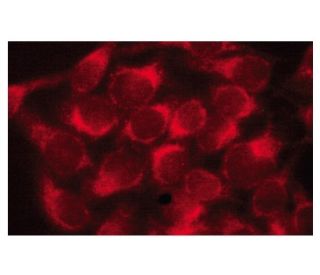
GCK Antibody (G-6): sc-17819
- GCK Antibody (G-6) is a mouse monoclonal IgG1 κ GCK antibody, cited in 18 publications, provided at 200 µg/ml
- raised against amino acids 318-405 of GCK of human origin
- GCK Antibody (G-6) is recommended for detection of GCK of mouse, rat and human origin by WB, IP, IF and ELISA
- Anti-GCK Antibody (G-6) is available conjugated to agarose for IP; HRP for WB, IHC(P) and ELISA; and to either phycoerythrin or FITC for IF, IHC(P) and FCM
- also available conjugated to Alexa Fluor® 488, Alexa Fluor® 546, Alexa Fluor® 594 or Alexa Fluor® 647 for WB (RGB), IF, IHC(P) and FCM, and for use with RGB fluorescent imaging systems, such as iBright™ FL1000, FluorChem™, Typhoon, Azure and other comparable systems
- also available conjugated to Alexa Fluor® 680 or Alexa Fluor® 790 for WB (NIR), IF and FCM; for use with Near-Infrared (NIR) detection systems, such as LI-COR®Odyssey®, iBright™ FL1000, FluorChem™, Typhoon, Azure and other comparable systems
- m-IgG Fc BP-HRP and m-IgG1 BP-HRP are the preferred secondary detection reagents for GCK Antibody (G-6) for WB applications. These reagents are now offered in bundles with GCK Antibody (G-6) (see ordering information below).

QUICK LINKS
SEE ALSO...
GCK Antibody (G-6) is a mouse monoclonal IgG1 kappa light chain antibody that detects GCK protein of mouse, rat, and human origin by western blotting (WB), immunoprecipitation (IP), immunofluorescence (IF), and enzyme-linked immunosorbent assay (ELISA). Anti-GCK antibody (G-6) is available in both non-conjugated and various conjugated forms, including agarose, horseradish peroxidase (HRP), phycoerythrin (PE), fluorescein isothiocyanate (FITC), and multiple Alexa Fluor® conjugates. Glucokinase, also known as hexokinase IV, plays a crucial role in glucose metabolism and is primarily located in pancreatic beta cells and the liver. In pancreatic beta cells, GCK acts as a glucose sensor, regulating insulin secretion in response to blood glucose levels, which is vital for maintaining glucose homeostasis. In the liver, GCK catalyzes the phosphorylation of glucose, marking the first committed step in glucose disposal. This enzymatic activity is essential because it determines the rate at which glucose is metabolized, and any dysfunction in GCK can lead to significant metabolic disorders. For instance, mutations in the GCK gene are associated with maturity onset diabetes of the young (MODY), highlighting the importance of this protein in both insulin regulation and glucose metabolism. GCK monoclonal antibody (G-6) effectively detects and quantifies GCK, making this antibody an invaluable tool for research into diabetes and metabolic diseases.
Alexa Fluor® is a trademark of Molecular Probes Inc., OR., USA
LI-COR® and Odyssey® are registered trademarks of LI-COR Biosciences
GCK Antibody (G-6) References:
- Update on mutations in glucokinase (GCK), which cause maturity-onset diabetes of the young, permanent neonatal diabetes, and hyperinsulinemic hypoglycemia. | Osbak, KK., et al. 2009. Hum Mutat. 30: 1512-26. PMID: 19790256
- Reduced penetrance of MODY-associated HNF1A/HNF4A variants but not GCK variants in clinically unselected cohorts. | Mirshahi, UL., et al. 2022. Am J Hum Genet. 109: 2018-2028. PMID: 36257325
- Inhibition of Hmbox1 Promotes Cardiomyocyte Survival and Glucose Metabolism Through Gck Activation in Ischemia/Reperfusion Injury. | Bei, Y., et al. 2024. Circulation. 150: 848-866. PMID: 38708602
- Glucokinase (GCK) in diabetes: from molecular mechanisms to disease pathogenesis. | Abu Aqel, Y., et al. 2024. Cell Mol Biol Lett. 29: 120. PMID: 39245718
- Transgenic knockouts reveal a critical requirement for pancreatic beta cell glucokinase in maintaining glucose homeostasis. | Grupe, A., et al. 1995. Cell. 83: 69-78. PMID: 7553875
- Upregulated hexokinase activity in isolated islets from diabetic 90% pancreatectomized rats. | Hosokawa, H., et al. 1995. Diabetes. 44: 1328-33. PMID: 7589832
- Human and rat beta cells differ in glucose transporter but not in glucokinase gene expression. | De Vos, A., et al. 1995. J Clin Invest. 96: 2489-95. PMID: 7593639
- Variable effects of maturity-onset-diabetes-of-youth (MODY)-associated glucokinase mutations on substrate interactions and stability of the enzyme. | Liang, Y., et al. 1995. Biochem J. 309 (Pt 1): 167-73. PMID: 7619052
- Animal model for maturity-onset diabetes of the young generated by disruption of the mouse glucokinase gene. | Bali, D., et al. 1995. J Biol Chem. 270: 21464-7. PMID: 7665557
- Glucose regulates the maximal velocities of glucokinase and glucose utilization in the immature fetal rat pancreatic islet. | Tu, J. and Tuch, BE. 1996. Diabetes. 45: 1068-75. PMID: 8690154
- The glucose sensor protein glucokinase is expressed in glucagon-producing alpha-cells. | Heimberg, H., et al. 1996. Proc Natl Acad Sci U S A. 93: 7036-41. PMID: 8692940
- Correction of diabetic alterations by glucokinase. | Ferre, T., et al. 1996. Proc Natl Acad Sci U S A. 93: 7225-30. PMID: 8692973
Ordering Information
| Product Name | Catalog # | UNIT | Price | Qty | FAVORITES | |
GCK Antibody (G-6) | sc-17819 | 200 µg/ml | $322.00 | |||
GCK Antibody (G-6): m-IgG Fc BP-HRP Bundle | sc-526575 | 200 µg Ab; 10 µg BP | $361.00 | |||
GCK Antibody (G-6): m-IgG1 BP-HRP Bundle | sc-531948 | 200 µg Ab; 20 µg BP | $361.00 | |||
GCK Antibody (G-6) AC | sc-17819 AC | 500 µg/ml, 25% agarose | $424.00 | |||
GCK Antibody (G-6) HRP | sc-17819 HRP | 200 µg/ml | $322.00 | |||
GCK Antibody (G-6) FITC | sc-17819 FITC | 200 µg/ml | $336.00 | |||
GCK Antibody (G-6) PE | sc-17819 PE | 200 µg/ml | $349.00 | |||
GCK Antibody (G-6) Alexa Fluor® 488 | sc-17819 AF488 | 200 µg/ml | $364.00 | |||
GCK Antibody (G-6) Alexa Fluor® 546 | sc-17819 AF546 | 200 µg/ml | $364.00 | |||
GCK Antibody (G-6) Alexa Fluor® 594 | sc-17819 AF594 | 200 µg/ml | $364.00 | |||
GCK Antibody (G-6) Alexa Fluor® 647 | sc-17819 AF647 | 200 µg/ml | $364.00 | |||
GCK Antibody (G-6) Alexa Fluor® 680 | sc-17819 AF680 | 200 µg/ml | $364.00 | |||
GCK Antibody (G-6) Alexa Fluor® 790 | sc-17819 AF790 | 200 µg/ml | $364.00 |