
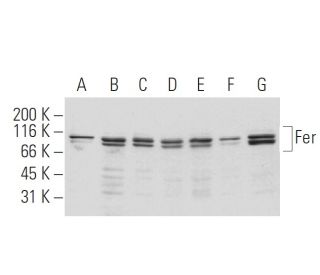

Fer Antibody (6B9): sc-81461
- Fer Antibody (6B9) is a mouse monoclonal IgG1 provided at 50 µg/0.5 ml
- raised against a peptide corresponding to amino acids near the C-terminus of Fer of human origin
- recommended for detection of Fer of mouse, rat, human and canine origin by WB and IP
- At present, we have not yet completed the identification of the preferred secondary detection reagent(s) for Fer Antibody (6B9). This work is in progress.

QUICK LINKS
SEE ALSO...
Fer Antibody (6B9) is a mouse monoclonal IgG1 antibody that detects Fer in mouse, rat, human, and canine samples through western blotting (WB) and immunoprecipitation (IP) applications. Fer is a non-receptor protein-tyrosine kinase belonging to the Fes/Fps family, characterized by a unique functional SH2 domain and role in mediating signaling pathways associated with receptor tyrosine kinases and cytokine receptors. Fer forms homotrimers in vivo through conserved coiled-coil domains, which are crucial for regulatory functions. N-terminal coiled-coil domains of Fer can undergo autophosphorylation in trans, allowing modulation of cellular activities through various phosphorylation states. This dynamic regulation becomes particularly significant during growth factor exposure, leading to tyrosine phosphorylation of Fer and subsequent recruitment to receptor tyrosine kinase complexes that include p85. Fer plays essential roles in insulin signaling, cell-cell communication, and human prostatic proliferative diseases, highlighting significant functions in cellular regulation and signaling pathways.
Alexa Fluor® is a trademark of Molecular Probes Inc., OR., USA
LI-COR® and Odyssey® are registered trademarks of LI-COR Biosciences
Fer Antibody (6B9) References:
- Fer kinase regulates cell migration through α-dystroglycan glycosylation. | Yoneyama, T., et al. 2012. Mol Biol Cell. 23: 771-80. PMID: 22238358
- Fer protein-tyrosine kinase promotes lung adenocarcinoma cell invasion and tumor metastasis. | Ahn, J., et al. 2013. Mol Cancer Res. 11: 952-63. PMID: 23699534
- Fer tyrosine kinase oligomer mediates and amplifies Src-induced tumor progression. | Oneyama, C., et al. 2016. Oncogene. 35: 501-12. PMID: 25867068
- FER mediated HGF-independent regulation of HGFR/MET activates RAC1-PAK1 pathway to potentiate metastasis in ovarian cancer. | Fan, G. 2020. Small GTPases. 11: 155-159. PMID: 29099290
- Translocation-generated ITK-FER and ITK-SYK fusions induce STAT3 phosphorylation and CD69 expression. | Fathi, NN., et al. 2018. Biochem Biophys Res Commun. 504: 749-752. PMID: 30217447
- FER and FES tyrosine kinase fusions in follicular T-cell lymphoma. | Debackere, K., et al. 2020. Blood. 135: 584-588. PMID: 31746983
- Phosphorylation of PKCδ by FER tips the balance from EGFR degradation to recycling. | Lonic, A., et al. 2021. J Cell Biol. 220: PMID: 33411917
- Fer and FerT Govern Mitochondrial Susceptibility to Metformin and Hypoxic Stress in Colon and Lung Carcinoma Cells. | Marciano, O., et al. 2021. Cells. 10: PMID: 33430475
- Direct synthesis of ultrathin FER zeolite nanosheets via a dual-template approach. | Li, Y., et al. 2022. RSC Adv. 12: 14183-14189. PMID: 35558859
- Fer-1 Protects against Isoflurane-Induced Ferroptosis in Astrocytes and Cognitive Impairment in Neonatal Mice. | Zhang, P., et al. 2024. Neurotox Res. 42: 27. PMID: 38819761
Ordering Information
| Product Name | Catalog # | UNIT | Price | Qty | FAVORITES | |
Fer Antibody (6B9) | sc-81461 | 50 µg/0.5 ml | $322.00 |