
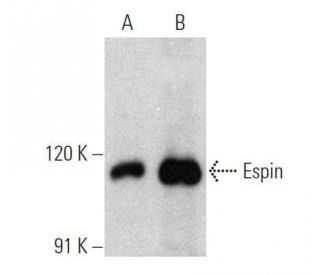
Espin Antibody (E-7): sc-393469
- Espin Antibody (E-7) is a mouse monoclonal IgG1 κ Espin antibody, cited in 3 publications, provided at 200 µg/ml
- raised against amino acids 645-767 mapping within an internal region of Espin of human origin
- Espin Antibody (E-7) is recommended for detection of Espin of mouse, rat and human origin by WB, IP, IF and ELISA; also reactive with additional species, including and canine and porcine
- Anti-Espin Antibody (E-7) is available conjugated to agarose for IP; HRP for WB, IHC(P) and ELISA; and to either phycoerythrin or FITC for IF, IHC(P) and FCM
- also available conjugated to Alexa Fluor® 488, Alexa Fluor® 546, Alexa Fluor® 594 or Alexa Fluor® 647 for WB (RGB), IF, IHC(P) and FCM, and for use with RGB fluorescent imaging systems, such as iBright™ FL1000, FluorChem™, Typhoon, Azure and other comparable systems
- also available conjugated to Alexa Fluor® 680 or Alexa Fluor® 790 for WB (NIR), IF and FCM; for use with Near-Infrared (NIR) detection systems, such as LI-COR®Odyssey®, iBright™ FL1000, FluorChem™, Typhoon, Azure and other comparable systems
- m-IgG Fc BP-HRP and m-IgG1 BP-HRP are the preferred secondary detection reagents for Espin Antibody (E-7) for WB applications. These reagents are now offered in bundles with Espin Antibody (E-7) (see ordering information below).

QUICK LINKS
SEE ALSO...
Espin Antibody (E-7) is a mouse monoclonal IgG1 kappa light chain antibody that detects Espin protein of mouse, rat, and human origin by western blotting (WB), immunoprecipitation (IP), immunofluorescence (IF), and enzyme-linked immunosorbent assay (ELISA). Anti-Espin antibody (E-7) is available in both non-conjugated and various conjugated forms, including agarose, horseradish peroxidase (HRP), phycoerythrin (PE), fluorescein isothiocyanate (FITC), and multiple Alexa Fluor® conjugates. Espin (ESPN), also known as autosomal recessive deafness type 36 protein (DFNB36), is an 854 amino acid cytoplasmic protein characterized by nine ankyrin repeats and one WH2 domain, which is crucial for function. The WH2 domain of ESPN plays a significant role in binding actin monomers, facilitating the assembly of actin bundles essential for structural integrity and signaling capabilities of actin-rich cellular specializations. This function is particularly important in sensory cells, where actin cytoskeleton organization is vital for effective sensory transduction. Mutations or defects in ESPN can lead to non-syndromic sensorineural deafness autosomal recessive type 36 (DFNB36), a condition resulting from damage to inner ear neural receptors or associated nerve pathways. In humans, ESPN is expressed as two isoforms due to alternative splicing, while in rodents, four major isoforms ranging from approximately 110 to 25 kDa have been identified, along with potential additional splice variants. ESPN has been shown to interact with proteins such as IRSp53 and Profilin-2, highlighting a role in cellular signaling and cytoskeletal dynamics.
Alexa Fluor® is a trademark of Molecular Probes Inc., OR., USA
LI-COR® and Odyssey® are registered trademarks of LI-COR Biosciences
Espin Antibody (E-7) References:
- The deaf jerker mouse has a mutation in the gene encoding the espin actin-bundling proteins of hair cell stereocilia and lacks espins. | Zheng, L., et al. 2000. Cell. 102: 377-85. PMID: 10975527
- Mutations of ESPN cause autosomal recessive deafness and vestibular dysfunction. | Naz, S., et al. 2004. J Med Genet. 41: 591-5. PMID: 15286153
- Espin gene (ESPN) mutations associated with autosomal dominant hearing loss cause defects in microvillar elongation or organisation. | Donaudy, F., et al. 2006. J Med Genet. 43: 157-61. PMID: 15930085
- Balanced levels of Espin are critical for stereociliary growth and length maintenance. | Rzadzinska, A., et al. 2005. Cell Motil Cytoskeleton. 62: 157-65. PMID: 16206170
- Differential expression of espin isoforms during epithelial morphogenesis, stereociliogenesis and postnatal maturation in the developing inner ear. | Sekerková, G., et al. 2006. Dev Biol. 291: 83-95. PMID: 16413524
- Targeted wild-type and jerker espins reveal a novel, WH2-domain-dependent way to make actin bundles in cells. | Loomis, PA., et al. 2006. J Cell Sci. 119: 1655-65. PMID: 16569662
- Structural polymorphism of the actin-espin system: a prototypical system of filaments and linkers in stereocilia. | Purdy, KR., et al. 2007. Phys Rev Lett. 98: 058105. PMID: 17358907
- Microvillar size and espin expression in principal cells of the adult rat epididymis are regulated by androgens. | Primiani, N., et al. 2007. J Androl. 28: 659-69. PMID: 17409466
- A novel mutation in the Espin gene causes autosomal recessive nonsyndromic hearing loss but no apparent vestibular dysfunction in a Moroccan family. | Boulouiz, R., et al. 2008. Am J Med Genet A. 146A: 3086-9. PMID: 18973245
- An actin-binding protein espin is a growth regulator for melanoma. | Yanagishita, T., et al. 2014. J Invest Dermatol. 134: 2996-2999. PMID: 24936833
- Lhx1/5 control dendritogenesis and spine morphogenesis of Purkinje cells via regulation of Espin. | Lui, NC., et al. 2017. Nat Commun. 8: 15079. PMID: 28516904
- Identification and characterization of espin, an actin-binding protein localized to the F-actin-rich junctional plaques of Sertoli cell ectoplasmic specializations. | Bartles, JR., et al. 1996. J Cell Sci. 109 (Pt 6): 1229-39. PMID: 8799813
Ordering Information
| Product Name | Catalog # | UNIT | Price | Qty | FAVORITES | |
Espin Antibody (E-7) | sc-393469 | 200 µg/ml | $322.00 | |||
Espin Antibody (E-7): m-IgG Fc BP-HRP Bundle | sc-527687 | 200 µg Ab; 10 µg BP | $361.00 | |||
Espin Antibody (E-7): m-IgG1 BP-HRP Bundle | sc-533060 | 200 µg Ab; 20 µg BP | $361.00 | |||
Espin Antibody (E-7) AC | sc-393469 AC | 500 µg/ml, 25% agarose | $424.00 | |||
Espin Antibody (E-7) HRP | sc-393469 HRP | 200 µg/ml | $322.00 | |||
Espin Antibody (E-7) FITC | sc-393469 FITC | 200 µg/ml | $336.00 | |||
Espin Antibody (E-7) PE | sc-393469 PE | 200 µg/ml | $349.00 | |||
Espin Antibody (E-7) Alexa Fluor® 488 | sc-393469 AF488 | 200 µg/ml | $364.00 | |||
Espin Antibody (E-7) Alexa Fluor® 546 | sc-393469 AF546 | 200 µg/ml | $364.00 | |||
Espin Antibody (E-7) Alexa Fluor® 594 | sc-393469 AF594 | 200 µg/ml | $364.00 | |||
Espin Antibody (E-7) Alexa Fluor® 647 | sc-393469 AF647 | 200 µg/ml | $364.00 | |||
Espin Antibody (E-7) Alexa Fluor® 680 | sc-393469 AF680 | 200 µg/ml | $364.00 | |||
Espin Antibody (E-7) Alexa Fluor® 790 | sc-393469 AF790 | 200 µg/ml | $364.00 |