
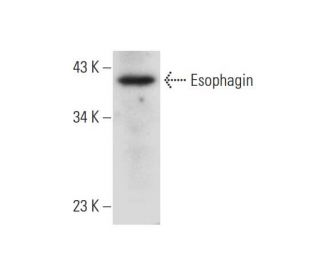
Esophagin Antibody (E-6): sc-514844
- Esophagin Antibody (E-6) is a mouse monoclonal IgM κ Esophagin antibody, cited in 1 publications, provided at 200 µg/ml
- raised against amino acids 103-152 mapping near the C-terminus of Esophagin of human origin
- recommended for detection of Esophagin of human origin by WB, IP, IF, IHC(P) and ELISA
- m-IgGκ BP-HRP is the preferred secondary detection reagent for Esophagin Antibody (E-6) for WB and IHC(P) applications. This reagent is now offered in a bundle with Esophagin Antibody (E-6) (see ordering information below). For additional m-IgGκ BP conjugates see our complete list of Mouse IgG Binding Proteins.

QUICK LINKS
SEE ALSO...
Esophagin Antibody (E-6) is a mouse monoclonal IgM kappa antibody that detects Esophagin protein of human origin by western blotting (WB), immunoprecipitation (IP), immunofluorescence (IF), and enzyme-linked immunosorbent assay (ELISA). Anti-Esophagin antibody (E-6) is available as non-conjugated format. Esophagin, also known as small proline-rich protein 3 (SPR3) or Cornifin β, belongs to the cornifin family of cornified-envelope structural proteins, primarily expressed in mucosal epithelia such as the esophagus and tongue. Esophagin expression significantly increases during epidermal keratinocyte differentiation, making Esophagin (E-6) monoclonal antibody a crucial marker of squamous differentiation. Esophagin functions as a cross-linking agent in cornified cell envelope formation, contributing to structural integrity and barrier function of the epithelium. This role proves particularly important for maintaining normal esophageal epithelial homeostasis by protecting against environmental stressors. Esophagin shares significant homology with related proteins SPRR1 and SPRR2, and while Esophagin remains typically absent in healthy human epithelium, Esophagin expression increases in various hyperproliferative skin disorders. In esophageal squamous cell carcinoma, Esophagin expression dramatically decreases, highlighting Esophagin′s potential as a biomarker for disease progression and epithelial integrity.
Alexa Fluor® is a trademark of Molecular Probes Inc., OR., USA
LI-COR® and Odyssey® are registered trademarks of LI-COR Biosciences
Esophagin Antibody (E-6) References:
- Transglutaminase crosslinking and structural studies of the human small proline rich 3 protein. | Steinert, PM., et al. 1999. Cell Death Differ. 6: 916-30. PMID: 10510474
- Activation of the esophagin promoter during esophageal epithelial cell differentiation. | Smolinski, KN., et al. 2002. Genomics. 79: 875-80. PMID: 12036303
- Differential expression of cornified cell envelope precursors in normal skin, intraorally transplanted skin and normal oral mucosa. | Katou, F., et al. 2003. Br J Dermatol. 148: 898-905. PMID: 12786819
- Infection with Human Papillomavirus alters expression of the small proline rich proteins 2 and 3. | Lehr, E., et al. 2004. J Med Virol. 72: 478-83. PMID: 14748073
- Esophagin and proliferating cell nuclear antigen (PCNA) are biomarkers of human esophageal neoplastic progression. | Kimos, MC., et al. 2004. Int J Cancer. 111: 415-7. PMID: 15221970
- Enhancement of long-term memory retention by Colostrinin in one-day-old chicks trained on a weak passive avoidance learning paradigm. | Stewart, MG. and Banks, D. 2006. Neurobiol Learn Mem. 86: 66-71. PMID: 16473531
- Decreased polyphenol transport across cultured intestinal cells by a salivary proline-rich protein. | Cai, K., et al. 2006. Biochem Pharmacol. 71: 1570-80. PMID: 16580640
- Two-dimensional electrophoresis study of in vitro pellicle formation and dental caries susceptibility. | Vitorino, R., et al. 2006. Eur J Oral Sci. 114: 147-53. PMID: 16630307
- Exogenous expression of Esophagin/SPRR3 attenuates the tumorigenicity of esophageal squamous cell carcinoma cells via promoting apoptosis. | Zhang, Y., et al. 2008. Int J Cancer. 122: 260-6. PMID: 17935133
Ordering Information
| Product Name | Catalog # | UNIT | Price | Qty | FAVORITES | |
Esophagin Antibody (E-6) | sc-514844 | 200 µg/ml | $322.00 | |||
Esophagin Antibody (E-6): m-IgGκ BP-HRP Bundle | sc-552691 | 200 µg Ab; 40 µg BP | $361.00 |