
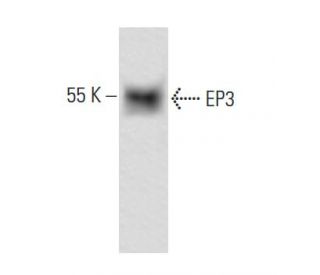


EP3 Antibody (5F5): sc-57105
- EP3 Antibody (5F5) is a mouse monoclonal IgG2a κ EP3 antibody, cited in 2 publications, provided at 50 µg/0.5 ml
- raised against recombinant EP3 of human origin
- recommended for detection of EP3 of mouse, rat, human and bovine origin by WB and IP
- At present, we have not yet completed the identification of the preferred secondary detection reagent(s) for EP3 Antibody (5F5). This work is in progress.

QUICK LINKS
SEE ALSO...
EP3 Antibody (5F5) is a mouse monoclonal IgG2a kappa light chain antibody that detects EP3 protein of mouse, rat, human, and bovine origin by western blotting (WB) and immunoprecipitation (IP). EP3 (5F5) antibody is available as the non-conjugated anti-EP3 antibody. EP3 protein plays a crucial role in regulating renal function and blood pressure by mediating prostaglandin E2 effects, a key lipid mediator derived from arachidonic acid metabolism. EP3 protein is predominantly expressed in renal vessels, the thick ascending limb, and the collecting duct, where EP3 exists in at least six alternative splice variants that couple to Gi proteins. These variants inhibit cyclic adenosine monophosphate (cAMP) levels, leading to a decrease in sodium and water transport, which is vital for maintaining fluid balance and blood pressure homeostasis. EP3 protein is also involved in uterine smooth muscle contraction, highlighting EP3′s importance in reproductive physiology. Understanding EP3 function and regulation is essential for elucidating EP3′s role in various physiological and pathological processes, including hypertension and renal disorders.
Alexa Fluor® is a trademark of Molecular Probes Inc., OR., USA
LI-COR® and Odyssey® are registered trademarks of LI-COR Biosciences
EP3 Antibody (5F5) References:
- Prostaglandin E receptors and the kidney. | Breyer, MD. and Breyer, RM. 2000. Am J Physiol Renal Physiol. 279: F12-23. PMID: 10894784
- Selective activation of E-type prostanoid(3)-receptors reduces myocardial infarct size. A novel insight into the cardioprotective effects of prostaglandins. | Thiemermann, C. and Zacharowski, K. 2000. Pharmacol Ther. 87: 61-7. PMID: 10924742
- Expression of prostaglandin E receptor EP4 subtype in rat adrenal zona glomerulosa: involvement in aldosterone release. | Muro, S., et al. 2000. Endocr J. 47: 429-36. PMID: 11075723
- Multiple signal transduction pathways through two prostaglandin E receptor EP3 subtype isoforms expressed in human uterus. | Kotani, M., et al. 2000. J Clin Endocrinol Metab. 85: 4315-22. PMID: 11095474
- G protein-coupled prostanoid receptors and the kidney. | Breyer, MD. and Breyer, RM. 2001. Annu Rev Physiol. 63: 579-605. PMID: 11181968
- EP3 activation facilitates bladder excitability via HCN channels on ICCs. | Wu, C., et al. 2017. Biochem Biophys Res Commun. 485: 535-541. PMID: 28131828
- The role of EP3-receptor expression in cervical dysplasia. | Hester, A., et al. 2019. J Cancer Res Clin Oncol. 145: 313-319. PMID: 30402741
- EP3 receptor is a prognostic factor in TA-MUC1-negative ovarian cancer. | Czogalla, B., et al. 2019. J Cancer Res Clin Oncol. 145: 2519-2527. PMID: 31485769
- EP3 Is an Independent Prognostic Marker Only for Unifocal Breast Cancer Cases. | Zati Zehni, A., et al. 2020. Int J Mol Sci. 21: PMID: 32580276
- EP3 enhances adhesion and cytotoxicity of NK cells toward hepatic stellate cells in a murine liver fibrosis model. | Tao, X., et al. 2022. J Exp Med. 219: PMID: 35420633
- [Molecular biology of prostaglandin E receptors--expression of multi-function by PGE receptor subtypes and isoforms]. | Ichikawa, A. 1998. Nihon Rinsho. 56: 1813-8. PMID: 9702058
- Regulation of renal function by prostaglandin E receptors. | Breyer, MD., et al. 1998. Kidney Int Suppl. 67: S88-94. PMID: 9736261
Ordering Information
| Product Name | Catalog # | UNIT | Price | Qty | FAVORITES | |
EP3 Antibody (5F5) | sc-57105 | 50 µg/0.5 ml | $322.00 |