
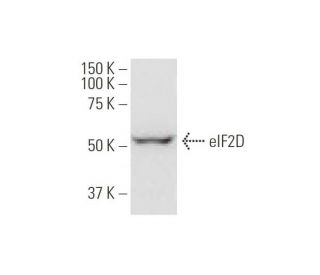
eIF2D Antibody (2D10): sc-293396
- eIF2D Antibody (2D10) is a mouse monoclonal IgG2a κ eIF2D antibody provided at 100 µg/ml
- raised against amino acids 485-584 of eIF2D of human origin
- recommended for detection of eIF2D of human origin by WB, IP and ELISA
- At present, we have not yet completed the identification of the preferred secondary detection reagent(s) for eIF2D Antibody (2D10). This work is in progress.

eIF2D Antibody (2D10) is a mouse monoclonal IgG2a antibody that detects eIF2D in human samples through applications such as western blotting (WB), immunoprecipitation (IP), and enzyme-linked immunosorbent assay (ELISA). eIF2D, or Eukaryotic Translation Initiation Factor 2D, is essential for the initiation phase of protein synthesis, a critical step in gene expression that ensures proper translation of mRNA into functional proteins. Notably, eIF2D operates independently of the traditional eIF2 complex, which is typically responsible for delivering initiator tRNA to the ribosome in a GTP-dependent manner. Instead, eIF2D directly binds to the 40S ribosomal subunit, facilitating recruitment of mRNA and assembly of the 48S initiation complex. This function is particularly vital during cellular stress responses when the canonical eIF2-dependent pathway may be inhibited, allowing for continued protein synthesis under adverse conditions. Furthermore, eIF2D recognizes and binds to the 5′ cap structure of mRNA molecules, acting as a cap-binding protein similar to eIF4E, but under specific circumstances, thus providing an alternative pathway for translation initiation. The versatility and redundancy of eIF2D highlight the adaptability of cellular machinery, ensuring that protein synthesis can persist across a variety of physiological states, making eIF2D a crucial player in maintaining cellular function and homeostasis.
Alexa Fluor® is a trademark of Molecular Probes Inc., OR., USA
LI-COR® and Odyssey® are registered trademarks of LI-COR Biosciences
eIF2D Antibody (2D10) References:
- The suppression of testis-brain RNA binding protein and kinesin heavy chain disrupts mRNA sorting in dendrites. | Severt, WL., et al. 1999. J Cell Sci. 112 (Pt 21): 3691-702. PMID: 10523505
- Excitatory amino acid receptor activation produces a selective and long-lasting modulation of gene expression in hippocampal neurons. | Jakoi, ER., et al. 1992. Brain Res. 582: 282-90. PMID: 1382803
- Molecular cloning of the cDNA for ligatin. | Jakoi, ER., et al. 1989. J Cell Sci. 93 (Pt 2): 227-32. PMID: 2482295
- Ligatin: a peripheral membrane protein with covalently bound palmitic acid. | Jakoi, ER., et al. 1987. J Biol Chem. 262: 1300-4. PMID: 3805022
- Retinal ligatin recognizes glycoproteins bearing oligosaccharides terminating in phosphodiester-linked glucose. | Marchase, RB., et al. 1982. Cell. 28: 813-20. PMID: 6807552
- Brain ligatin: a membrane lectin that binds acetylcholinesterase. | Gaston, SM., et al. 1982. J Cell Biochem. 18: 447-59. PMID: 7085778
- A possible role for ligatin and the phosphoglycoproteins it binds in calcium-dependent retinal cell adhesion. | Marchase, RB., et al. 1982. J Cell Biochem. 18: 461-8. PMID: 7085779
- Kindling produces long-lasting and selective changes in gene expression of hippocampal neurons. | Perlin, JB., et al. 1993. Proc Natl Acad Sci U S A. 90: 1741-5. PMID: 8446587
- Post-transcriptional regulation of gene expression in hippocampal neurons by glutamate receptor activation. | Jakoi, ER., et al. 1995. Brain Res. 693: 124-32. PMID: 8653400
Ordering Information
| Product Name | Catalog # | UNIT | Price | Qty | FAVORITES | |
eIF2D Antibody (2D10) | sc-293396 | 100 µg/ml | $322.00 |