
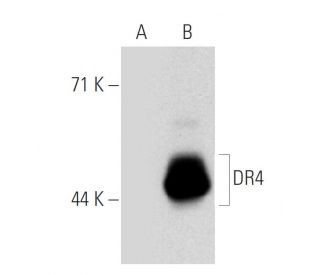


DR4 Antikörper (B-N28): sc-65312
- DR4 Antikörper B-N28 ist ein monoklonales IgG1 aus der Maus, verwendet in 2 wissenschaftlichen Veröffentlichungen, in einer Menge von 100 µg/ml
- gegen rekombinante TRAIL R1/Fc-Chimäre mit Ursprung human
- Empfohlen für die Detektion von DR4 aus der Spezies human per WB und IP
- Als Direktkonjugat zur Detektion von DR4 wird DR4 (B-9): sc-8411 angeboten; Primärantikörper konjugiert mit AC, HRP, FITC, PE, Alexa Fluor® 488, 594, 647, 680 und 790.
- Aktuell testen wir noch unsere Sekundärantikörper um das beste Bindeprotein für diesen Primärantikörper DR4 (B-N28) zu finden. Kontaktieren Sie uns bitte, wenn Sie Fragen hierzu haben sollten.

Direktverknüpfungen
Tumor-Nekrose-Faktor (TNF) ist ein pleiotropes Zytokin, dessen Funktion durch zwei unterschiedliche Zelloberflächenrezeptoren, TNF-R1 und TNF-R2, vermittelt wird, die auf den meisten Zelltypen exprimiert werden. Die Funktion von TNF wird hauptsächlich durch TNF-R1-Signalisierung vermittelt. Beide Rezeptoren gehören zur wachsenden TNF-Rezeptor-Superfamilie, die FAS-Antigen und CD40 umfasst. TNF-R1 enthält ein cytoplasmatisches Motiv, das als "Todesdomäne" bezeichnet wird und das für die Transduktion des apoptotischen Signals notwendig ist. Die Todesdomäne wird auch in mehreren anderen Rezeptoren, einschließlich FAS, DR2 (oder TRUNDD), DR3 (Death Receptor 3), DR4 und DR5, gefunden. TRUNDD, DR4 und DR5 sind Rezeptoren für das apoptoseinduzierende Zytokin TRAIL. Ein Rezeptor ohne Todesdomäne, der als Lockstoffrezeptor (DcR1 oder TRID) bezeichnet wird, bindet spezifisch an TRAIL und kann eine Rolle bei der zellulären Resistenz gegen apoptotische Stimuli spielen.
Alexa Fluor® ist ein Markenzeichen von Molecular Probes Inc., OR., USA
LI-COR® und Odyssey® sind Markenzeichen von LI-COR Biosciences
DR4 Antikörper (B-N28) Literaturhinweise:
- Die Rolle des gemeinsamen DR4-Epitops bei der Selektion und Bindung autoreaktiver T-Zellen bei rheumatoider Arthritis. | Nepom, GT. 2001. Rheum Dis Clin North Am. 27: 305-15. PMID: 11396094
- HLA-DR3 und DR4 und ihr Zusammenhang mit der Inzidenz und dem Fortschreiten der diabetischen Retinopathie. | Wong, TY., et al. 2002. Ophthalmology. 109: 275-81. PMID: 11825808
- Etablierung von HLA-DR4-transgenen Mäusen zur Identifizierung von CD4+-T-Zell-Epitopen tumorassoziierter Antigene. | Yatsuda, J., et al. 2013. PLoS One. 8: e84908. PMID: 24386437
- DR4-spezifische TRAIL-Varianten sind bei Bauchspeicheldrüsenkrebs wirksamer als Wildtyp-TRAIL. | Yu, R., et al. 2014. Cancer Biol Ther. 15: 1658-66. PMID: 25482930
- Erzeugung und Charakterisierung neuartiger Anti-DR4- und Anti-DR5-Antikörper, die durch genetische Immunisierung entwickelt wurden. | Dubuisson, A., et al. 2019. Cell Death Dis. 10: 101. PMID: 30718507
- HLA-DR4 und andere genetische Marker bei rheumatoider Arthritis. | Stastny, P., et al. 1988. Br J Rheumatol. 27 Suppl 2: 132-8. PMID: 3261186
- Molekulare Diversität von HLA-DR4-Haplotypen. | Gregersen, PK., et al. 1986. Proc Natl Acad Sci U S A. 83: 2642-6. PMID: 3458223
- HLA-DR4 und Lungenfunktionsstörung bei rheumatoider Arthritis. | Scott, TE., et al. 1987. Am J Med. 82: 765-71. PMID: 3494398
- Die Zuordnung von HLA-DR ohne diabetogene HLA-DR3 und HLA-DR4 sagt die Insulinunabhängigkeit nach einer Pankreasinsel-Transplantation voraus. | Ballou, C., et al. 2023. Front Immunol. 14: 1110544. PMID: 37026004
- Merkmale von Autoantikörper-positiven Personen ohne HLA-DR4-DQ8- oder HLA-DR3-DQ2-Haplotypen mit hohem Risiko. | Redondo, MJ., et al. 2024. Diabetologia.. PMID: 39670998
Bestellinformation
| Produkt | Katalog # | EINHEIT | Preis | ANZAHL | Favoriten | |
DR4 Antikörper (B-N28) | sc-65312 | 100 µg/ml | $322.00 |