
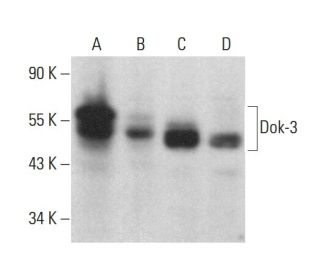
Dok-3 Antibody (G-6): sc-271131
- Dok-3 Antibody (G-6) is a mouse monoclonal IgG2b κ provided at 200 µg/ml
- raised against amino acids 231-444 mapping at the C-terminus of Dok-3 of mouse origin
- recommended for detection of Dok-3 of mouse, rat and human origin by WB, IP, IF and ELISA
- m-IgGκ BP-HRP is the preferred secondary detection reagent for Dok-3 Antibody (G-6) for WB applications. This reagent is now offered in a bundle with Dok-3 Antibody (G-6) (see ordering information below). For additional m-IgGκ BP conjugates see our complete list of Mouse IgG Binding Proteins.

Dok-3 Antibody (G-6) is a mouse monoclonal IgG2b antibody that detects Dok-3 in mouse, rat, and human samples through applications such as western blotting (WB), immunoprecipitation (IP), immunofluorescence (IF), and enzyme-linked immunosorbent assay (ELISA). Dok-3 is a crucial adapter protein that plays a significant role in recruiting inhibitory molecules, particularly in immune cells like B cells and macrophages. Dok-3 expression increases during immunoreceptor-mediated cellular activation, leading to tyrosine phosphorylation. Upon phosphorylation, Dok-3 interacts with 5′ inositol phosphatase SHIP and protein tyrosine kinase Csk, which are essential for negative regulation of immunoreceptor signaling in hematopoietic cells. This regulatory function maintains immune homeostasis and prevents overactivation of immune responses, which can lead to autoimmune diseases. Dok-3 (G-6) antibody serves as an invaluable tool for researchers studying immune signaling pathways and mechanisms of immune regulation.
Alexa Fluor® is a trademark of Molecular Probes Inc., OR., USA
LI-COR® and Odyssey® are registered trademarks of LI-COR Biosciences
Dok-3 Antibody (G-6) References:
- Mice lacking Dok-1, Dok-2, and Dok-3 succumb to aggressive histiocytic sarcoma. | Mashima, R., et al. 2010. Lab Invest. 90: 1357-64. PMID: 20548287
- Dok-3 and Dok-1/-2 adaptors play distinctive roles in cell fusion and proliferation during osteoclastogenesis and cooperatively protect mice from osteopenia. | Kajikawa, S., et al. 2018. Biochem Biophys Res Commun. 498: 967-974. PMID: 29548825
- Dok3-protein phosphatase 1 interaction attenuates Card9 signaling and neutrophil-dependent antifungal immunity. | Loh, JT., et al. 2019. J Clin Invest. 129: 2717-2729. PMID: 31180338
- Dok-3 deficient mice display different immune clustering and Tim-3 expression. | Yan, W., et al. 2019. Eur J Med Res. 24: 26. PMID: 31351483
- DOK3 is involved in microglial cell activation in neuropathic pain by interacting with GPR84. | Gao, WS., et al. 2020. Aging (Albany NY). 13: 389-410. PMID: 33281117
- Dok3 is involved in cisplatin-induced acute kidney injury via regulation of inflammation and apoptosis. | Yang, YY., et al. 2021. Biochem Biophys Res Commun. 569: 132-138. PMID: 34245977
- DOK3 maintains intestinal homeostasis by suppressing JAK2/STAT3 signaling and S100a8/9 production in neutrophils. | Loh, JT., et al. 2021. Cell Death Dis. 12: 1054. PMID: 34743196
- DOK3 promotes proliferation and inhibits apoptosis of prostate cancer via the NF-κB signaling pathway. | Jin, K., et al. 2023. Chin Med J (Engl). 136: 423-432. PMID: 36867541
- Loss of Dok-3 in Non-tumor Cells Induces Malignant Transformation of Benign Epithelial Tumor Cells of the Intestine. | Arimura, S., et al. 2022. Cancer Res Commun. 2: 1590-1600. PMID: 36970719
- Expression and clinical significance of DOK3 in renal clear cell carcinoma. | Wang, YF., et al. 2023. J Int Med Res. 51: 3000605231174974. PMID: 37235715
Ordering Information
| Product Name | Catalog # | UNIT | Price | Qty | FAVORITES | |
Dok-3 Antibody (G-6) | sc-271131 | 200 µg/ml | $322.00 | |||
Dok-3 Antibody (G-6): m-IgGκ BP-HRP Bundle | sc-534873 | 200 µg Ab; 40 µg BP | $361.00 |