
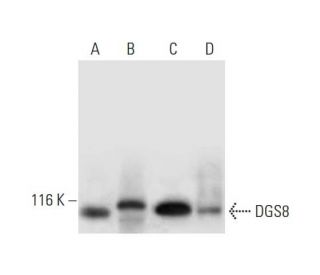


DGS8 Antibody (E-10): sc-377249
- DGS8 Antibody (E-10) is a mouse monoclonal IgG1 κ DGS8 antibody provided at 200 µg/ml
- specific for an epitope mapping between amino acids 49-85 near the N-terminus of DGS8 of human origin
- DGS8 Antibody (E-10) is recommended for detection of DGS8 isoforms 1, 2 and 3 of mouse, rat and human origin by WB, IP, IF and ELISA
- Anti-DGS8 Antibody (E-10) is available conjugated to agarose for IP; HRP for WB, IHC(P) and ELISA; and to either phycoerythrin or FITC for IF, IHC(P) and FCM
- also available conjugated to Alexa Fluor® 488, Alexa Fluor® 546, Alexa Fluor® 594 or Alexa Fluor® 647 for WB (RGB), IF, IHC(P) and FCM, and for use with RGB fluorescent imaging systems, such as iBright™ FL1000, FluorChem™, Typhoon, Azure and other comparable systems
- also available conjugated to Alexa Fluor® 680 or Alexa Fluor® 790 for WB (NIR), IF and FCM; for use with Near-Infrared (NIR) detection systems, such as LI-COR®Odyssey®, iBright™ FL1000, FluorChem™, Typhoon, Azure and other comparable systems
- TransCruz reagent for ChIP application (sc-377249 X, 200 µg/0.1 ml)
- m-IgG1 BP-HRP and m-IgGκ BP-HRP are the preferred secondary detection reagents for DGS8 Antibody (E-10) for WB applications. These reagents are now offered in bundles with DGS8 Antibody (E-10) (see ordering information below).

QUICK LINKS
SEE ALSO...
DGS8 Antibody (E-10) is a mouse monoclonal IgG1 kappa light chain antibody that detects DGS8 of mouse, rat, and human origin by western blotting (WB), immunoprecipitation (IP), immunofluorescence (IF), and enzyme-linked immunosorbent assay (ELISA). DGS8 (E-10) antibody is available in both non-conjugated and various conjugated forms, including agarose, horseradish peroxidase (HRP), phycoerythrin (PE), fluorescein isothiocyanate (FITC), and multiple Alexa Fluor® conjugates. DGS8, also known as DiGeorge syndrome critical region 8 protein, is crucial in the etiology of velocardiofacial/DiGeorge syndrome (VCFS/DGS), a condition characterized by a range of developmental anomalies including structural and functional palate defects, conotruncal cardiac malformations, immunodeficiency, hypocalcemia, and distinctive facial features. DGS8 is encoded by the DGCR8 gene, which is often deleted in individuals with DiGeorge syndrome, leading to ubiquitous expression in various tissues. DGS8 is primarily localized in the embryonic brain, blood vessels, thymus, and palate in mice, highlighting a significant role during development and potential impact on the immune system and craniofacial structure. Anti-DGS8 antibody (E-10) effectively detects DGS8 across multiple species and applications, making this reagent an invaluable tool for researchers studying the molecular mechanisms underlying DiGeorge syndrome and related disorders.
Alexa Fluor® is a trademark of Molecular Probes Inc., OR., USA
LI-COR® and Odyssey® are registered trademarks of LI-COR Biosciences
DGS8 Antibody (E-10) References:
- Molecular cloning and expression analysis of a novel gene DGCR8 located in the DiGeorge syndrome chromosomal region. | Shiohama, A., et al. 2003. Biochem Biophys Res Commun. 304: 184-90. PMID: 12705904
- DiGeorge syndrome: an update. | Baldini, A. 2004. Curr Opin Cardiol. 19: 201-4. PMID: 15096950
- The Drosha-DGCR8 complex in primary microRNA processing. | Han, J., et al. 2004. Genes Dev. 18: 3016-27. PMID: 15574589
- The human DiGeorge syndrome critical region gene 8 and Its D. melanogaster homolog are required for miRNA biogenesis. | Landthaler, M., et al. 2004. Curr Biol. 14: 2162-7. PMID: 15589161
- MicroRNA biogenesis and cancer. | Gregory, RI. and Shiekhattar, R. 2005. Cancer Res. 65: 3509-12. PMID: 15867338
- DiGeorge syndrome: new insights. | Goldmuntz, E. 2005. Clin Perinatol. 32: 963-78, ix-x. PMID: 16325672
- Molecular and genetic aspects of DiGeorge/velocardiofacial syndrome. | Driscoll, DA. 2006. Methods Mol Med. 126: 43-55. PMID: 16930005
- Posttranscriptional crossregulation between Drosha and DGCR8. | Han, J., et al. 2009. Cell. 136: 75-84. PMID: 19135890
- Autoregulatory mechanisms controlling the Microprocessor. | Triboulet, R. and Gregory, RI. 2010. Adv Exp Med Biol. 700: 56-66. PMID: 21627030
- Splice site m6A methylation prevents binding of DGCR8 to suppress KRT4 pre-mRNA splicing in oral squamous cell carcinoma. | Li, X., et al. 2023. PeerJ. 11: e14824. PMID: 36811004
- Tumor Promoting Role of NRIP1 in Oral Squamous Cell Carcinoma: The Involvement of NSD2-Mediated Histone Methylation of DGCR8. | Zhang, L. and Hu, G. 2023. Tohoku J Exp Med. 260: 193-204. PMID: 37045786
- A transcription-independent role for HIF-1α in modulating microprocessor assembly. | Li, JN., et al. 2024. Nucleic Acids Res. 52: 11806-11821. PMID: 39319577
Ordering Information
| Product Name | Catalog # | UNIT | Price | Qty | FAVORITES | |
DGS8 Antibody (E-10) | sc-377249 | 200 µg/ml | $322.00 | |||
DGS8 Antibody (E-10): m-IgGκ BP-HRP Bundle | sc-553174 | 200 µg Ab; 40 µg BP | $361.00 | |||
DGS8 Antibody (E-10): m-IgG1 BP-HRP Bundle | sc-553175 | 200 µg Ab; 20 µg BP | $361.00 | |||
DGS8 Antibody (E-10) X | sc-377249 X | 200 µg/0.1 ml | $322.00 | |||
DGS8 Antibody (E-10) AC | sc-377249 AC | 500 µg/ml, 25% agarose | $424.00 | |||
DGS8 Antibody (E-10) HRP | sc-377249 HRP | 200 µg/ml | $322.00 | |||
DGS8 Antibody (E-10) FITC | sc-377249 FITC | 200 µg/ml | $336.00 | |||
DGS8 Antibody (E-10) PE | sc-377249 PE | 200 µg/ml | $349.00 | |||
DGS8 Antibody (E-10) Alexa Fluor® 488 | sc-377249 AF488 | 200 µg/ml | $364.00 | |||
DGS8 Antibody (E-10) Alexa Fluor® 546 | sc-377249 AF546 | 200 µg/ml | $364.00 | |||
DGS8 Antibody (E-10) Alexa Fluor® 594 | sc-377249 AF594 | 200 µg/ml | $364.00 | |||
DGS8 Antibody (E-10) Alexa Fluor® 647 | sc-377249 AF647 | 200 µg/ml | $364.00 | |||
DGS8 Antibody (E-10) Alexa Fluor® 680 | sc-377249 AF680 | 200 µg/ml | $364.00 | |||
DGS8 Antibody (E-10) Alexa Fluor® 790 | sc-377249 AF790 | 200 µg/ml | $364.00 | |||
DGS8 (E-10) Neutralizing Peptide | sc-377249 P | 100 µg/0.5 ml | $69.00 |