
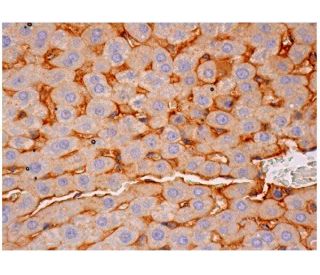


DC-SIGNR Antibody (H-2): sc-271381
- DC-SIGNR Antibody (H-2) is a mouse monoclonal IgA provided at 200 µg/ml
- specific for an epitope mapping between amino acids 12-41 near the N-terminus of DC-SIGNR of human origin
- recommended for detection of DC-SIGNR of human origin by WB, IP, IF, IHC(P) and ELISA
- At present, we have not yet completed the identification of the preferred secondary detection reagent(s) for DC-SIGNR Antibody (H-2). This work is in progress.

DC-SIGNR Antibody (H-2) is a mouse monoclonal IgA antibody that detects DC-SIGNR in human samples through various applications including western blotting (WB), immunoprecipitation (IP), immunofluorescence (IF), immunohistochemistry with paraffin-embedded sections (IHCP), and enzyme-linked immunosorbent assay (ELISA). DC-SIGNR, also known as CD209L or L-SIGN, is a type II integral membrane protein predominantly expressed on sinusoidal endothelial cells, where DC-SIGNR plays a crucial role in the immune response by binding to E2 glycoproteins of hepatitis C virus. This interaction facilitates viral uptake by liver and lymph node endothelial cells, thereby influencing hepatitis C infection pathogenesis. DC-SIGNR′s ability to mediate viral entry highlights DC-SIGNR′s importance in both viral transmission and immune evasion, making DC-SIGNR a valuable target for therapeutic interventions. Anti-DC-SIGNR antibody (H-2) is essential for researchers studying viral infection mechanisms and immune system response, providing insights that could lead to novel antiviral strategy development.
Alexa Fluor® is a trademark of Molecular Probes Inc., OR., USA
LI-COR® and Odyssey® are registered trademarks of LI-COR Biosciences
DC-SIGNR Antibody (H-2) References:
- DC-SIGNR, a DC-SIGN homologue expressed in endothelial cells, binds to human and simian immunodeficiency viruses and activates infection in trans. | Pöhlmann, S., et al. 2001. Proc Natl Acad Sci U S A. 98: 2670-5. PMID: 11226297
- DC-SIGN and DC-SIGNR bind ebola glycoproteins and enhance infection of macrophages and endothelial cells. | Simmons, G., et al. 2003. Virology. 305: 115-23. PMID: 12504546
- Hepatitis C virus glycoproteins interact with DC-SIGN and DC-SIGNR. | Pöhlmann, S., et al. 2003. J Virol. 77: 4070-80. PMID: 12634366
- Isolation and characterization of the human DC-SIGN and DC-SIGNR promoters. | Liu, H., et al. 2003. Gene. 313: 149-59. PMID: 12957386
- Distinct functions of DC-SIGN and its homologues L-SIGN (DC-SIGNR) and mSIGNR1 in pathogen recognition and immune regulation. | Koppel, EA., et al. 2005. Cell Microbiol. 7: 157-65. PMID: 15659060
- West Nile virus discriminates between DC-SIGN and DC-SIGNR for cellular attachment and infection. | Davis, CW., et al. 2006. J Virol. 80: 1290-301. PMID: 16415006
- The nine-repeat DC-SIGNR isoform is associated with increased HIV-RNA loads and HIV sexual transmission. | Xu, L., et al. 2010. J Clin Immunol. 30: 402-7. PMID: 20217198
- The VNTR polymorphism of the DC-SIGNR gene and susceptibility to HIV-1 infection: a meta-analysis. | Li, H., et al. 2012. PLoS One. 7: e42972. PMID: 22957026
- Oligomerization domains in the glycan-binding receptors DC-SIGN and DC-SIGNR: Sequence variation and stability differences. | Dos Santos, Á., et al. 2017. Protein Sci. 26: 306-316. PMID: 27859859
- Chemo-Enzymatic Synthesis of S. mansoni O-Glycans and Their Evaluation as Ligands for C-Type Lectin Receptors MGL, DC-SIGN, and DC-SIGNR. | Pham, J., et al. 2020. Chemistry. 26: 12818-12830. PMID: 32939912
Ordering Information
| Product Name | Catalog # | UNIT | Price | Qty | FAVORITES | |
DC-SIGNR Antibody (H-2) | sc-271381 | 200 µg/ml | $322.00 | |||
DC-SIGNR (H-2) Neutralizing Peptide | sc-271381 P | 100 µg/0.5 ml | $69.00 |