
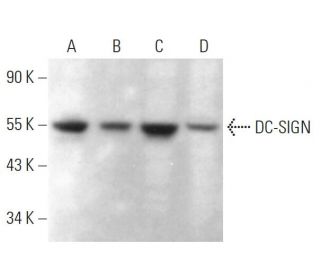

DC-SIGN Anticuerpo (8C1): sc-53580
- DC-SIGN Anticuerpo (8C1) es un monoclonal de ratón IgG1 κ, ver las 2 publicaciones, proporcionado como 200 µg/ml
- producido contra DC-SIGN de origen pig tailed macaque
- DC-SIGN Anticuerpo (8C1) es recomendado para detectar DC-SIGN of human origin and CD209e of mouse and rat origin medainte WB, IP y FCM; también reactivo con otras especies, incluyendo anyd pig tailed macaque and porcine
- DC-SIGN Anticuerpo (8C1) es disponible conjugado a agarosa para IP; HRP para WB, IHC(P) y ELISA; y tanto a phycoerythrin como a FITC para IF, IHC(P) y FCM
- también disponible conjugado a Alexa Fluor® 488, Alexa Fluor® 546, Alexa Fluor® 594 o Alexa Fluor® 647 para WB (RGB), IF, IHC (P) y FCM
- también disponible conjugado a Alexa Fluor® 680 o Alexa Fluor® 790 para WB (NIR), IF y FCM
- Actualmente, aún no hemos completado la identificación de los reactivos de detección secundaria preferidos para DC-SIGN Anticuerpo (8C1). Este trabajo está en progreso.

El anticuerpo anti-DC-SIGN (8C1) es un anticuerpo monoclonal IgG1 de ratón de cadena ligera kappa que detecta el DC-SIGN de origen humano y el CD209e de origen de ratón y rata mediante western blotting (WB), inmunoprecipitación (IP) y citometría de flujo (FCM). El anticuerpo anti-DC-SIGN (8C1) está disponible tanto en forma no conjugada como en varias formas conjugadas, incluyendo agarosa, peroxidasa de rábano picante (HRP), ficoeritrina (PE), isotiocianato de fluoresceína (FITC) y múltiples conjugados Alexa Fluor®. Las células dendríticas (DC), que expresan DC-SIGN, desempeñan un papel crucial en el sistema inmunitario como células presentadoras de antígenos localizadas en los tejidos mucosos periféricos que migran a los tejidos linfoides. El anticuerpo monoclonal DC-SIGN (8C1) reconoce una proteína de membrana de tipo II que facilita la unión a la molécula de adhesión intercelular 3 (ICAM-3), mediando la interacción inicial entre las células dendríticas y las células T en reposo a través de la sinapsis inmunológica. Esta interacción es vital para la respuesta inmunitaria, especialmente en la infección por VIH-1, ya que el DC-SIGN permite a las células dendríticas capturar el VIH-1 en las superficies mucosas y transportarlo a los compartimentos linfoides, favoreciendo una transinfección eficaz de las células T. Comprender las características estructurales de DC-SIGN ayuda a los investigadores a apreciar mejor su papel en la vigilancia inmunitaria y la patogénesis de la infección vírica, lo que convierte al anticuerpo anti-DC-SIGN (8C1) en una herramienta esencial para estudiar estos procesos.
Alexa Fluor® es una marca registrada de Molecular Probes Inc., OR., USA
REIVEW LI-COR® y Odyssey® son marcas registradas de LI-COR Biosciences.
DC-SIGN Anticuerpo (8C1) Referencias:
- Funciones distintas de DC-SIGN y sus homólogos L-SIGN (DC-SIGNR) y mSIGNR1 en el reconocimiento de patógenos y la regulación inmune. | Koppel, EA., et al. 2005. Cell Microbiol. 7: 157-65. PMID: 15659060
- La importancia clínica de DC-SIGN y DC-SIGNR, que son nuevos marcadores expresados en el cáncer de colon humano. | Jiang, Y., et al. 2014. PLoS One. 9: e114748. PMID: 25504222
- El moco colorrectal se une a DC-SIGN e inhibe la transinfección por VIH-1 de los linfocitos T CD4+. | Stax, MJ., et al. 2015. PLoS One. 10: e0122020. PMID: 25793526
- La función endocítica es fundamental para la infección por el virus de la gripe A a través de DC-SIGN y L-SIGN. | Gillespie, L., et al. 2016. Sci Rep. 6: 19428. PMID: 26763587
- Uso diferencial de las lectinas de tipo C L-SIGN y DC-SIGN para la endocitosis del flebovirus. | Léger, P., et al. 2016. Traffic. 17: 639-56. PMID: 26990254
- Dominios de oligomerización en los receptores de unión a glicanos DC-SIGN y DC-SIGNR: Variación de secuencia y diferencias de estabilidad. | Dos Santos, Á., et al. 2017. Protein Sci. 26: 306-316. PMID: 27859859
- La vía mTOR-RUNX1 regula la expresión de DC-SIGN en las células epiteliales tubulares renales. | Zhou, S., et al. 2019. Biochem Biophys Res Commun. 519: 620-625. PMID: 31540687
- Expresión de receptores de lectina de tipo C similares a DC-SIGN en Salmo salar. | Ojeda, N., et al. 2020. Dev Comp Immunol. 113: 103806. PMID: 32739503
- Combate de la diseminación del SARS-CoV-2 mediada por DC-SIGN mediante polímeros que imitan a los glicanos. | Cramer, J., et al. 2024. Arch Pharm (Weinheim). 357: e2300396. PMID: 38086006
- La vacunación con liposomas alfa-GC dirigidos a DC-SIGN conduce al control del tumor, independientemente de las células T activadas de forma subóptima. | de Haas, AM., et al. 2024. Pharmaceutics. 16: PMID: 38794243
Información sobre pedidos
| Nombre del producto | Número de catálogo | UNIDAD | Precio | CANTIDAD | Favoritos | |
DC-SIGN Anticuerpo (8C1) | sc-53580 | 200 µg/ml | $322.00 | |||
DC-SIGN Anticuerpo (8C1) AC | sc-53580 AC | 500 µg/ml, 25% agarose | $424.00 | |||
DC-SIGN Anticuerpo (8C1) HRP | sc-53580 HRP | 200 µg/ml | $322.00 | |||
DC-SIGN Anticuerpo (8C1) FITC | sc-53580 FITC | 200 µg/ml | $336.00 | |||
DC-SIGN Anticuerpo (8C1) PE | sc-53580 PE | 200 µg/ml | $349.00 | |||
DC-SIGN Anticuerpo (8C1) Alexa Fluor® 488 | sc-53580 AF488 | 200 µg/ml | $364.00 | |||
DC-SIGN Anticuerpo (8C1) Alexa Fluor® 546 | sc-53580 AF546 | 200 µg/ml | $364.00 | |||
DC-SIGN Anticuerpo (8C1) Alexa Fluor® 594 | sc-53580 AF594 | 200 µg/ml | $364.00 | |||
DC-SIGN Anticuerpo (8C1) Alexa Fluor® 647 | sc-53580 AF647 | 200 µg/ml | $364.00 | |||
DC-SIGN Anticuerpo (8C1) Alexa Fluor® 680 | sc-53580 AF680 | 200 µg/ml | $364.00 | |||
DC-SIGN Anticuerpo (8C1) Alexa Fluor® 790 | sc-53580 AF790 | 200 µg/ml | $364.00 |