
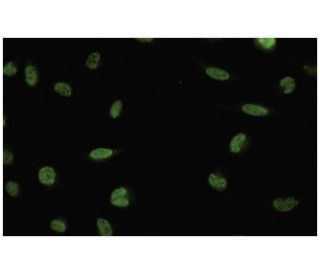


CLIM-1 Antibody (Q7): sc-101088
- CLIM-1 Antibody (Q7) is a mouse monoclonal IgG1 κ CLIM-1 antibody, cited in 1 publications, provided at 100 µg/ml
- raised against recombinant CLIM-1 of human origin
- recommended for detection of CLIM-1 of mouse, rat and human origin by WB, IP, IF and ELISA
- At present, we have not yet completed the identification of the preferred secondary detection reagent(s) for CLIM-1 Antibody (Q7). This work is in progress.

CLIM-1 Antibody (Q7) is a mouse monoclonal IgG1 kappa light chain antibody that detects CLIM-1 protein of mouse, rat, and human origin by western blotting (WB), immunoprecipitation (IP), immunofluorescence (IF), and enzyme-linked immunosorbent assay (ELISA). Anti-CLIM-1 antibody (Q7) is available as the non-conjugated format. CLIM-1, also known as nuclear LIM interactor, plays a crucial role in forming transcriptional regulatory complexes essential for gene expression regulation. CLIM-1 interacts with LIM-only proteins, such as LMO1 and LMO2, to facilitate heteromeric complex assembly that enhances nuclear retention of LIM proteins, influencing cellular differentiation and function. CLIM-1 modulates transcription factors involved in neuronal development and function, making CLIM-1 a key player in the central nervous system. CLIM-1 also regulates T cell development, highlighting CLIM-1′s significance in both nervous and immune systems. With broad species reactivity and versatility in various applications, anti-CLIM-1 antibody (Q7) serves as an invaluable tool for researchers studying LIM domain proteins in cellular processes.
Alexa Fluor® is a trademark of Molecular Probes Inc., OR., USA
LI-COR® and Odyssey® are registered trademarks of LI-COR Biosciences
CLIM-1 Antibody (Q7) References:
- Disordered T-cell development and T-cell malignancies in SCL LMO1 double-transgenic mice: parallels with E2A-deficient mice. | Chervinsky, DS., et al. 1999. Mol Cell Biol. 19: 5025-35. PMID: 10373552
- Characterization of the Lmo4 gene encoding a LIM-only protein: genomic organization and comparative chromosomal mapping. | Tse, E., et al. 1999. Mamm Genome. 10: 1089-94. PMID: 10556429
- Expression of LIM protein genes Lmo1, Lmo2, and Lmo3 in adult mouse hippocampus and other forebrain regions: differential regulation by seizure activity. | Hinks, GL., et al. 1997. J Neurosci. 17: 5549-59. PMID: 9204936
- Identification and characterization of LMO4, an LMO gene with a novel pattern of expression during embryogenesis. | Kenny, DA., et al. 1998. Proc Natl Acad Sci U S A. 95: 11257-62. PMID: 9736723
- Cloning and chromosomal localization of two novel human genes encoding LIM-domain binding factors CLIM1 and CLIM2/LDB1/NLI. | Semina, EV., et al. 1998. Mamm Genome. 9: 921-4. PMID: 9799849
- Identification of the LMO4 gene encoding an interaction partner of the LIM-binding protein LDB1/NLI1: a candidate for displacement by LMO proteins in T cell acute leukaemia. | Grutz, G., et al. 1998. Oncogene. 17: 2799-803. PMID: 9840944
- The LMO1 and LDB1 proteins interact in human T cell acute leukaemia with the chromosomal translocation t(11;14)(p15;q11). | Valge-Archer, V., et al. 1998. Oncogene. 17: 3199-202. PMID: 9872335
Ordering Information
| Product Name | Catalog # | UNIT | Price | Qty | FAVORITES | |
CLIM-1 Antibody (Q7) | sc-101088 | 100 µg/ml | $322.00 |