
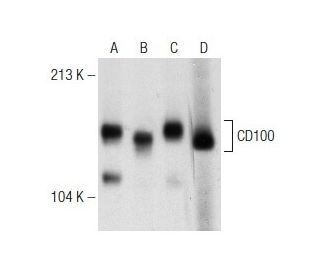


CD100 Antibody (30): sc-136250
- CD100 Antibody (30) is a mouse monoclonal IgG1, cited in 1 publications, provided at 50 µg/0.5 ml
- raised against amino acids 721-861 of CD100 of human origin
- recommended for detection of CD100 of mouse, rat and human origin by WB, IP and IF; not recommended for IP
- At present, we have not yet completed the identification of the preferred secondary detection reagent(s) for CD100 Antibody (30). This work is in progress.

QUICK LINKS
SEE ALSO...
CD100 Antibody (30) is a mouse monoclonal IgG1 antibody that detects CD100 in mouse, rat, and human samples through applications such as western blotting (WB), immunoprecipitation (IP), and immunofluorescence (IF). CD100, also known as SEMA4D, is a crucial transmembrane protein that plays a significant role in the immune system, distinguishing itself as the only member of the semaphorin family expressed in immune tissues. Anti-CD100 antibody (30) is vital for studying T cell proliferation and B cell aggregation, which are essential processes for an effective immune response. CD100 interacts with CD72, a receptor that normally inhibits B cell activity, thereby regulating B cell responses. When CD100 binds to CD72, CD100 induces tyrosine dephosphorylation of CD72, leading to the dissociation of SHP-1, a negative regulator, and effectively turning off the inhibitory signal. This mechanism highlights CD100′s importance in modulating immune responses, making CD100 a key player in both adaptive and innate immunity. The gene encoding human CD100 is located on chromosome 9q22.2, and CD100 expression is observed in various tissues, including the kidney, heart, lung, and neural tissues, underscoring CD100′s multifaceted role in both development and immune function. CD100 (30) monoclonal antibody is an invaluable tool for researchers studying immune regulation and the intricate signaling pathways involved in T and B cell interactions.
Ordering Information
| Product Name | Catalog # | UNIT | Price | Qty | FAVORITES | |
CD100 Antibody (30) | sc-136250 | 50 µg/0.5 ml | $322.00 |