
Date published: 2026-4-25

1-800-457-3801

SCBT Portrait Logo
Seach Input

caveolin-1 Antibody (4H312): sc-70516

4.9(8)
Write a reviewAsk a question

Datasheets
  • caveolin-1 Antibody (4H312) is a mouse monoclonal IgG2b κ, cited in 26 publications, provided at 200 µg/ml
  • raised against purified Glut4 vesicles from adipocytes of rat origin
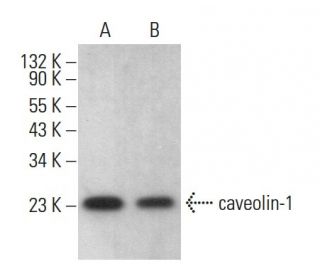
  • recommended for detection of caveolin-1 of mouse, rat, human and, to a lesser extent, hamster origin by WB, IP, IF and FCM
  • available conjugated to either phycoerythrin or FITC for IF and FCM
  • m-IgG Fc BP-HRP is the preferred secondary detection reagent for caveolin-1 Antibody (4H312) for WB applications. This reagent is now offered in a bundle with caveolin-1 Antibody (4H312) (see ordering information below).

Gene Editing Promo Banner

QUICK LINKS

SEE ALSO...

caveolin-1 Antibody (4H312) is a mouse monoclonal IgG2b kappa light chain antibody that targets caveolin-1, also known as CAV1, a key structural protein of caveolae, small invaginations in the plasma membrane of various cell types. anti-caveolin-1 antibody (4H312) is raised against purified Glut4 vesicles from adipocytes of rat origin, allowing for the detection of caveolin-1 in mouse, rat, human, and to a lesser extent, hamster samples through applications such as western blotting (WB), immunoprecipitation (IP), immunofluorescence (IF), and flow cytometry (FCM). Caveolin-1 is predominantly located in the plasma membrane, where caveolin-1 plays a crucial role in the formation and maintenance of caveolae, which are involved in processes like endocytosis, signal transduction, and lipid regulation. The localization of caveolin-1 within caveolae is essential for the compartmentalization of signaling molecules, including G protein-coupled receptors, thereby facilitating efficient cellular communication and response to external stimuli. Additionally, caveolin-1 is implicated in the transcytosis of macromolecules across endothelial cells, the uptake of small molecules via potocytosis, and the regulation of cholesterol homeostasis, making caveolin-1 vital for maintaining cellular and vascular health. caveolin-1 monoclonal antibody (4H312) is available in both conjugated and non-conjugated forms, including options such as agarose, horseradish peroxidase (HRP), phycoerythrin (PE), fluorescein isothiocyanate (FITC), and various Alexa Fluor® conjugates, providing researchers with versatile tools for diverse experimental setups. caveolin-1 (4H312) antibody supports in-depth investigations into the roles of caveolae in cellular physiology and pathology, facilitating advancements in understanding complex biological processes and disease mechanisms.

For Research Use Only. Not Intended for Diagnostic or Therapeutic Use.

Alexa Fluor® is a trademark of Molecular Probes Inc., OR., USA

LI-COR® and Odyssey® are registered trademarks of LI-COR Biosciences

Ordering Information

Product NameCatalog #UNITPriceQtyFAVORITES

caveolin-1 Antibody (4H312)

sc-70516
200 µg/ml
$322.00

caveolin-1 Antibody (4H312): m-IgG Fc BP-HRP Bundle

sc-525696
200 µg Ab; 10 µg BP
$361.00

caveolin-1 Antibody (4H312) FITC

sc-70516 FITC
200 µg/ml
$336.00

caveolin-1 Antibody (4H312) PE

sc-70516 PE
200 µg/ml
$349.00

o you know what sequence of the protein recognize? N or C terminal?

Asked by: CAV_1
Thank you for your question. This mouse monoclonal caveolin-1 (4H312) antibody, sc-70516, was raised against purified Glut4 vesicles from adipocytes of rat origin. The exact epitope has not been mapped, so no further information is available.
Answered by: Tech Service
Date published: 2020-02-21

Are there any issues with using sc-70516: caveolin-1 (4H312) mouse monoclonal primary antibody on mouse samples?

Asked by: jerojero
Thank you for your inquiry. The use of mouse monoclonal antibodies with mouse samples is very common and typically poses no problem. To eliminate any potential cross-reactivity of an anti-mouse secondary detection reagent,we recommend using a directly conjugated primary antibody. Please contact our special orders department for pricing and availability of sc-70516 conjugates.
Answered by: Technical Support
Date published: 2017-03-07
  • y_2026, m_4, d_23, h_7CST
  • bvseo_bulk, prod_bvqa, vn_bulk_3.0.43
  • cp_1, bvpage1
  • co_hasquestionsanswers, tq_2
  • loc_en_US, sid_70516, prod, sort_[SortEntry(order=LAST_APPROVED_ANSWER_SUBMISSION_TIME, direction=DESCENDING)]
  • clientName_scbt
  • bvseo_sdk, java_sdk, bvseo-4.0.0
  • CLOUD, getContent, 118ms
  • QUESTIONS, PRODUCT
Rated 5 out of 5 by from Excellent for ImmunofluorescenceI tested this antibody for IF in PFA-fixed VeroE6 cells. Dil: 1/200, secondary: antimouse Alexa488 (Invitrogen A21202). Excellent caveolin-1 staining. Attached image was collected on VeroE6 by confocal Zeiss 800 (Scale bar: 10 um). Immunofluorescence procedure: Storti et al. 10.1016/j.bpc.2019.106225.
Date published: 2020-11-26
Rated 5 out of 5 by from Very good fro WB!This worked great on the first try with my standard lysis and blotting protocol. Showed the differences I had expected from a proteomics study. I am using human breast cancer cells.
Date published: 2019-01-18
Rated 5 out of 5 by from a good antibody for IF and WBThis antibody stains plasma membrane as expected (1:200 dilution, formaldehyde-fixed HeLa). It also recognizes a band of predicted M.W. on the western blot (1:500 dilution, 40ug HeLa extract).
Date published: 2017-09-01
Rated 5 out of 5 by from Great antibody in western blotIt worked very well in western blot in rat lungs tissue.
Date published: 2017-08-11
Rated 5 out of 5 by from Various publications support the use of product scVarious publications support the use of product sc-70516 in WB using rat, human and mouse samples. -SCBT Publication Review
Date published: 2015-05-04
Rated 5 out of 5 by from It has been reported that this antibody isIt has been reported that this antibody is suitable for use in co-IP using mouse C2C12 mucle cells. -SCBT Publication Review
Date published: 2015-02-26
Rated 5 out of 5 by from Publishable data observed by IF and IHC usingPublishable data observed by IF and IHC using paraformaldehyde fixed mouse brain microvessels. -SCBT Publication Review
Date published: 2015-02-21
Rated 4 out of 5 by from Robust signal observed by WB using CHO wholeRobust signal observed by WB using CHO whole cell lysate. -SCBT QC
Date published: 2013-01-07
  • y_2026, m_4, d_23, h_7
  • bvseo_bulk, prod_bvrr, vn_bulk_3.0.43
  • cp_1, bvpage1
  • co_hasreviews, tv_0, tr_8
  • loc_en_US, sid_70516, prod, sort_[SortEntry(order=SUBMISSION_TIME, direction=DESCENDING)]
  • clientName_scbt
  • bvseo_sdk, java_sdk, bvseo-4.0.0
  • CLOUD, getReviews, 16ms
  • REVIEWS, PRODUCT
caveolin-1 Antibody (4H312) is rated 4.9 out of 5 by 8.
  • y_2026, m_4, d_23, h_7
  • bvseo_bulk, prod_bvrr, vn_bulk_3.0.43
  • cp_1, bvpage1
  • co_hasreviews, tv_0, tr_8
  • loc_en_US, sid_70516, prod, sort_[SortEntry(order=SUBMISSION_TIME, direction=DESCENDING)]
  • clientName_scbt
  • bvseo_sdk, java_sdk, bvseo-4.0.0
  • CLOUD, getAggregateRating, 106ms
  • REVIEWS, PRODUCT