
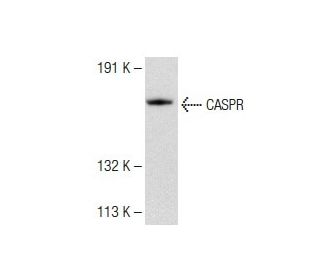


CASPR Antibody (E-8): sc-373777
- CASPR Antibody (E-8) is a mouse monoclonal IgG1 κ, cited in 1 publications, provided at 200 µg/ml
- raised against amino acids 1251-1316 of CASPR of human origin
- recommended for detection of CASPR of mouse, rat and human origin by WB, IP, IF, IHC(P) and ELISA
- m-IgG Fc BP-HRP is the preferred secondary detection reagent for CASPR Antibody (E-8) for WB and IHC(P) applications. This reagent is now offered in a bundle with CASPR Antibody (E-8) (see ordering information below).

QUICK LINKS
CASPR Antibody (E-8) is a mouse monoclonal IgG1 antibody that detects CASPR in mouse, rat, and human samples through various applications including western blotting (WB), immunoprecipitation (IP), immunofluorescence (IF), immunohistochemistry, and enzyme-linked immunosorbent assay (ELISA). CASPR, also known as contactin-associated protein 1, plays a crucial role in the formation and maintenance of the paranodal junctions in myelinated axons, which are essential for proper nerve signal conduction. By demarcating distinct subdomains in the axonal membrane, CASPR facilitates the interaction between glial cells and neurons, thereby influencing the development and stability of the nervous system. CASPR′s extracellular domain shares similarities with other neurexins, allowing CASPR to bind to the glycoprotein contactin, which is vital for the organization of the nodal architecture. Additionally, CASPR′s localization at the paranodal junctions is critical for the clustering of voltage-gated sodium channels, ensuring efficient action potential propagation. CASPR′s ability to interact with specific proteins and strategic positioning within the cell underscores CASPR′s importance in neuronal communication and myelination processes, making anti-CASPR antibody (E-8) an invaluable tool for researchers studying neurobiology and related fields.
Alexa Fluor® is a trademark of Molecular Probes Inc., OR., USA
LI-COR® and Odyssey® are registered trademarks of LI-COR Biosciences
CASPR Antibody (E-8) References:
- Caspr regulates the processing of contactin and inhibits its binding to neurofascin. | Gollan, L., et al. 2003. J Cell Biol. 163: 1213-8. PMID: 14676309
- Disposition of axonal caspr with respect to glial cell membranes: Implications for the process of myelination. | Pedraza, L., et al. 2009. J Neurosci Res. 87: 3480-91. PMID: 19170162
- Differential clustering of Caspr by oligodendrocytes and Schwann cells. | Eisenbach, M., et al. 2009. J Neurosci Res. 87: 3492-501. PMID: 19565653
- Localization of the paranodal protein Caspr in the mammalian retina. | O'Brien, BJ., et al. 2010. Mol Vis. 16: 1854-63. PMID: 21031018
- Caspr interaction with Amyloid Precursor Protein reduces amyloid-β generation in vitro. | Fan, LF., et al. 2013. Neurosci Lett. 548: 255-60. PMID: 23748076
- Neuronal Ig/Caspr recognition promotes the formation of axoaxonic synapses in mouse spinal cord. | Ashrafi, S., et al. 2014. Neuron. 81: 120-9. PMID: 24411736
- Caspr and caspr2 are required for both radial and longitudinal organization of myelinated axons. | Gordon, A., et al. 2014. J Neurosci. 34: 14820-6. PMID: 25378149
- Robust pCASL perfusion imaging using a 3D Cartesian acquisition with spiral profile reordering (CASPR). | Greer, JS., et al. 2019. Magn Reson Med. 82: 1713-1724. PMID: 31231894
- CASPR, an analysis pipeline for single and paired guide RNA CRISPR screens, reveals optimal target selection for long non-coding RNAs. | Bergadà-Pijuan, J., et al. 2020. Bioinformatics. 36: 1673-1680. PMID: 31681950
- NLR-1/CASPR Anchors F-Actin to Promote Gap Junction Formation. | Meng, L. and Yan, D. 2020. Dev Cell. 55: 574-587.e3. PMID: 33238150
Ordering Information
| Product Name | Catalog # | UNIT | Price | Qty | FAVORITES | |
CASPR Antibody (E-8) | sc-373777 | 200 µg/ml | $322.00 | |||
CASPR Antibody (E-8): m-IgG Fc BP-HRP Bundle | sc-540398 | 200 µg Ab; 10 µg BP | $361.00 |